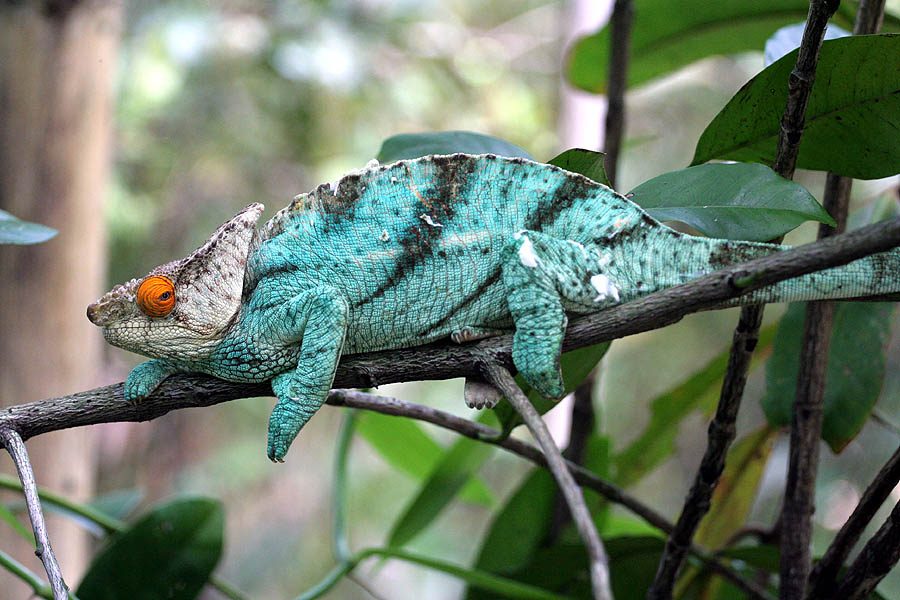
Parson's chameleon
Calumma parsonii
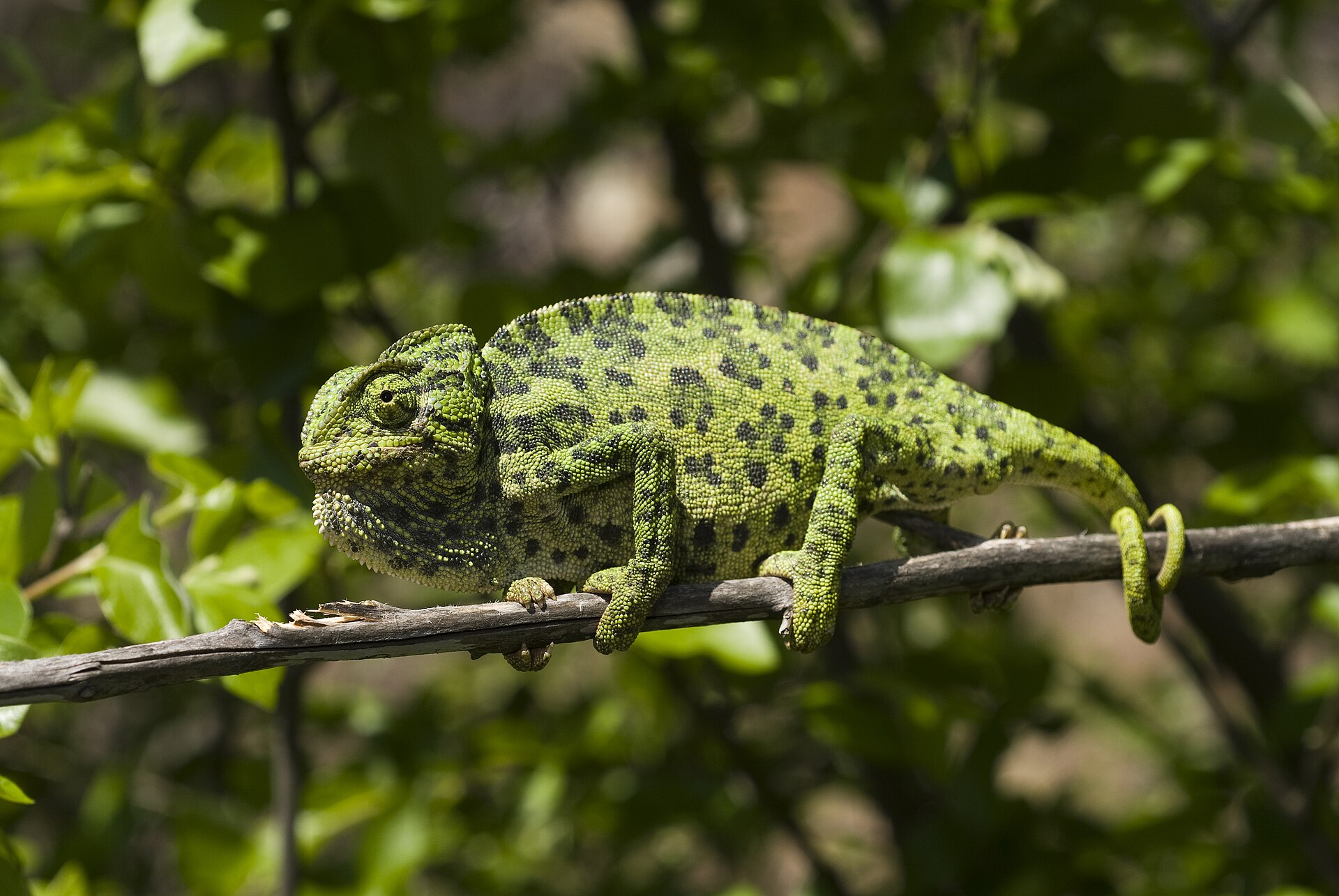
Parson's chameleon is one of the largest chameleons in the world, a slow, long-lived giant of Madagascar's forests, able to change colour.
Characteristics
Temperament
Slow, solitary and arboreal; long-lived for a chameleon.
Diet
Insectivorous: insects and small invertebrates caught with the tongue.
A giant among chameleons
Parson's chameleon (Calumma parsonii) is a large lizard of the family Chamaeleonidae, endemic to Madagascar, and one of the largest chameleons in the world: it can reach about 70 cm in total length. Its bulky body is supported by sturdy legs with pincer-like toes, while the long prehensile tail acts as a fifth limb. Like all chameleons it has independently rotating eyes and a lightning-fast extendable tongue. Males bear two bony ridges on the snout, like flattened horns. It is known for changing colour with mood and temperature, in shades from green to blue and yellow.
Habitat and range
It lives in the primary rainforests of eastern and northern Madagascar, from the lowlands to around 1,200 metres. It favours humid, wooded habitats but can also tolerate partly disturbed forests as long as they are rich in vegetation.
Behaviour and diet
It is slow, solitary and arboreal: it moves cautiously among branches, catching insects and other small invertebrates with the lightning projection of its tongue. Among chameleons it is unusually long-lived and slow to breed: females lay large clutches of eggs that take many months to hatch.
Did you know?
Its slowness and longevity set it apart from other chameleons, which are often very short-lived. Its size and variable colouring make it one of the most sought-after — and unfortunately collected — reptiles among enthusiasts.
Conservation
The IUCN lists it as Near Threatened. The destruction of Madagascar's forests and capture for the exotic pet trade are the main pressures; captive-bred animals are the better choice.
Pros
- One of the largest chameleons in the world
- Unusually long-lived among chameleons
- Variable, fascinating colouring
Cons
- Near Threatened
- Threatened by deforestation and trade
- Slow breeding, long-incubating eggs