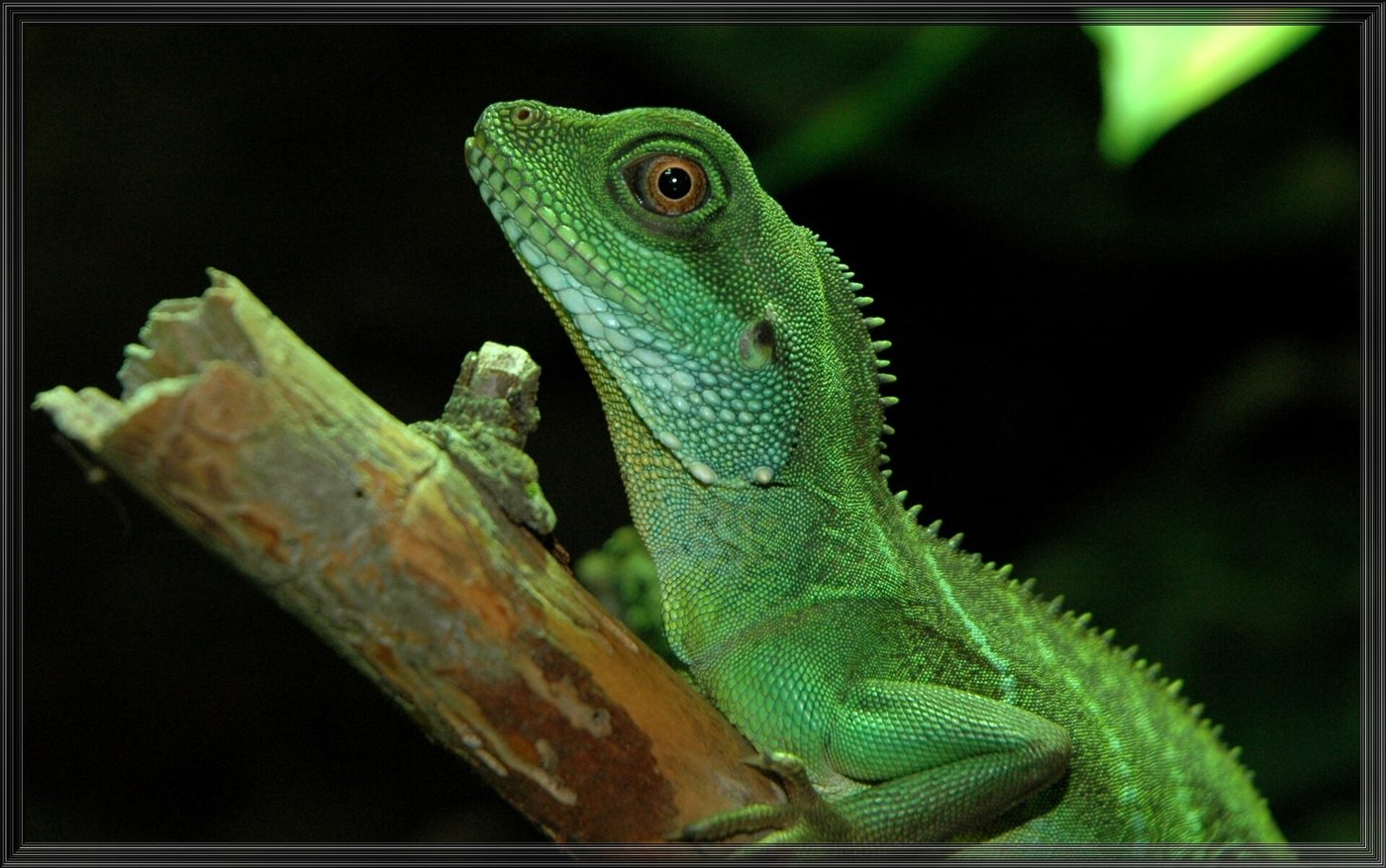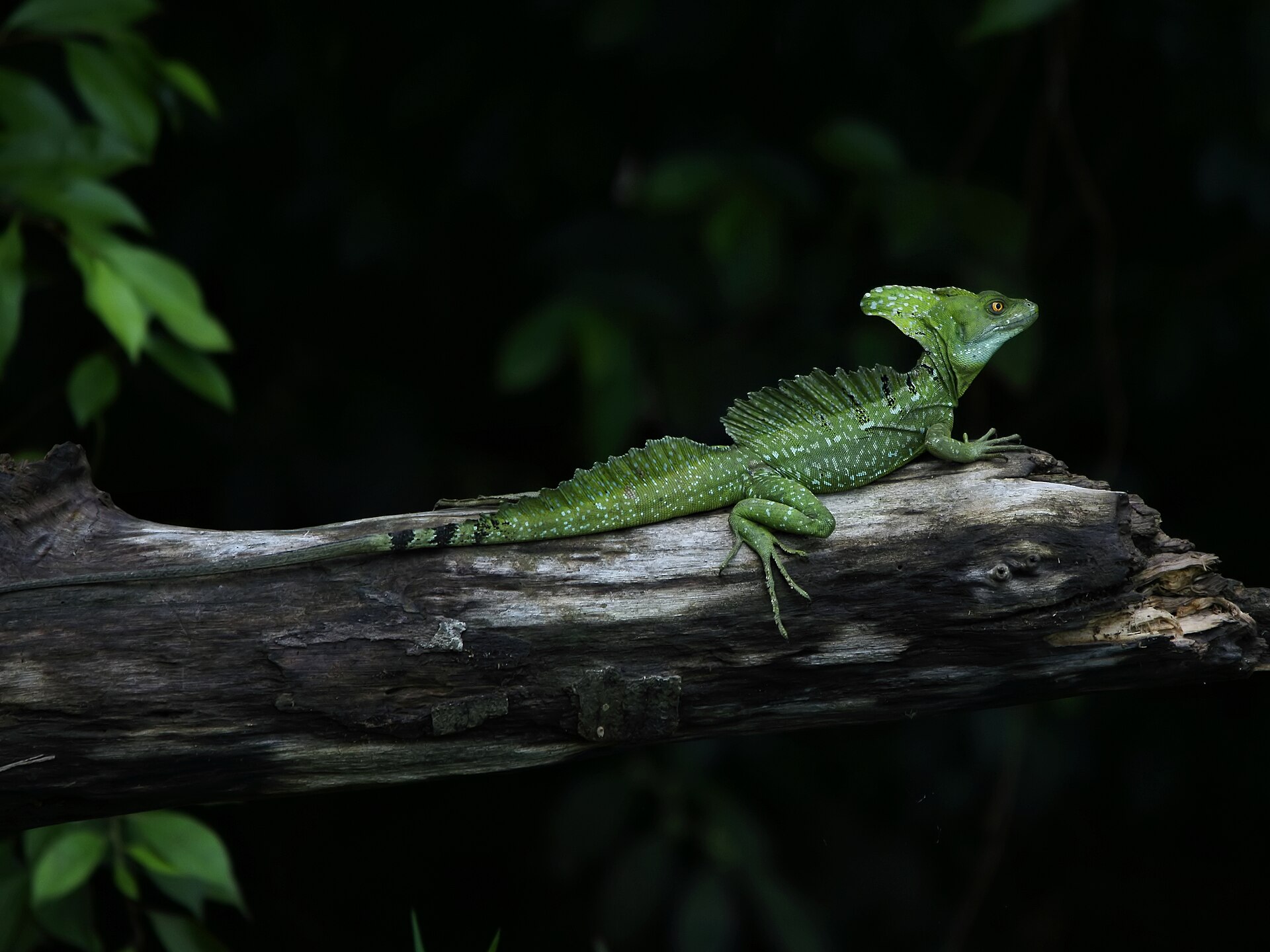
Plumed Basilisk
Basiliscus plumifrons
Characteristics
Temperament
Solitary or small groups (1M + 2-4F), diurnal, semi-arboreal-aquatic. "JESUS CHRIST LIZARD": runs ON WATER at 4.5 m/s for 4-20 m! Excellent swimmer, 30 min underwater. Male with TRIPLE dorsal crest (head, back, tail) — unique in family. Bright green with blue/turquoise spots. Temperature-dependent sex determination.
Diet
Generalist omnivore. Insects (50-70% diet), small vertebrates (lizards, geckos, small fish, frogs), freshwater crustaceans, fruit (10-20%), flowers, occasional eggs. Hunting from perch on low branch or riverbank, rapid sprint, bite capture. Seasonal adaptation: more fruit in dry season, more animals in wet.
The Plumed Basilisk (Basiliscus plumifrons), also known as the "Jesus Christ Lizard", is one of the most charismatic reptiles of Central America. It is a medium-large lizard of the family Corytophanidae, endemic to Neotropical riparian rainforests (Honduras, Nicaragua, Costa Rica, Panama). Distinctive features:
- Bipedal aquatic running: runs on the water surface on two legs at speeds of 4.5 m/s (16 km/h) for distances of 4-20 meters
- Triple crest: adult males have three distinct dorsal crests — on head, back, and tail — unique in the family Corytophanidae
- Bright green colour: emerald green body with blue/turquoise spots (males) and yellow (females)
- Long tail: 75% of total length (45-67 cm of 60-90 cm total)
- Excellent swimmer: can stay underwater up to 30 minutes
- Omnivore: insects, small vertebrates, fruit, flowers
- Arboreal + aquatic: lives in forests along rivers, jumps into water to escape predators
IUCN status: Least Concern (LC). Abundant population in protected Central American forests (Tortuguero NP, Corcovado NP). Local threats: habitat loss, illegal pet trade.
Classification and category
Order Squamata, suborder Iguania, family Corytophanidae, genus Basiliscus. Family Corytophanidae is exclusively Neotropical with 9 living species. The genus Basiliscus contains 4 living species: B. plumifrons (Plumed, this entry — largest and most colourful), B. basiliscus (Common/Brown — described by Linnaeus 1758), B. galeritus (Andean), B. vittatus (Striped).
Etymology: "Basiliscus" from Greek "basilískos" (little king) — reference to crown-like crest. In European folklore, the Basilisk was a mythological king-serpent. "Plumifrons" from Latin "pluma" (feather) + "frons" (forehead). Described scientifically by Cope in 1876.
Morphological parameters: Weight 200-600 g. Total length 60-90 cm (record 96 cm). Snout-vent 18-25 cm. Tail 45-65 cm (75% total!). Longevity: 7-10 years natural, 15-20 captive (record 22). Sexual maturity 18-24 months. Reproduction: seasonal, 4-17 eggs/year in underground nests. Incubation 65-105 days. Temperature-dependent sex determination: higher temps = more females.
Habitat and distribution
Endemic to Central American Neotropical rainforests. Honduras (northern limit), Nicaragua, Costa Rica (main population — Tortuguero, Corcovado, La Selva), Panama (south to Darién). Habitats: gallery rainforest (along rivers/streams — primary), lowland wet forest (0-1,500 m), mangroves, mountain streamsides. Does not tolerate dry forests, urban areas, altitudes above 1,500 m. IUCN: Least Concern. Threats: deforestation (Honduras, Nicaragua), illegal pet trade, stray cat predation, river pollution. CITES: NOT included. Costa Rica has strict catch laws — protected populations in national parks.
Diet
Generalist omnivore. Diet: insects (50-70% — grasshoppers, beetles, mantises, dragonflies, butterflies, ants), small vertebrates (smaller lizards, geckos, small fish, frogs, toads), crustaceans (freshwater shrimp, small crabs), fruit (10-20% — palm fruits, figs, tropical fruits), flowers (small amount), eggs (occasional). Hunting technique: perching on low branch or riverside + visual location + explosive sprint + bite capture. Adaptable to seasons: more fruit in dry season, more animals in wet season.
Physical features
Slender agile silhouette adapted to arboreal-aquatic habitat. Coloration: Male adult: bright emerald green with blue turquoise spots on flanks and limbs, cream-yellow belly. Female: more subdued green, yellow spots instead of blue. Juveniles: green with black/brown bands (camouflage). Three crests (only adult males): head crest (4-6 cm, "helmet"), dorsal crest (2-3 cm along spine), caudal crest (on first half of tail). Erectile via specialised muscles for display.
"Water-runner" anatomy: long muscular hind legs (60% of snout-vent length), shorter forelimbs, 5 long hind toes with LATERAL SKIN LOBES (skin fringes) increasing surface area on water — KEY adaptation. Tail 75% of total length — rudder in water, balance on branches. Smooth small scales.
Physiological: Water-running speed 4.5 m/s (16 km/h) for 4-20 m, terrestrial sprint 11 km/h, underwater time up to 30 minutes (slows heart rate), jump 1.5-2 m, vision excellent including UV, vocalisations: hisses/puffs (rare).
Behaviour and curiosities
Solitary or small groups (1 male + 2-4 females). Diurnal. Semi-arboreal-aquatic. Territory along 10-50 m of riverbank. Territorial display: crest elevation, "exaggerated push-ups", ritualised wrestling. Mating seasonal (wet season May-November). Female lays 4-17 eggs in underground nests near water. Incubation 65-105 days at ~28°C. TSD: higher temps = more females. Hatchlings completely independent from birth, can run on water within hours.
Defence: FLIGHT INTO WATER. Jumps from tree onto river surface, RUNS for 4-20 m, then swims or dives (up to 30 min). Predators: caimans, large fish, eagles (Spizaetus), snakes (boa).
Famous curiosity: "running on water". Physics: large hind feet + lateral skin lobes increase water surface area, 20 Hz step frequency creates and uses air bubbles before they collapse, kinetic energy (4.5 m/s) sustains motion. MIT studies (2003-2008) modelled mathematically. Critical velocity formula v = √(2gd/π) — Plumed Basilisk hits exactly the calculated speed. Only lizards under 200 g can run on water indefinitely; Plumed Basilisk (200-600 g) can do 4-20 m before sinking. A human would need to run at 100 km/h to replicate — physiologically impossible.
"Jesus Christ" nickname: from Matthew 14:22-33 (Jesus walking on water). Widely used in literature and Costa Rican tourism. Mythological basilisk: European medieval folklore had king-serpent basilisk killing with gaze (Pliny the Elder, Natural History Book 8). Spanish conquerors named the New World lizards after this myth due to crown-like crest. Unique triple crest only in B. plumifrons among 4 Basiliscus species. TSD: climate change risk to sex ratios. Underwater swimming: 30 min with slowed heartbeat (~10 bpm vs 70-100). Display "push-ups": ritualised wrestling, common to iguanids. Calculated velocity: exact match between physics theory and biological reality. Costa Rican ecotourism star: Tortuguero, La Selva, Manuel Antonio, Corcovado. Precocial hatchlings: independent from birth, can run on water within hours. Longevity: 7-10 years natural, 15-20 captive.
Pros
- Capacità UNICA al mondo: correre sull'acqua a 4,5 m/s
- Maschio con tripla cresta dorsale spettacolare
- Star dell'ecoturismo costaricano (Tortuguero, La Selva)
- IUCN Least Concern, popolazione stabile
Cons
- Deforestazione minaccia popolazioni Honduras/Nicaragua
- Pet trade illegale (specialmente cuccioli colorati)
- Determinazione sesso temperatura-dipendente vulnerabile a cambiamento climatico
- Dipendenza stretta da habitat rivieraschi