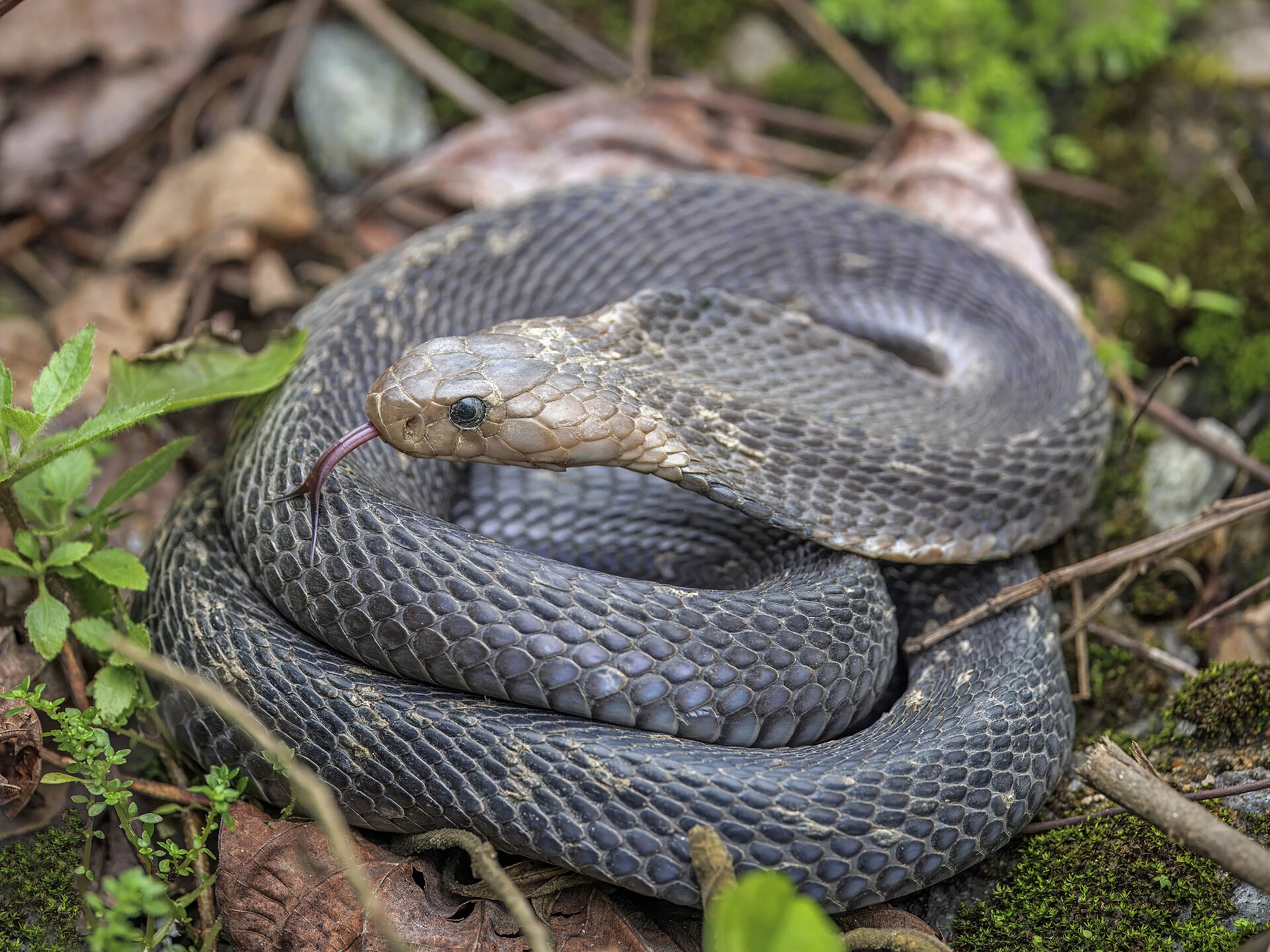
King Cobra
Ophiophagus hannah
Characteristics
Temperament
Solitary, diurnal-crepuscular, intelligent. Territorial (100 hectares). Individually recognises its handlers. Only snake in the world that builds a nest. Raises 1/3 of body vertically, "walks" upright at 5-8 km/h.
Diet
Specialised ophiophagous: feeds almost only on other snakes (rat snakes, common cobras, small pythons). Immune to venom of other Elapidae. Neurotoxic venom: 380-600 mg per bite (kills elephant or 20 people).
The King Cobra (Ophiophagus hannah), also known as Hamadryad (from Greek "lady of the trees"), is the longest venomous snake in the world and one of the most fascinating reptiles on the planet. Widespread in the tropical forests of South and Southeast Asia, it is a specialised ophiophage (feeds almost exclusively on other snakes, hence the scientific name Ophiophagus = "snake eater"). The only snake in the world capable of building a nest to lay eggs, endowed with remarkable intelligence among reptiles and primitive social behaviour, it has been venerated for millennia in Hindu and Buddhist cultures as a divine symbol. Its bite can kill an adult elephant in 3 hours or cause human death within 30 minutes in the absence of antivenom serum.
Classification and category
The King Cobra belongs to the order Squamata, suborder Serpentes, family Elapidae (the same as cobras, mambas, taipans, coral snakes), genus Ophiophagus. It is the only species of the genus, distinct from true cobras (genus Naja) by larger size, longer venom fangs, specialised ophiophagous behaviour and nesting capability. Average length of adults is 3-4 metres, with documented record specimens up to 5.85 m (London Zoo, 1937, specimen from Malaysia). Average weight is 6-12 kg, with records of 21 kg. Males are larger than females. Colour varies by geographic area: olive, brown, black, with yellow, beige or white bands. There are at least 4 genetically distinct populations (recent studies suggest possible future taxonomic "splits" into 4 distinct species: Western Ghats King Cobra, Indochinese, Philippine and Indonesian).
Habitat and distribution
The habitat of the King Cobra consists of humid tropical forests, rainforests, gallery forests, mangroves, rubber plantations and bordering agricultural areas. It prefers areas with water availability (rivers, lakes, swamps) — it is in fact an excellent swimmer — and dense forest cover. It lives mainly at ground level, but is capable of climbing trees (up to 15 m in height) and swimming for kilometres. It tolerates altitudes from 0 to 2,000 m above sea level.
The geographic distribution covers vast territories of South and Southeast Asia: peninsular India (especially Western Ghats and Sundarbans), Bangladesh, Nepal, Bhutan, Myanmar, Thailand, Cambodia, Laos, Vietnam, southern China (Yunnan, Hainan), peninsular Malaysia, Sumatra, Borneo, Java, Philippines. Conservation status is listed as Vulnerable (VU) by the IUCN (2010), with global population estimated at 5,000-30,000 adult individuals, in 30% decline in the last generation. The main threats are: habitat loss (deforestation, agricultural and urban expansion), hunting for skin and for traditional Chinese and Laotian medicine (bile and meat are used in pseudo-medicinal recipes), killing out of fear. The species has been protected since 1972 in India (Wildlife Protection Act, Schedule II), classified in CITES Appendix II.
Diet
The King Cobra is an extremely rare food specialist among snakes: it is almost exclusively ophiophagous (eats other snakes). Its diet in nature includes: rat snakes (Ptyas mucosa, main diet), common cobras (Naja naja, Naja kaouthia — incredibly, predated even though venomous), small pythons, water snakes, occasionally monitor lizards and ground birds. It is immune to the venom of other Elapidae thanks to modified acetylcholine receptors. The food requirement is low: an adult can survive on a single large meal per month.
The hunting technique is based on olfactory and vibrational senses: the King Cobra detects the presence of other snake prey by tracing their olfactory trail with the forked tongue (Jacobson's organ). Once the prey is located, it approaches silently, attacks with a lightning bite and injects the neurotoxic venom: the lethal dose for humans is only 7 mg, but a single injection contains 380-600 mg of venom (enough to kill over 20 people or an adult elephant). The venom contains mainly α-neurotoxins and cytotoxins that block cardiorespiratory neurotransmitters. The prey dies in 5-30 minutes from respiratory paralysis. The King Cobra then swallows the prey whole, starting from the head, in a process that can last 30-60 minutes.
Physical features
The King Cobra has a long, slender, muscular body with smooth and shiny scales. The colour varies from greyish-olive to dark brown, with characteristic light transverse bands yellow-cream or white along the back (more evident in juveniles, fade with age). The belly is yellow-cream. Juveniles have contrasting colouration with well-defined yellow bands, warning signal (mimicry with other venomous snakes).
The head is broad, slightly wider than the neck, with large black eyes and round pupils (characteristic of diurnal and active snakes). It possesses fixed anterior venom fangs (proteroglyph), 8-15 mm long, positioned in the front of the jaw. Under stress or threat, the King Cobra raises up to 1/3 of body length in vertical position, exposes the characteristic "hood" (expansion of the cervical ribs) and produces a low and deep hiss (8-12 Hz, similar to a dog's growl). A 4 m king cobra can raise up to 1.3 m in height, enough to look an adult man in the eyes. The species is famous for the ability to "walk": it can move forward while keeping part of the body erect, at a speed of 5-8 km/h. The scales are smooth and overlapping, in 17 dorsal rows. The tongue is black, forked, constantly moving to detect odours.
Behaviour and curiosities
The King Cobra is a solitary, diurnal-crepuscular, surprisingly intelligent animal. Several ethologist observations are unique among snakes: marked territoriality (a specimen defends up to 100 hectares), spatial memory (recognises and remembers locations and feeders), primitive social behaviour (King Cobras in captivity individually recognise their handlers and show visibly different stress with unknown people).
The most extraordinary unique characteristic is nesting: the King Cobra is the only snake in the world that builds a true nest for eggs. Between April and June (Asian rainy season) the female gathers leaves, twigs and plant debris with her body, forming a mound of 1.5-2 m in diameter and 30-50 cm in height. She lays 20-40 eggs inside, covers them with more leaves, and stands guard aggressively for the entire incubation period (60-90 days). The heat of the vegetable decomposition of the nest maintains a constant temperature of 28-30 °C. Once the eggs are about to hatch, the female abandons the nest so as not to eat her own young (her chemo-therapeutic receptors do not distinguish between snake prey and her own offspring). The young at birth measure 45-55 cm and are already venomous, completely independent.
Longevity in the wild is 20-30 years, with captive specimens documented up to 33 years. The King Cobra is venerated throughout Asia: in Hinduism it is the "Nāga", symbol of divine wisdom and protection (the deity Vishnu is depicted sleeping on the King Cobra Shesha), in Buddhism it is the guardian of the Buddha (the cobra Mucalinda protected the Buddha under the rain during meditation). The Indian festival of Nag Panchami annually celebrates the King Cobra. The famous "King Cobra" programme of the National Geographic Channel has greatly contributed to knowledge of the species. Scientifically, the study of King Cobra venom has led to the discovery of new pain-relief drugs: the compound cobratoxin is 100 times more potent than morphine and is the subject of pharmaceutical development for chronic pain.
Pros
- Serpente velenoso più lungo del mondo (record 5,85 m)
- Unico serpente che costruisce un nido per le uova
- Intelligenza notevole: riconosce gli handler
- Simbolo divino in induismo (Nāga) e buddismo (Mucalinda)
Cons
- Veleno letale: morso uccide uomo in 30 min o elefante in 3 ore
- Vietato in terraristica nella maggior parte dei paesi UE
- IUCN Vulnerable: in declino del 30% per perdita habitat
- Caccia per medicina tradizionale (bile, carne)