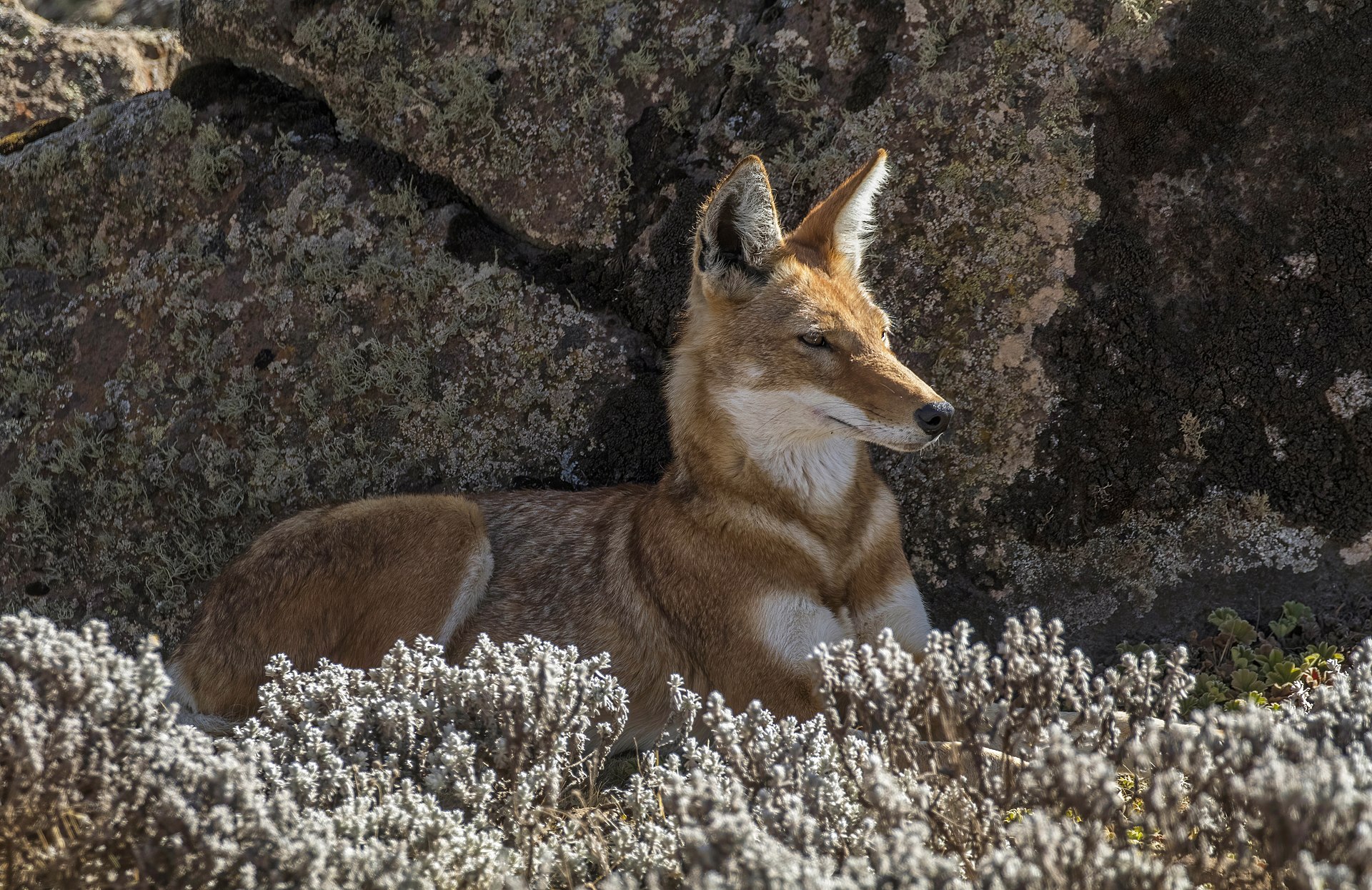
Ethiopian Wolf
Canis simensis
Characteristics
Temperament
Social, territorial and of unique biology: it lives in close-knit family packs like wolves but hunts small rodents alone. Diurnal, active when its prey is. The pack collectively defends its rich hunting territory. Cooperative breeding with "helpers". Shy and utterly tied to the Afroalpine highlands. Not a pet: an extremely rare, endangered wild wolf, threatened by disease and hybridization with dogs.
Diet
A carnivore hyper-specialized on high-altitude rodents, a rarity among large canids. It feeds almost exclusively on Afroalpine rodents (up to over 90% of the diet), especially the giant mole-rat and grass rats; occasionally hares, eggs, ungulate young and carrion. Though living in a pack, it hunts alone: it scours the grasslands, locates rodents at their burrows and strikes in a final ambush, sometimes digging to reach underground prey. Pack life serves to defend the territory, not to hunt together.
The Ethiopian Wolf (Canis simensis), also known as the Simien fox or Abyssinian wolf, is the world's rarest canid and Africa's most endangered carnivore. Famous for:
- Extreme rarity: only a few hundred individuals survive, split into a handful of isolated populations
- Highland exclusivity: it lives only in the Afroalpine grasslands of Ethiopia, above 3,000 metres
- A "slender red wolf" look: a slim body, long legs, a rusty-red coat with white throat and underparts
- A double social life: it lives in close-knit packs like wolves but hunts alone for small rodents
- Rodent specialization: it feeds almost exclusively on high-altitude rodents, especially giant mole-rats
- The threat of disease: rabies and distemper spread by domestic dogs can wipe out whole populations
IUCN status: Endangered, with a population estimated at a few hundred adults and declining. It is a true wolf of Africa, a close relative of the grey wolf and the coyote, but with a unique ecology: where other large canids hunt big prey in packs, the Ethiopian wolf has specialized in solitary hunting of the rodents of the "roof of Africa".
Classification and category
Order Carnivora, family Canidae, genus Canis — the same as the grey wolf (Canis lupus), the coyote and the domestic dog. Despite its looks and old fox-evoking names ("Simien fox"), it is not a fox: genetic studies place it among the true wolves, as an African relative of the grey wolf. Its ancestors are thought to have reached Africa from Eurasia relatively recently (a few hundred thousand years ago), then specialized in the unique environment of the Ethiopian highlands. Not to be confused with other African canids: the golden jackal and African jackals (smaller and more generalist); the African wild dog or painted wolf (larger, blotched, a pack hunter of big prey); and the red fox, which it resembles only superficially in colour. Etymology: "Canis" is Latin for "dog/wolf"; "simensis" comes from the Simien Mountains in Ethiopia, one of its strongholds; the local Amharic name is "ky kebero", "red jackal". Parameters: Body 84-100 cm. Tail ~27-32 cm (bushy, black-tipped). Shoulder height ~53-62 cm. Weight 11-20 kg (males larger than females). Longevity about 8-10 years in the wild. Reproduction: usually only the dominant pair in a pack breeds; gestation ~60-62 days; litters of 2-6 pups, raised in the den and cared for by the whole group (cooperative breeding with "helpers").
Habitat and distribution
The Ethiopian Wolf is an endemic strictly tied to the Ethiopian highlands: it lives only in Ethiopia, in a few isolated mountain areas (the most important being the Bale Mountains, home to the largest population, and the Simien Mountains). Habitat — a unique, restricted environment: Afroalpine grasslands and heaths above 3,000 metres (up to about 4,500 m), a cold, high-altitude world of grasses, tussocks and cushion plants; it is precisely these highlands that hold the very high densities of burrowing rodents the wolf feeds on. The problem is that this habitat is tiny and fragmented: the few suitable high-altitude "islands" are separated by unsuitable valleys, increasingly eroded by farming and livestock grazing. The Ethiopian wolf is diurnal, active when its rodent prey is, and territorial: the pack collectively defends its hunting area. IUCN: Endangered. With a few hundred individuals in isolated populations, it is extremely vulnerable — a single epidemic or the loss of one highland can put the whole species at risk.
Diet
A carnivore hyper-specialized on high-altitude rodents — a rarity among large canids: Afroalpine rodents (the almost exclusive basis of the diet, up to over 90%); the giant mole-rat (Tachyoryctes macrocephalus), a key prey in the Bale Mountains, a large burrowing rodent; grass rats and other small surface rodents; and occasionally hares, eggs, ungulate young and carrion. Hunting strategies: solitary hunting (though it lives in a pack, the wolf hunts alone, scouring the grasslands and locating rodents at their burrows); stalk-and-dig (it approaches slowly or waits motionless by a burrow, then strikes, sometimes digging to reach underground prey); and the benefit of the pack without pack hunting (its social life serves to defend the rich hunting territory from neighbouring groups, not to hunt together — a model almost opposite to the grey wolf's). Crucially, the Ethiopian wolf's survival is closely tied to the abundance of Afroalpine rodents and thus to the health of the high-altitude grasslands; degradation of this habitat hits both prey and predator.
Physical features
An elegant, slender, long-legged canid, perfectly adapted for running and hunting in the open high-altitude grasslands. Coat: a warm rusty-red/fulvous on the back and flanks; white throat, chest, belly and inner legs, with a sharp border between the red and the white; often a white band under the throat and white markings on the face; a bushy tail with a black tip. The body: a slim, light, runner's build; a long, narrow, pointed muzzle (an adaptation for seizing rodents in burrows); large pointed ears, well erect; and long legs to move efficiently across open expanses. Performance: keen hearing and smell to locate rodents; a fast final lunge in the ambush; endurance in moving across the territory; and social vocalizations — calls and choruses to keep contact within the pack.
Behaviour and curiosities
A social, territorial animal with a singular biology. It lives in close-knit family packs, with a hierarchy and strong bonds between members, who regroup and socialize several times a day with greeting ceremonies. Yet, unlike the grey wolf, each individual spends much of the day hunting small rodents alone. It is this combination — pack social life plus solitary hunting — that makes it unique among large canids.
The "wolf that looks like a fox": because of its red coat, slim body and tapering muzzle, the Ethiopian wolf was long called the "Simien fox" and mistaken for a fox or jackal; in fact genetics revealed it to be a true wolf, closely related to the grey wolf and the coyote — an African relative of the world's northern wolves, isolated on the "roofs of Africa". The mole-rat hunter: in the Bale Mountains, its stronghold, the Ethiopian wolf depends heavily on a single curious animal, the giant mole-rat, a large rodent that lives in tunnels and surfaces to graze; the Afroalpine grasslands hold very high densities of these and other rodents, a "mine" of prey that let the wolf specialize so extremely. The invisible threat: the greatest danger to the Ethiopian wolf is not direct hunting but disease — domestic dogs living near mountain communities transmit rabies and distemper, capable of causing devastating epidemics; in the past single outbreaks have killed much of entire populations within weeks, which is why conservation programmes include vaccination campaigns, of both dogs and the wolves themselves. Hybridization: besides disease, domestic dogs also threaten the Ethiopian wolf through hybridization, as crosses with dogs dilute the genome of populations nearest to villages — the same kind of problem affecting other wild canids and cats in this portal, from the Dingo to the European Wildcat. The flagship of the highlands: the Ethiopian wolf has become the symbol of conserving Ethiopia's Afroalpine ecosystems; protecting it means safeguarding an entire high-altitude habitat, rare and rich in endemic species (other mammals, birds and plants found only there) — a classic "umbrella species" whose survival is tied to that of the whole "roof of Africa".
Pros
- Canide più raro del mondo: enorme valore per la biodiversità
- Specie-bandiera degli ecosistemi afroalpini d'Etiopia
- Ecologia unica: vive in branco ma caccia roditori da solo
- Utile controllore dei roditori d'alta quota
Cons
- IUCN In pericolo: poche centinaia di individui, popolazioni isolate
- Gravemente minacciato da rabbia e cimurro dei cani domestici
- Minacciato dall'ibridazione con i cani e dalla perdita di habitat
- Non è un animale domestico: lupo selvatico endemico e protetto