Bat-eared Fox
Otocyon megalotis
Characteristics
Temperament
Social, peaceful and with a strong pair bond: it lives in monogamous pairs or small family groups that share a territory and dens and forage together. Uncompetitive, it "chose" insects to avoid larger carnivores. Mainly nocturnal in hot areas, more diurnal in cool periods. It stands out for paternal care: it is mainly the male that raises the pups. Not a pet: a small wild African canid, a specialized insectivore.
Diet
An insectivore, an absolute exception among canids. It feeds mainly on termites (especially harvester termites) and dung beetles and their larvae; it also eats other insects, scorpions, spiders and occasionally small vertebrates, eggs and fruit. It locates prey by listening for it underground with its enormous ears, then digs quickly to reach it. To process thousands of insects it has an unusually high number of teeth and a jaw that can chew at great speed; it also gets much of its water from termites.
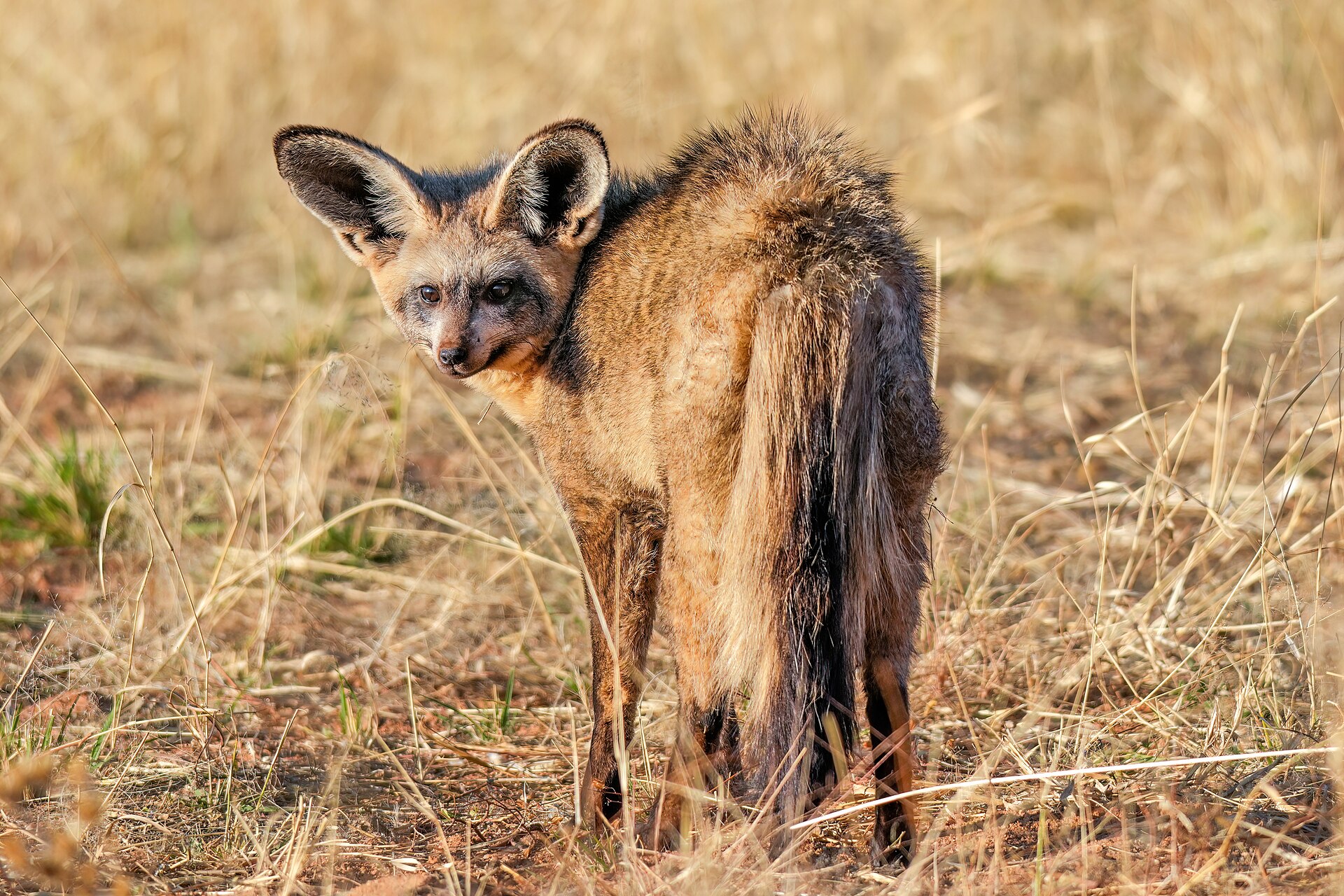
The Bat-eared Fox (Otocyon megalotis) is a small African canid, one of the most unmistakable and singular of the family. Famous for:
- Enormous ears: gigantic relative to the body (up to ~13 cm), among the largest of any carnivore
- "Antenna" ears: it uses them to listen for insects moving and digging in the soil, before locating them
- An insectivorous diet: it feeds mainly on termites and other insects — an absolute rarity among canids, usually carnivores or omnivores
- Extra teeth: it has more teeth than almost any other placental mammal, adapted to crunching insects
- The model father: in the bat-eared fox it is mainly the male that cares for the pups
- The black mask: the dark face, ears and legs give it an elegant, recognizable look
IUCN status: Least Concern (LC), widespread and locally common. It is an African canid very different from big hunters like the African wild dog or opportunists like the Golden jackal: the bat-eared fox has taken an evolutionary path of its own, giving up hunting prey to become a refined "insect scavenger" of the savannas.
Classification and category
Order Carnivora, family Canidae, but the only species of the genus Otocyon. It is considered one of the oldest and most distinct lineages among living canids, having split early from the rest of the family: it is therefore not a true fox of the genus Vulpes, despite its looks and English name. Not to be confused with other big-eared or similar animals: the fennec (Vulpes zerda), also a small big-eared African canid but a true desert fox, smaller and with a different diet; the foxes of the genus Vulpes and the jackals, more "ordinary" carnivore-omnivore relatives; and the aardwolf, another African termite-eater but a relative of the hyenas, not a canid. Etymology: "Otocyon" joins Greek otos ("ear") and kyon ("dog"), i.e. "ear-dog"; "megalotis" means "large-eared" — everything in the name celebrates its most obvious trait. Parameters: Body 46-66 cm. Tail 23-34 cm (bushy, black-tipped). Ears up to ~13 cm, huge relative to the head. Weight 3-5.3 kg. Longevity about 6-9 years in the wild, up to ~13 in captivity. Reproduction: usually monogamous pairs; gestation ~60-70 days; litters of 2-6 pups, with a particularly important paternal role (see curiosities).
Habitat and distribution
The Bat-eared Fox lives in two distinct, separate areas of Africa: East Africa (from Ethiopia and Somalia through Kenya to Tanzania) and Southern Africa (from Angola and Zambia to Botswana, Namibia and South Africa). Preferred habitats — open, dry environments: grassy savannas, arid grasslands and steppes (its prime habitat); areas of low vegetation and soft soil, rich in termites and other insects; and zones of short or grazed grass, where it is easier to locate and dig up prey. Its distribution closely follows that of harvester termites and other key insects: the bat-eared fox favours precisely the ground that holds these prey in abundance. To shelter from heat and predators it digs or uses underground dens. It is mainly nocturnal in the hotter seasons and areas, becoming more diurnal in cool periods. IUCN: Least Concern. A relatively common, adaptable species; it can even benefit from livestock grazing, which keeps grass short and favours the termites and dung beetles it eats.
Diet
The Bat-eared Fox is an insectivore, a true exception in a family — the canids — made of hunters and omnivores. It eats: termites (the basis of the diet, especially harvester termites, genus Hodotermes); dung beetles and their larvae (the other great resource); other insects, scorpions and spiders; and occasionally small vertebrates, eggs, fruit and plant parts. Hunting strategies: "radar" listening (the bat-eared fox walks head-down with its enormous ears turned toward the ground, sensing the faintest sounds of insects moving below the surface); targeted digging (once it locates prey by ear, it digs quickly with its forepaws to reach it); and group foraging (family members often look for food together, spread out but close, increasing safety). Crucially, to crunch thousands of insects the bat-eared fox has evolved unique adaptations, including an unusually high number of teeth (up to about fifty, more than almost any other "normal" placental mammal) and a special jaw musculature that lets it chew at great speed. Termites also provide much of the water it needs.
Physical features
A small, elegant, alert canid, dominated by its spectacular ears. The ears (its hallmark): enormous, broad and rounded, up to about 13 cm long; they serve a dual purpose — to locate insects underground and to disperse heat, helping the animal not to overheat in the sunny savannas. Coat and body: yellowish-grey/fulvous fur, dense and soft; a black "mask" on the face, black backs of the ears, dark legs and a bushy black-tipped tail; a slender, light build, with legs suited to long walking and digging; and a pointed muzzle with small, insect-suited teeth. Performance: exceptional hearing (its main weapon, to "see" prey with its ears); fast digging with the forepaws; agility and speed (it sprints and changes direction sharply to escape predators); and thermoregulation (the big ears radiate heat, an advantage in the warm climate).
Behaviour and curiosities
A social animal with a strong pair bond. It lives in monogamous pairs or small family groups that share a territory, rest together in dens and often look for food in company. It is a peaceful, uncompetitive canid that "chose" insects precisely to avoid competition with larger carnivores.
Record-breaking ears: the bat-eared fox's ears are among the largest, relative to body size, of any carnivore — and not just ornaments but precision tools; walking head-down with its ears pointed at the ground, the animal can hear the faint clicking of termite jaws and the movements of beetle larvae below the surface, locating prey without seeing it; the same richly vascularized ears act as a "radiator" to disperse heat. The insect-eating canid: in a family of predators and omnivores, the bat-eared fox is the exception that proves the rule — its diet is overwhelmingly insects, especially termites and dung beetles; this specialization let it occupy a free "niche", avoiding direct competition with other African canids and carnivores that hunt much larger prey. Extra teeth: to process huge numbers of insects, evolution gave the bat-eared fox a special dentition — it has more teeth than almost all other placental mammals (often 46-50, with extra molars), small and suited to crushing exoskeletons, and a special jaw musculature lets it chew at impressive speed, "mincing" prey at a rapid pace. The caring father: the bat-eared fox is famous among ethologists for its unusual division of parental roles — it is mainly the male that looks after the pups, guarding, warming, defending and playing with them, while the female spends more time feeding to produce milk; it is one of the most pronounced cases of paternal care among mammals, a real exception in the carnivore world. Living with livestock: unlike many wild animals, the bat-eared fox can benefit from the presence of domestic livestock — grazing keeps the grass short, ideal for finding insects, and the animals' dung attracts the dung beetles the fox loves; so rather than an enemy of herders, it is often an ally that reduces pasture pests. "Not a fox": despite its looks and English "fox" name, the bat-eared fox does not belong to the true-fox genus — it is the sole member of the genus Otocyon and one of the oldest, most isolated evolutionary lineages among living canids: a small "branch of its own" on the dog family tree, the first to take the path of insectivory.
Pros
- Canide unico e affascinante: insettivoro con orecchie da record
- IUCN Least Concern, diffuso e adattabile
- Utile in agricoltura: divora termiti e parassiti dei pascoli
- Raro esempio di forte cura paterna tra i carnivori
Cons
- Non è un animale domestico (canide selvatico africano)
- Dipende da termiti e insetti: sensibile a pesticidi e siccità
- Preda di sciacalli, grandi felini e rapaci
- A volte ucciso per errore o per la pelliccia in alcune aree