Rottweiler
Canis lupus familiaris
Characteristics
Temperament
Balanced, calm, self-confident, extremely loyal. ATTS character test score 83-85% (higher than Labrador). Dominant but not aggressive. Requires experienced owner and early socialisation. "Bump and lean": pushes body against owner as affection.
Diet
Carnivore: 1,700-2,700 kcal/day. Large breed premium kibble (28-35% protein). 2 meals/day to reduce GDV risk. Slow-growth puppies: 1.2:1 Ca/P ratio essential. Tendency to obesity.
The Rottweiler is a large dog breed originating in Germany, recognised by the FCI in Group 2 (Pinscher and Schnauzer type-Molossian and Swiss Mountain dogs). It is one of the oldest and noblest breeds in European dog breeding: it descends directly from the Molossian dogs of the Roman legions that crossed the Alps in the 1st century BC accompanying the troops. The name derives from the German city of Rottweil, in Baden-Württemberg, where the breed stabilised over the centuries as "Rottweiler Metzgerhund" (Rottweil butcher's dog), used to drive cattle to market and pull carts. Robust, powerful, intelligent and deeply loyal, the modern Rottweiler is admired as a versatile working breed: guarding, personal protection, police, military, rescue, therapy. It weighs 35-60 kg and has a height of 56-68 cm. Its character — balanced, calm, self-confident — makes it an exceptional companion for experienced owners.
Classification and category
The Rottweiler is classified by the FCI (Fédération Cynologique Internationale) in Group 2 — Pinscher and Schnauzer type, Molossian, Swiss Mountain Dogs, Section 2.1 (Molossian Mastiff type), with working trial. FCI standard number 147. The breed is also recognised by the AKC (American Kennel Club) in the "Working" group and by the British Kennel Club in the "Working Group". The official breed standard specifies: males 61-68 cm at the withers, 50 kg (ideal size); females 56-63 cm, 42 kg. Very robust, vigorous and powerful built dog. The origins date back to the Assyrian Molossian dogs that, through trade, reached the Roman Empire and were used as war and fighting dogs. When the Roman legions crossed the Alps (1st century BC) to conquer Germany, they brought these dogs with them to drive slaughter cattle following the troops. A Roman colony was founded on the area of today's Rottweil (original name: "Arae Flaviae"), which became the centre of an important grazing region. The dogs remained here after the Roman retreat and were crossed with local shepherd dogs, giving rise to the modern breed. The official standard was codified in 1901, after the breed risked extinction at the end of the 19th century with the decline of cattle trade.
Habitat and distribution
The Rottweiler is a domestic dog (Canis lupus familiaris) and therefore has no natural habitat. It adapts well to houses with garden where it can move and watch the territory; it suffers life in small apartments without outdoor spaces due to its large size and need for daily physical activity. It tolerates cold climate well thanks to the double coat (woolly undercoat); less well summer heat (the black colour of the coat absorbs heat). It needs 1-2 hours of activity per day to maintain physical and mental health: walks, running, play, obedience exercises, scent work. It is a dog that does not tolerate solitude: it needs to be in close contact with the family, ideally inside the house.
The global distribution of the Rottweiler is wide. It is among the top 10 most popular breeds in the world according to FCI/AKC statistics. In 2024 the AKC ranks it 7th among the most registered breeds in the USA. The world population is estimated in several million specimens. The largest populations are in: Germany (country of origin, headquarters of the ADRK — Allgemeiner Deutscher Rottweiler-Klub, official club since 1907), USA (over 1 million registrations), Brazil, Russia, Poland, Italy. The Rottweiler is professionally employed: in Germany and USA it is one of the preferred breeds of police and military (together with German Shepherd and Malinois). It is very used in rescue and assisted therapy. In some countries (UK, Ireland, Spain, Italy in some regions, Australia, Singapore) it is included in the lists of potentially dangerous breeds — not banned but with specific regulations (muzzle, mandatory insurance in public places). Life expectancy: 8-11 years, lower than smaller breeds due to large size and some genetic predispositions.
Diet
The Rottweiler is a carnivore with dietary needs suitable for a large and very active dog. The daily caloric requirement for an adult is 1,700-2,700 kcal, according to age, weight, activity. The ideal diet includes: fresh meat or premium kibble with high protein content (28-35% protein), moderate fats (12-18%), complex carbohydrates (rice, potatoes, whole grains), vitamins, minerals. The Ca/P ratio must be balanced (1.2:1) for correct bone growth of puppies — imbalances cause joint dysplasia. It is advisable to divide the meal in 2 daily portions (morning and evening) to reduce the risk of gastric torsion (GDV — dilation-volvulus syndrome), a frequent fatal pathology in large breeds with deep chest. Avoid intense physical exercise 1-2 hours before and after the meal.
Puppies require special attention: they need specific "large breed" puppy kibble, formulated for slow growth (Rottweilers should not grow too quickly to avoid bone problems). They develop slowly: complete physical maturity is reached at 24-36 months (vs 12-18 months in small breeds). They should be fed 3-4 meals a day until 6 months, then 2 meals. Forbidden foods: chocolate, grapes, onions, garlic, cooked bones (risk of splinters and obstruction), xylitol, alcohol. Tendency to obesity: the Rottweiler loves to eat and gains weight easily with overfeeding and little activity; overweight aggravates joint problems (hip/elbow dysplasia), cardiac and diabetes. Ideal weight should be monitored visually: well-defined waist, ribs palpable but not visible. Useful supplements in maturity: glucosamine+chondroitin (joints), omega-3 (skin/coat), CoQ10 (heart).
Physical features
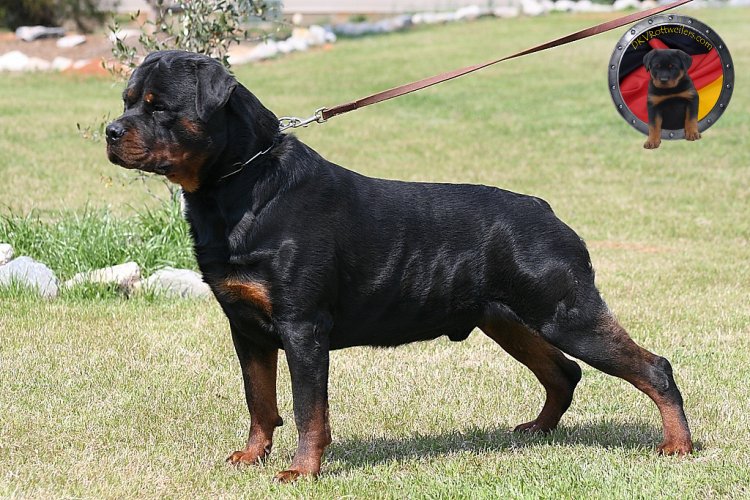
The Rottweiler has an athletic, powerful, well-proportioned physique. The body structure is compact and muscular, slightly longer than tall (ratio 9:10 or 10:11). The height at the withers is 61-68 cm for males, 56-63 cm for females; the weight 50 kg (males) and 42 kg (females) as ideal standard, with specimens up to 60 kg. The head is of medium length, strong and wide between the ears, with well-pronounced stop. The muzzle is of truncated triangle shape, well-developed, with nose always black, wide nostrils. The jaws are powerful, square-shaped, with scissor bite (upper incisors closing slightly in front of the lower ones); complete dentition is 42 teeth, robust.
The eyes are medium-sized, almond-shaped, of dark brown colour; the gaze is usually calm and watchful. The ears are triangular-shaped, set high, hanging, of medium size; carried adherent to the head. The neck is muscular, of good length, dry (without dewlap). The trunk is massive, with broad and deep chest, straight back, short loin. The tail, historically docked, is now banned from amputation (caudotomy) in many countries including Italy, Germany, UK — it is therefore kept natural. The legs are straight, strong, well-angled; round, compact feet, with robust black nails. The coat is the most iconic feature: black and tan, composed of short, coarse, adherent topcoat, of brilliant black colour, with tan markings (light brown-mahogany spots) well-defined in specific positions: over the eyes, on the cheeks, on the muzzle and under the throat, on the chest (2 triangular spots), on the legs (inside and outside), under the tail. The undercoat is woolly and insulating (absent in some specimens for hot climates). Shedding is moderate constant, abundant 2× a year (spring and autumn moult).
Behaviour and curiosities
The Rottweiler is a dog with a balanced, calm, self-confident character, deeply loyal to the family. The FCI standard describes it: "good character, affectionate, obedient, docile, hard-working, and ready to work". It is a dominant dog but not aggressive by nature: in ATTS (American Temperament Test Society) character tests the Rottweiler reaches a score of 83-85%, higher than Golden Retriever, Labrador and Beagle. Its reputation as an "aggressive dog" is largely a media myth amplified by rare but dramatic incidents. The reality: it is an intelligent dog, reserved with strangers, affectionate with its own, excellent as natural protection of home and family. It requires an experienced owner, capable of firm but fair leadership. Early socialisation (from 8 weeks) is fundamental: a puppy that meets many people, animals, different environments develops a stable character.
Historical curiosities: the Rottweiler was so appreciated by medieval German butchers that it carried the money bag hanging from the neck after having sold cattle at the market — a dog so imposing that no one dared approach. In the First World War it was the first dog used as a "messenger dog" by the German army, before the standard was extended to German Shepherds. Sports curiosity: in the dog world the Rottweiler is one of the most decorated breeds; it regularly wins IPO/IGP competitions (Internationale Gebrauchshund-Prüfung — competition of obedience, scent track, defence). Media curiosity: the breed appeared in famous films such as "The Omen" (1976), "Beverly Hills Cop", the Rottweiler dog "Stratton" in numerous '80s-'90s action films, contributing (unfortunately) to an exaggerated reputation of danger. Health curiosity: larger breeds like the Rottweiler have shorter life due to: osteosarcoma (bone cancer, common after 7 years), hip and elbow dysplasia (genetic), dilated cardiomyopathy (heart), gastric torsion (GDV). German working bloodlines tend to be healthier than more massive American "show" ones. Ethological curiosity: the Rottweiler has a characteristic "bump and lean": it pushes its body against the owner as a sign of affection — behaviour inherited from the era of cattle dogs when they pushed cows. All Rottweiler owners know this "love push". Life expectancy: 8-11 years (records go to 13-14 years with good genetics and care). Reproduction: an average litter is 6-10 puppies, but can reach 12-15. Puppies at birth weigh 400-700 g, already with the black mask and tan markings visible.
Pros
- Cane da guardia naturale: protezione efficace e fedele
- Intelligenza eccezionale (8° razza più intelligente al mondo per Stanley Coren)
- Molto addestrabile per ruoli professionali (polizia, militare, soccorso)
- Legame indissolubile con la famiglia, ottimo con bambini ben socializzato
Cons
- Aspettativa di vita breve (8-11 anni)
- Predisposto a displasia anca/gomito, osteosarcoma, torsione gastrica
- In alcuni Paesi/regioni: razza potenzialmente pericolosa con regolamentazioni
- Non adatto a padroni inesperti — richiede leadership ferma