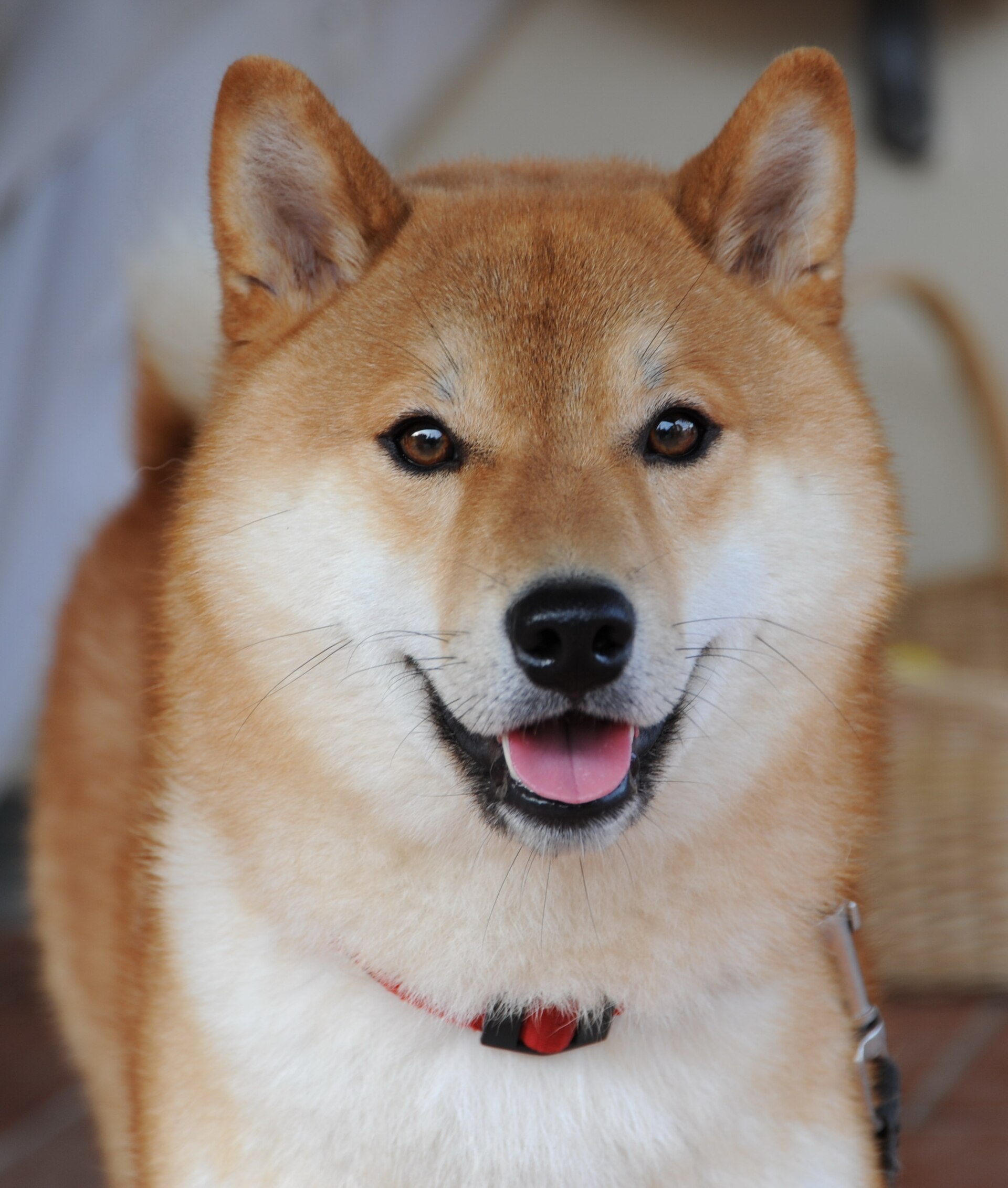
Shiba Inu
Canis lupus familiaris
Characteristics
Temperament
Independent, intelligent, lively, stubborn, loyal to family. Quasi-feline behaviour: cleanliness, rarely barks, detached. Famous for the "shiba scream" (shrill cry when stressed). Mascot of the "doge meme" and Dogecoin (Kabosu).
Diet
Carnivore: 500-800 kcal/day. Premium kibble (28-32% protein), avoid wheat. Tendency to be picky. Frequent food allergies (5-10%): chicken, beef, soy, corn, dairy. 2 meals/day.
The Shiba Inu (柴犬, "shiba ken") is an ancient Japanese dog breed, classified by the FCI in Group 5 (Spitz and primitive type dogs) section 5 (Asian Spitz and related breeds). It is the smallest of the 6 native Japanese breeds and one of the oldest in the world: genetic studies show that it is one of the 14 breeds most similar to the wolf in genetic profile, indicating a prehistoric origin (about 8,000-9,000 years ago). The name "Shiba" has three interpretations: (1) "small" in ancient Japanese, (2) "dry brown/reddish" (referring to the colour of autumn woods), (3) "brushwood" (referring to the original hunting habitat in bushes). "Inu" means "dog". Traditionally used for hunting small game (foxes, pheasants, hares, wild boar) in the Japanese mountains, today it is one of the most popular companion dogs in the world. It is famous for its independent, intelligent, lively and sometimes stubborn character — much like a cat in behaviour. It weighs 7-11 kg and is 35-43 cm tall. It has become one of the most iconic internet memes in history ("doge", 2013).
Classification and category
The Shiba Inu is classified by the FCI in Group 5 — Spitz and primitive type dogs, Section 5 (Asian Spitz), FCI standard number 257. Also recognised by AKC (American Kennel Club, "Non-Sporting" group) since 1992. The official standard provides for: males 38-41 cm at the withers, 9-11 kg; females 35-38 cm, 7-9 kg. Sexual dimorphism is marked in height but little in weight.
The Shiba Inu is one of the 6 native Japanese breeds:
- Shiba Inu — the smallest and most popular
- Akita Inu — the largest (40-50 kg), famous for Hachiko
- Kishu Ken — white, wild boar hunting
- Shikoku Ken — hunting in Shikoku
- Kai Ken — the brindle "tiger"
- Hokkaido — Ainu Ken, from the North
Genetic studies of 2004 and 2010 (Stanford University, UCLA) have classified the Shiba as one of the 14 "ancient breeds" most similar to the wolf (together with chow-chow, akita, basenji, alaskan malamute, siberian husky, samoyed). The breed was brought near extinction in World War II: of the millions of pre-war specimens, only a few hundred survived. The modern breed was reconstructed in the 1950s-60s from 3 surviving local strains (Sanin, Mino, Shinshu). The modern standard was codified in 1934 by the Nihon Ken Hozonkai (Nippo), the Japanese society for the conservation of native breeds. In 1936 the breed was declared a "Living Natural Monument" by the Japanese government — one of the very few dogs in the world with this status of legal protection. Longevity is excellent: 12-16 years on average, with records of 26 years (the dog "Pusuke", Japan, who died in 2011 at 26 years and 9 months, at the time the oldest dog in the world).
Habitat and distribution
The Shiba Inu is a domestic dog (Canis lupus familiaris) and has no natural habitat. It is extremely adaptable: it does well in apartment (thanks to its small size), in houses with garden, and in rural areas. It tolerates cold climate well thanks to the double woolly undercoat; less well humid heat (summer moulting is massive). It is a very clean dog: it cleans itself frequently like a cat, is easy to train to do its needs outside, and has very little body odour. It needs 1-2 hours of activity per day: brisk walks, play, olfactory exploration. It has a very strong hunting instinct: can chase any small animal (squirrels, cats, rabbits) — it is important to keep it on a leash in open spaces.
The global distribution is wide. In Japan it is the most popular dog breed (35% of Japan Kennel Club registrations), considered a national cultural symbol (along with the akita and the Japanese bobtail cat). In the USA it has had exponential growth in popularity since the 2000s: AKC ranks it at 43rd place in 2024 registrations (out of 200 breeds). In Europe it is very popular in: United Kingdom, Germany, France, Italy (rapidly growing popularity since 2010, today ~3,000 puppies/year registered with ENCI). The exceptional longevity and small dimensions make it suitable for modern urban contexts. The "doge meme" of 2013 (photo of shiba "Kabosu" with Comic Sans inscriptions, viral on Reddit) has contributed enormously to global popularity: its "icon" has become one of the most iconic memes in internet history, was also used for the creation of the cryptocurrency Dogecoin (market capitalisation up to 30 billion USD in 2021). Kabosu, the original shiba dog of the meme, died in 2024 at 18 years.
Diet
The Shiba Inu is a carnivore with needs suitable for a moderately active small dog. The daily caloric requirement for an adult is 500-800 kcal (variable based on activity and climate). The ideal diet includes: premium kibble with high protein content (28-32% protein), moderate fats (12-16%), complex carbohydrates (rice, sweet potato — many Shibas are wheat intolerant), vitamins, minerals. It is advisable to divide the meal in 2 daily portions. The breed is generally picky about food: it willingly refuses new or unappetising foods, often even if hungry (behaviour similar to a cat). Therefore, flavour rotation is important to maintain interest.
The Shiba is subject to food allergies with above-average incidence (5-10% of specimens). Most common triggers: chicken, beef, soy, corn, wheat, dairy. Symptoms: itching (especially on paws and ears), recurrent otitis, gastro-intestinal problems. In case of suspicion, an exclusion diet (new protein like duck, deer, salmon) for 8-12 weeks is the standard diagnostic strategy. Forbidden foods: chocolate, grapes, onions, garlic, cooked bones, xylitol, alcohol. Tendency to overweight: moderate — the Shiba is naturally less voracious than other breeds, but if sedentary it can gain weight. Ideal weight should be monitored visually with the "defined waist". Useful supplements: probiotics for sensitive intestine, omega-3 for skin/coat, glucosamine after 7 years.
Physical features
The Shiba Inu has a compact, well-proportioned, naturally elegant physique, similar to a miniaturised fox. The height-to-length ratio is 10:11 (dog slightly longer than tall). The height at the withers is 38-41 cm for males, 35-38 cm for females. The weight is 9-11 kg (males) and 7-9 kg (females). The head resembles that of a fox: wide, with accentuated but soft stop, triangular-shaped muzzle. The skull is slightly rounded. The nose is black (even in cream colour variants), moist. The jaws are powerful, with complete dentition of 42 teeth, scissor closure.
The eyes are triangular-shaped, of dark brown colour, with a lively and intelligent expression. The ears are small, triangular, well proportioned, always erect (spitz characteristic). The neck is muscular, strong, of medium length. The trunk is compact, with straight and strong back, short loin, well-developed chest. The tail is the most iconic characteristic: curled or sickle-shaped, carried over the back, with two main variants — "sashio" (curled in complete spiral) or "maki" (sickle-shaped folded over). The legs are straight, robust, well angled; the feet are compact, cat-shaped, with black claws.
The coat is the most distinctive characteristic: double, consisting of hard, straight, adherent topcoat (length 2-3 cm) and woolly, soft and dense undercoat (length 1-2 cm) — excellent protection against cold and humidity. Shedding is abundant: moderate constant moult + 2 massive moults per year (spring, autumn) — the "sheading season" is famous for the amount of hair lost (5-10 brushings per week for 2-3 weeks). The colours admitted by the FCI standard are:
- Red — the most common (75% of specimens): intense/orange red with "urajiro": the characteristic white marking on the muzzle, under the throat, on the chest, on the belly, on the inside of the legs, under the tail
- Sesame — red with interspersed black hairs
- Black Sesame — more black than red
- Black and Tan — black with brown markings and white urajiro
- Cream — white-cream (not accepted as official FCI standard but common)
Behaviour and curiosities
The Shiba Inu is famous for its unique character: independent, intelligent, self-confident, lively, sometimes stubborn, reserved with strangers, deeply loyal to family. The temperament is described as "kan'i" (bold, courageous), "ryosei" (good disposition, intelligent mind), "sobuku" (refined simplicity) — the three fundamental traits according to the official Japanese standard. The most characteristic trait is the "shiba scream": a shrill, high-pitched and prolonged cry that the dog emits when stressed, annoyed, or unwilling to do something (e.g. nail clipping, bath). It is not a normal bark: it is a "scream" similar to a human cry, audible at 100+ metres. Memorable and amusing (for observers).
The Shiba is also famous for its quasi-feline nature: it cleans itself frequently, is very clean, rarely barks (prefers to vocalise with various sounds), and can be detached/independent. In the USA they say "cats in dog's body". The Shiba is not the "clingy" dog like Golden Retriever or Labrador: it is an affectionate dog but reserved in demonstrations, and fond of its own independence. This characteristic makes it both adored and frustrating: training requires patience, significant rewards (very palatable food), and lack of strong leadership ruins its upbringing. It is not a breed for beginners who want an "easy" dog.
Historical curiosities: the Shiba Inu was declared a "Living Natural Monument" by the Japanese government in 1936 — one of the very few dogs in the world with legal protection status (along with the other 5 native Japanese breeds, which are all protected). World War II curiosity: the breed was close to extinction (1945) due to war and a post-war distemper epidemic. Only thanks to the efforts of a few Japanese conservators, starting from 3 geographical strains (Sanin, Mino, Shinshu), the breed was saved and reconstituted. Memetic curiosity: the "Doge meme" is one of the most famous and lasting memes in internet history. Born in February 2013 from a photo of "Kabosu", a shiba bitch from Sakuray (Japan), published by her owner Atsuko Sato. The photo showed Kabosu in expressive poses with raised eyebrows. The meme — with phrases in Comic Sans like "much wow", "so doge" — went viral globally. In 2014 it inspired the creation of "Dogecoin" (DOGE), a cryptocurrency with its icon, which reached a market capitalisation of 30 billion USD in 2021. Kabosu died in May 2024 at 18 years; world newspapers gave the announcement (one of the few dogs with an international obituary). Shiba brain curiosity: studies of 2009 (Hokkaido University) have shown that the Shiba has exceptional spatial memory: it remembers 50-100 locations of potential prey in its territory, and follows olfactory paths memorised for years. It is one of the most "problem-solving" breeds in the dog world. Health curiosity: the Shiba is one of the healthiest breeds globally: rates of genetic diseases among the lowest among purebred dogs. The main predispositions are: patellar luxation (rare), food/atopic allergies (5-10%), glaucoma (5%), epilepsy (rare). Breed curiosity: the Shiba does not behave like a "typical" dog: does not always come when called (the instinct for independence wins), does not willingly share food, does not greet all acquaintances with enthusiasm. But if it finds in you its respected "leader", it will be loyal for life.
Pros
- Una delle razze più antiche al mondo (8.000-9.000 anni)
- Monumento Naturale Vivente protetto dal Giappone (1936)
- Longevità eccezionale (12-16 anni, record 26)
- Icona mondiale: 'doge meme' e Dogecoin (capitalizzazione 30 miliardi USD)
Cons
- Carattere indipendente: difficile da addestrare per principianti
- 'Shiba scream' rumoroso quando stressato
- Muta massiccia 2 volte l'anno (sotto-pelo lanoso)
- Fuga facile per istinto di caccia (sempre guinzaglio)