Russian Blue
Felis catus
Characteristics
Temperament
Calm, intelligent, reserved. "Perfect cat for introverts". Affectionate but not intrusive. Bonds with a single "favourite human". Reserved with strangers. Moderate vocal (chirps and trills). Hydrophilic. Suffers sudden changes.
Diet
Obligate carnivore, medium metabolism. 250-300 kcal/day in 2-3 meals. High-quality kibble (35-40% protein) or wet/BARF. Tendency to overweight post-sterilisation. Hydrophilic: fountains recommended.
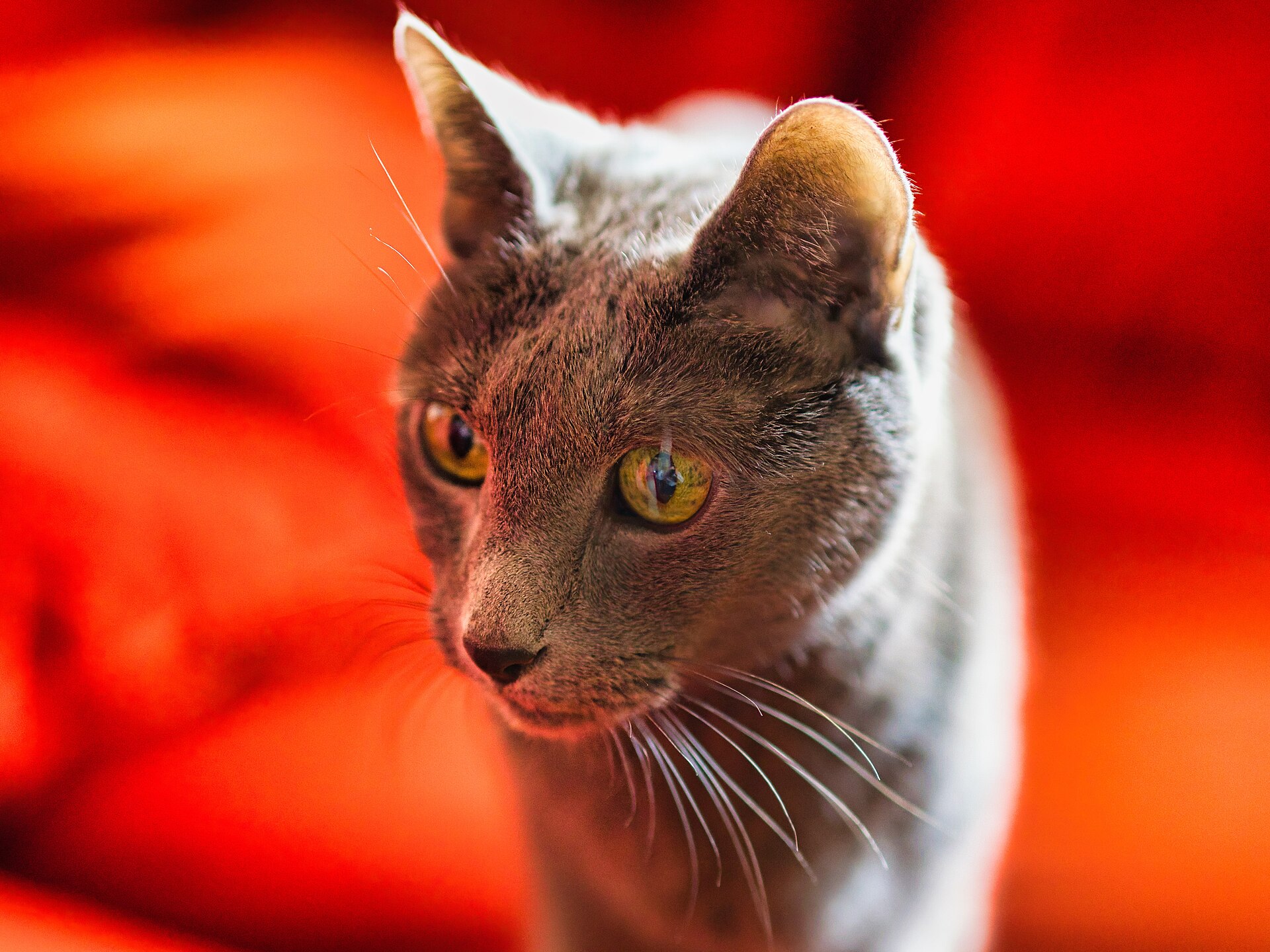
The Russian Blue (Felis catus), also known as the Russian Blue Cat or Archangel Cat, is one of the oldest and most elegant cat breeds in the world. Originating from the Russian port of Arkhangelsk on the White Sea, legend has it that it was the "cat of the tsars" of the Russian imperial family in the 17th-18th centuries. Three characteristics make it unmistakable: the short, dense, double coat of silver-blue grey with metallic reflections, the brilliant emerald green eyes in stark contrast, and the characteristic "Mona Lisa enigmatic smile" (the conformation of the muzzle forms a slight permanent smile). With a calm, intelligent and reserved character, it is considered one of the healthiest and longest-lived cats in the world (15-20 years), and one of the most hypoallergenic breeds thanks to the low content of Fel d 1 (allergenic protein) in the saliva.
Classification and category
The Russian Blue belongs to the species Felis catus, the domestic subspecies derived from the African wildcat (Felis silvestris lybica). It is classified by FIFe in Category III — Shorthair (code RUS), by CFA as a distinct breed, by British GCCF as Russian Group 4. The standard provides for a medium size: weight 3-5 kg for females, 4-7 kg for males, withers height 25-30 cm. The structure is slim and refined, "foreign body type" (elongated and elegant body, not compact like the British). Full physical maturity is reached at 2-3 years. The breed was officially recognised by the British Kennel Club in 1912, by FIFe in 1939, by the American CFA in 1949. There are selected colour variants but not always officially recognised: Russian White, Russian Black, Nebelung (long-haired variant, today a distinct breed since 1987). Only the silver blue is admitted by FIFe for the official Russian Blue.
Habitat and distribution
The Russian Blue is a completely domestic breed, perfectly adapted to apartment life. Its reserved, calm and rarely vocal nature makes it ideal for urban families of all sizes, even with children and other animals (if well socialised). It is particularly suited to "calm" and regular owners: it does not like chaos, excessive noise, sudden changes (it is a breed that suffers greatly from moves and novelties). It is not a breed that lives well outdoors in freedom: too reserved and cautious, it suffers intense heat.
The history of the breed is shrouded in mythical legend and partial historical data. The origins date back to the Russian port of Arkhangelsk (Archangel) on the White Sea, from which they take the name "Archangel Cat". Tradition narrates that they were the favourite cats of the Russian tsars (Peter the Great, Catherine II) at the imperial palaces of Saint Petersburg, cherished as court companions. The first specimens were brought to England by English sailors who traded timber with Russia between 1850-1870. They were exhibited for the first time at the Crystal Palace Show in London in 1875 in the "Archangel Cat" category — in fact the first international exhibition. In 1912 the British GCCF established its own category. The breed was brought close to extinction during the Second World War (only about ten specimens remained in Europe); the reconstruction programme (1947-1965) used crossings with Siamese blue points and British Blues to reconstitute the genetics. Today it is widespread globally, with concentrations in North America, Europe (especially Great Britain, Germany, Italy, Russia), Australia, Japan. The average price of a pedigree FIFe kitten is 1,000-2,000 euros; show line specimens 2,500-4,000 euros.
Diet
The Russian Blue is an obligate carnivore with medium metabolism: the daily caloric requirement of a 4 kg adult is about 250-300 kcal, distributed in 2-3 small meals. The ideal diet consists of high-quality kibble rich in animal protein (minimum 35-40%), or wet feeding (cans) or BARF under veterinary supervision. The breed is voracious: it has excellent appetite and can tend to overweight if portions are not controlled, especially after sterilisation (30% metabolism drop).
The breed is generally one of the most robust among pedigree cats, with very few specific genetic predispositions. Pathologies to monitor: hypertrophic cardiomyopathy (HCM) rare, urinary infections (FLUTD) and urinary stones (mild predisposition, hydration control), obesity (behavioural problem post-sterilisation), diabetes in advanced age. Annual cardio screening from 5 years onwards is recommended. The care of the coat requires minimal attention: the double structure (guard hairs + dense undercoat) is self-cleaning, weekly brushing is enough to maintain shine. The emerald green eyes do not require particular care (unlike the Persian or the Birman). Water must always be available, fresh, in abundant quantities. The Russian Blue is particularly hydrophilic: some specimens love to play with water, cat fountains are recommended.
Physical features
The Russian Blue has an elegant, long, slender, muscular body, defined by the standard as "foreign body type" (elongated foreign-oriental typology). The head has a modified triangular shape (in the form of a rounded wedge), with medium-long muzzle, flat forehead, strong chin. The ears are large, wide at the base, well spaced, with slightly rounded tips. The eyes are the most iconic trait after the coat: large, slightly oval, well spaced, of intense bright emerald green colour (the rigid standard: yellow or amber eyes disqualify). Kittens are born with blue eyes that gradually turn green between 4 and 12 months.
The coat is the most distinctive feature in the world: short hair (1-2 cm), double, dense, of "silky-velvet" consistency (unique in the feline world). The guard hairs have silvery tips that reflect light, giving the iconic "plush shimmer" effect (sparkling reflection similar to blue velvet). The undercoat is dense and insulating (Russian climate inheritance). The standard colour is uniform silver-blue grey with silvery guard hair tipping: blue must be as light as possible, never dark grey. The FIFe standard excludes any variation (spots, banding, ticking, frosting); the hair must be uniform throughout the body. The skin under the hair is grey (visible on nose and paw pads). The paw pads are lilac-pink (unique characteristic: the only blue cat with pink pads, instead of grey/blue like British Blue and Korat). The legs are long and elegant, with small oval feet. The tail is long, well proportioned to the body, with slightly rounded tip. The "Mona Lisa smile": the conformation of the muzzle (line of the mouth slightly turned up at the corners) forms a characteristic permanent half-smile, an iconic trait of the breed.
Behaviour and curiosities
The Russian Blue has a calm, intelligent, reserved temperament. It is often described as "the perfect cat for introverts": affectionate but not intrusive, social but not excessive, intelligent but not hyperactive. It bonds deeply with the owner (often with a single "favourite human") and shows great devotion, following the human from one room to another but maintaining a "dignified distance". It is reserved with strangers: usually it hides on the arrival of guests, revealing itself only after verifying that they do not represent a threat.
Intelligence is exceptional: the Russian Blue easily learns domestic routines, recognises its own name, understands simple commands, can be trained to use the toilet, do tricks. The spatial memory is extraordinary: once familiar with an environment, it remembers perfectly the arrangement of objects. "It talks very little": meowing is rare, delicate, melodious, never shrill. However, it has a wide range of "chirps" and "trills" used to communicate with the owner, especially on return home. It is hydrophilic: many specimens love to play with running water, cat fountains, sinks. It gets along with respectful children, elderly people, other cats, calm dogs (if well socialised).
The breed is considered among the most hypoallergenic in the world: it produces lower amounts of the Fel d 1 protein in the saliva than the feline average, significantly reducing allergic reactions (not eliminating them completely). Recent studies from Indiana University (2019) have confirmed that Russian Blues produce 50% less Fel d 1 than the average. However, NO cat is 100% hypoallergenic. Historical curiosity: the Russian Blue is the subject of numerous legends: the most known narrates that it was the sacred cat of the northern village of Archangel, considered a bearer of good luck by sailors. Tsar Nicholas I was a devoted owner, and it is said that Queen Victoria of England owned one given to her by the Russian imperial family. Famous modern owners: Marilyn Monroe, Frank Sinatra, Queen Elizabeth II (had a Russian Blue named "Apollo"). Longevity is excellent: 15-20 years on average, with well-cared specimens reaching 22-25 years (one of the longest-lived cats in the world for longevity). In Japanese animation films, the Russian Blue is a classic: it appears in numerous anime series as a symbol of elegance and mystery.
Pros
- Mantello blu-argento unico al mondo, occhi verde smeraldo
- Ipoallergenico (50% meno Fel d 1)
- Salute robusta, longevità eccellente (15-20 anni, fino 25)
- Carattere ideale per persone tranquille e introverse
Cons
- Soffre molto cambiamenti, traslochi, novità
- Non adatto a famiglie chaotiche o con bambini molto piccoli
- Raro in Italia (1-2 allevatori per regione)
- Prezzo elevato (1.000-4.000 €)