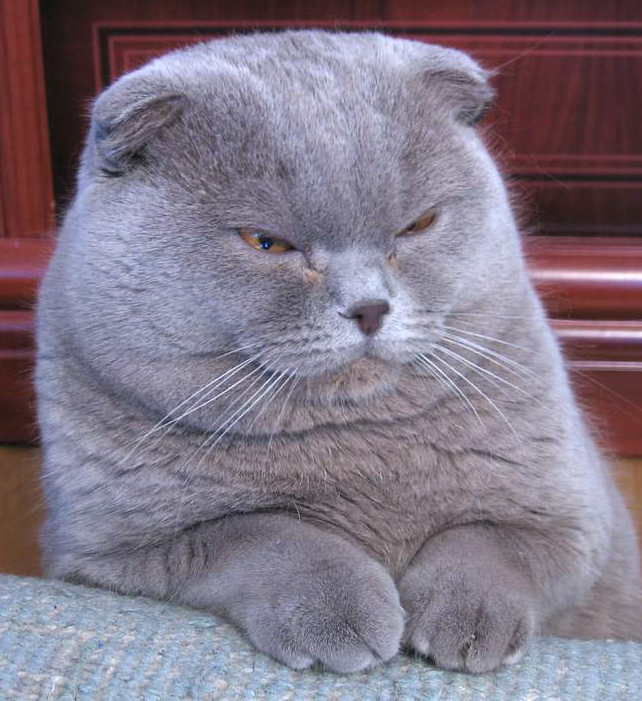
Scottish Fold
Felis catus
Characteristics
Temperament
Quiet, affectionate, intelligent, social, adaptable. Famous for the "buddha" posture (sitting on hindquarters), subdued vocalisations, docile behaviour. FGFR3 mutation: all specimens develop some form of osteochondrodysplasia (breeding banned in some countries).
Diet
Strict carnivore: 200-300 kcal/day. Wet/dry premium food with 30-40% protein. Integrate glucosamine/chondroitin after 4-5 years to prevent joint problems. NO obesity: worsens arthritis. NO milk (lactose).
The Scottish Fold is a cat breed originating in Scotland famous for its most distinctive characteristic: ears folded forward, which give the cat a unique appearance, "owl-shaped". This characteristic derives from a dominant genetic mutation in the FGFR3 gene that affects cartilage development, folding the auricle against the head. The breed was born in 1961 from a single cat born on a farm in Coupar Angus (Perthshire, Scotland), called "Susie". All Scottish Folds in the world are descendants of Susie. It weighs 3-6 kg, of medium size. It has a quiet, affectionate, social, intelligent character, ideal for family and apartment life. It has become one of the most popular cat breeds in the world, particularly appreciated on social media: the cat "Maru" (Japan), a Scottish Fold/Scottish Straight, is one of the most famous cats on YouTube with over 1 billion total views (channel since 2008). The breed is also subject to ethical controversies: the mutation also causes osteochondrodysplasia (joint problems) in specimens, and breeding is banned in some countries (Belgium, Netherlands from 2024). The FIFe standard no longer recognises the breed since 1971.
Classification and category
The Scottish Fold is a cat breed classified by:
- CFA (Cat Fanciers Association, USA) — recognised since 1978 as a separate breed, both short-hair and long-hair variety (called "Highland Fold")
- TICA (The International Cat Association) — recognised since 1979
- GCCF (Governing Council of the Cat Fancy, UK) — NOT recognised since 1971 (ethical controversy)
- FIFe (Fédération Internationale Féline, Europe) — NOT recognised since 1971 (health reasons)
The origins are very recent compared to other breeds: in 1961, William Ross, a sheep shepherd from the farm of Coupar Angus (Perthshire, Scotland), noticed a small white cat with strange ears — folded forward — born on his nearby farm called "Tayside". The kitten, named "Susie", had a spontaneous genetic mutation that changed the cartilage of her ears. William Ross took one of her daughters, "Snooks", and began a selection programme. The breed was recognised in 1966 by the GCCF with the name "Lop-eared cat", but then cancelled in 1971 due to health concerns about joint problems. The breed was brought to the USA in 1971 by geneticist Pat Turner; there the CFA accepted it in 1978.
Adult dimensions are: weight 4-6 kg (males), 3-4 kg (females). Moderate sexual dimorphism. Longevity is 11-14 years on average. A very important genetic characteristic: the FGFR3 mutation ("Fd") is dominant. A cat with two copies of the gene (homozygous Fd/Fd) develops severe osteochondrodysplasia already from 7-12 months of age (debilitating joint problems). For this reason, the ethical standard requires pairing a Scottish Fold (Fd/fd, heterozygous) with a Scottish Straight (fd/fd, normal ears) to obtain healthy kittens — about 50% will have folded ears, 50% normal ears (called Scottish Straight, separate breed). In recent years some countries have banned reproduction: Belgium (2024), Netherlands (2024), Scotland (the breed is banned by the Scottish Animal Welfare Commission since 2022).
Habitat and distribution
The Scottish Fold is a domestic cat (Felis catus) and has no natural habitat. It adapts perfectly to apartment life: it is one of the breeds most suited to urban contexts thanks to its quiet character, medium size, low space requirement. It tolerates solitude well during the day (owner at work): it is not an excessively "clingy" breed. It needs mental stimulation: scratching posts, interactive toys, climbing. It prefers temperate climates; it does not tolerate excessive heat well (>30°C).
The global distribution is very wide. The USA are the main market (CFA: 8th-12th place in registrations). Japan is probably the country with most Scottish Folds per capita: there is a real "Scottish Fold fashion" from the 2000s, fuelled by the YouTube channel "Mugumogu" (cat "Maru", over 1 billion views, active since 2008). In Russia and Ukraine it is a popular breed. In Europe the diffusion is reduced due to FIFe non-recognition and recent bans. In Italy there are about 500-1,000 specimens registered with ENCI/ANFI/AIGA. The global population is estimated at hundreds of thousands of specimens.
Recent controversy on social media and celebrities: the Scottish Fold was "the star cat" for many years, also owned by Taylor Swift (her cats "Olivia Benson", "Meredith Grey", and "Benjamin Button" are famous), Ed Sheeran ("Calippo" and "Dorito"), Harry Styles, etc. Animal welfare associations (PETA, RSPCA, FAB) have publicly asked celebrities not to promote the breed to avoid incentivising the breeding of cats with potential genetic problems. In 2023 the Vet Med Association of UK published a "guideline" asking to discourage the adoption/purchase of Scottish Folds.
Diet
The Scottish Fold is a strict carnivore, like all domestic cats (Felis catus). The daily caloric requirement is 200-300 kcal for an adult (4-5 kg weight). The ideal diet includes: wet food (pouches or pâté) or high-quality dry food with at least 30-40% protein, fats 15-20%, minimum carbohydrates (<25%, ideally <15%), mandatory taurine (cats do not synthesise taurine). 2-3 daily portions are recommended (or food at free disposal, but controlled to avoid obesity).
An important characteristic: Scottish Folds tend to develop arthritis and osteochondrodysplasia in the limbs — a genetic characteristic of the mutation that defines them. For this reason, it is crucial to:
- Maintain ideal weight (NO obesity!) to reduce joint stress
- Integrate glucosamine and chondroitin after 4-5 years (protect joints)
- Integrate omega-3 EPA/DHA (natural anti-inflammatories)
- Water always available (predisposed to kidney problems)
Forbidden foods: chocolate, onions, garlic, grapes, milk (yes, most adult cats are lactose intolerant), canned tuna (toxic in excess for mercury), cooked bones, xylitol, alcohol. Tendency to overweight: moderate-high. The stocky physique of the Scottish Fold does not help to notice weight increases visually: monitor with weekly weighing. The ideal weight is one where the ribs are felt under a slight layer of fat, and there is a visible "waist" from above.
Physical features
The Scottish Fold has a medium, round, compact, muscular physique. The head is the most iconic feature: round, broad, with full cheeks, giving a "full moon-shaped" or "ball" appearance. The skull is rounded without sharp edges. The muzzle is short, broad, with slightly accentuated stop. The nose is variable in colour according to the coat colour.
The ears are the most distinctive and iconic feature: folded forward and downward, against the head, so that the tip almost touches the base of the skull. There are 3 degrees of folding:
- Single Fold — ear folded in half, tip forward (most common)
- Double Fold — ear folded in half, tip further folded downward (medium)
- Triple Fold — ear completely folded against the head (rare, more "flattened")
Scottish Fold kittens are born with normal ears: the folding begins at 3-4 weeks and is completed within 3-4 months. Not all kittens develop the folding: in 50% of cases (heterozygous fd/fd), the ears remain normal — these cats are called "Scottish Straight" (officially separate breed since 2004). The eyes are large, round, of various colour (yellow, blue, green, coppery) — the "doll eyes" effect is characteristic. The body is medium, robust, muscular, with broad chest. The neck is short and stocky. The tail is of medium length, well furred in long-haired varieties. The legs are of medium length, well proportioned; round feet.
The coat exists in 2 varieties:
- Short Hair — the classic Scottish Fold: dense, soft, plush hair. Minimum maintenance (1-2 brushings per week)
- Long Hair (Highland Fold) — long and silky hair. Medium-high maintenance (3-4 brushings per week)
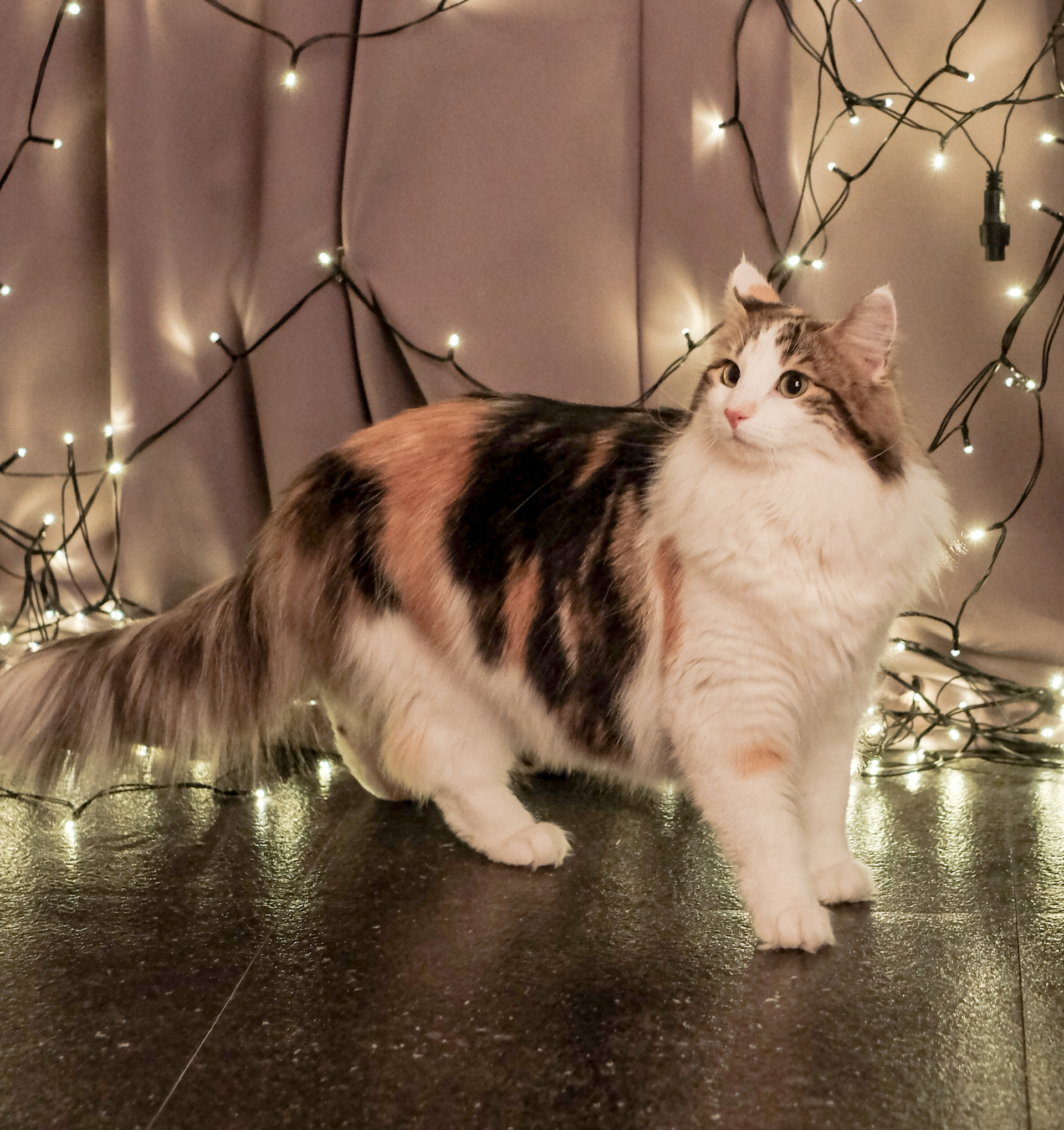
The colours admitted are practically all: white, black, blue (grey), red, cream, tortie, calico, tabby (mackerel, classic, ticked), bicolor, point. The most known visual characteristic is the "sweet, owl-like eye": the combination of round head, large eyes, folded ears, and short neck creates a perpetual "baby face" expression that activates in humans an instinctive affective response (Konrad Lorenz's "Kindchenschema" effect).
Behaviour and curiosities
The Scottish Fold is a cat with a quiet, affectionate, intelligent, social, adaptable character. It is known for being one of the most "docile" cats among domestic breeds. Typical behavioural characteristics:
- "Buddha" posture: the Scottish Fold loves to sit on its hind legs with straight back and front legs relaxed outward, like a meditating buddha. It is a unique and photogenic position.
- Characteristic "tail dance": it moves the tail in a slow and fluid way during social interactions.
- Subdued vocalisations: it meows rarely, and with a sweet and low voice (unlike the Siamese or Oriental which are very vocal).
- Social but not clingy: it likes to be in company but does not require constant attention. Ideal for people who work outside the home.
- Excellent with children and other animals: peaceful, tolerant, rarely aggressive.
- Intelligent and curious: learns to use complex litter boxes, opens doors, follows simple calls.
Famous curiosities: the cat "Maru" (Japanese, Scottish Fold/Scottish Straight hybrid) is one of the most famous cats in YouTube history: his channel "mugumogu" (active since 2008) has over 1 billion total views, with iconic videos like "Maru jumps in box" (over 30 million views). Maru died in 2023 at 15 years; the news was given by the main Japanese media. Celebrity curiosity: Taylor Swift has 2 famous Scottish Folds: "Olivia Benson" (since 2014, referring to Law & Order SVU) — one of the richest cats in the world, valued at $97 million thanks to appearances in music videos and merchandising — and "Meredith Grey" (referring to Grey's Anatomy, 2011-2024). Ed Sheeran also has 2 Scottish Folds: "Calippo" and "Dorito", who often appear in his social media. Genetic curiosity: the Scottish Fold was one of the first mammals to "felinise the cartilage" through a spontaneous FGFR3 mutation. Genetic studies have discovered that the same mutation exists in some breeds of turkeys and chickens, always as an anomaly. Breed curiosity: Scottish Straights (normal ears) are very similar to British Shorthairs: the two parents of Susie's first litters were "British Shorthair", which is why the Scottish Fold is "British Shorthair with folded ears". Ethical curiosity: in 2024 Belgium banned breeding, followed by the Netherlands. Scotland has banned reproduction since 2022. In the USA the ethical debate is heated but breeding is still legal. Health curiosity: 100% of Scottish Folds develop some form of osteochondrodysplasia; the homozygous (Fd/Fd) are the most serious and painful cases. For this reason ethical breeders always pair Fold × Straight (never Fold × Fold).
Pros
- Aspetto unico e iconico: orecchie ripiegate, baby face
- Carattere tranquillo, affettuoso, ideale per appartamento
- Ottimo con bambini e altri animali
- Gatti famosi: Maru (1 miliardo YouTube), Olivia Benson di Taylor Swift
Cons
- Mutazione genetica causa problemi articolari (osteocondrodisplasia)
- Allevamento vietato in Belgio, Paesi Bassi (2024), Scozia (2022)
- Non riconosciuto da FIFe e GCCF per motivi etici
- Necessità di accoppiamento etico: Fold × Straight, mai Fold × Fold