Serval
Leptailurus serval
Characteristics
Temperament
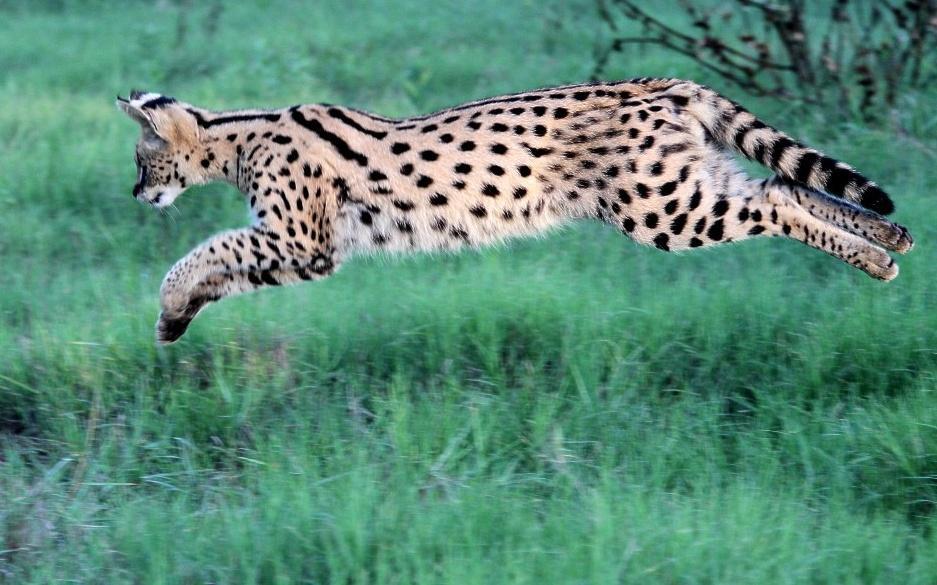
Solitary, crepuscular-nocturnal, territorial. "GAZELLE CAT": LONGEST LEGS in proportion among felines (54-66 cm shoulder!). Giant ears — ultra-sensitive hearing (detects rodents underground/grass). RECORD VERTICAL JUMP 3 m to catch birds in flight. Rodent specialist (90% diet) with 50% hunt success. Monotypic genus. Popular "Savannah cat" domestic hybrids.
Diet
Small mammal specialist. Rodents 90% diet (Otomys, Rhabdomys, Mastomys), birds 5-10% (caught IN FLIGHT with 3 m leaps!), reptiles, amphibians, occasional fish, large insects. Hunting: acoustic search + ear localisation + 1-3 m vertical leap + lethal bite. 50% success (among highest in felines). 8-15 prey/day (1.5-3 kg meat).
The Serval (Leptailurus serval) is one of Africa's most fascinating felids. Widespread in all sub-Saharan savannas, nicknamed the "gazelle cat" for its extraordinary features:
- Longest legs in proportion among all felines: 54-66 cm at shoulder, with body weight only 7-18 kg — highest leg/body ratio among all felids (22-27%)
- Giant ears: 10-12 cm, largest among felines in proportion to skull — ULTRA-SENSITIVE hearing that detects rodents underground/in tall grass
- Record vertical jump: 3 meters in height — to catch birds in flight!
- Rodent specialisation: 90% of diet is small mammals
- 50% hunting success rate: among highest in felines (lions 30%, cheetahs 50%, leopards 38%)
- Monotypic genus: unique in its taxonomy (Leptailurus contains only L. serval)
- "Savannah cat" hybrids: crossing with domestic cats created a popular breed (F1-F4)
IUCN status: Least Concern (LC), but declining regionally in West Africa. Global population: hundreds of thousands of individuals. Distribution: from Mauritania to Ethiopia, from Sahel to South Africa.
Classification and category
Order Carnivora, family Felidae, subfamily Felinae, genus Leptailurus (monotypic). 3 subspecies recognised: L. s. serval, L. s. constantina, L. s. lipostictus. Closest relative: Caracal (in catalogue). Both belong to the Felini tribe, separated ~5 Mya. Can hybridise in captivity. Other close relative: African Golden Cat (Caracal aurata).
Etymology: "Leptailurus" from Greek "leptós" (slender) + "aílouros" (cat). "Serval" from Portuguese "lobo-cerval". Described by Schreber 1776.
Parameters: Weight 7-18 kg (record 23 kg). Head-body 60-100 cm. Shoulder height 54-66 cm (record among felids in body-weight proportion!). Tail 20-45 cm. Longevity: 10-12 years natural, 19-20 captive. Sexual maturity 12-24 months. Gestation 65-75 days. Litter 1-5 cubs (avg 2-3). 1-2 litters/year.
Habitat and distribution
Wide distribution in sub-Saharan Africa. Excluded only from Sahara, dense Congo rainforests, deserts. West Africa: fragmented and declining (subspecies constantina). Central Africa: moderate presence. East Africa: dense populations (Serengeti, Masai Mara, Tsavo). Southern Africa: stable. North Africa: EXTINCT. Habitats: grass savannas (main), wetlands (excellent), montane grasslands up to 3,000 m, gallery forests, Miombo woodland. Avoids deserts, dense rainforest, urban areas.
IUCN: Least Concern. Threats: habitat loss, hunting for fur (illegal trade for fashion coats), persecution (livestock conflict), pet trade for Savannah cat breeding, road accidents, fragmentation. CITES: Appendix II.
Diet
Small mammal specialist. Diet: rodents 90% (Otomys, Rhabdomys, Mastomys), birds 5-10% (catches in flight!), reptiles (lizards, small snakes), amphibians (frogs in wet season), occasional fish, large insects (especially juveniles), occasional small hares, chickens (conflict). 50% hunting success rate — among highest in felines. Technique: acoustic search + ultra-sensitive ear localisation + 1-3 m vertical leap onto prey + nape bite. 8-15 rodents/day consumed (1.5-3 kg meat).
Physical features
UNIQUE silhouette — "gazelle cat". Coat: golden-yellow base with black spots; varieties include "servalina" (tiny spots), "melanistic" (entirely black, 11% in high-altitude E.Africa). Ringed tail with black tip. Head: GIANT ears 10-12 cm (largest among felines, rotate independently 180°), short refined muzzle, yellow-green slanting eyes. Body: ULTRA-LONG hind legs (54-66 cm at shoulder!), unique leg-to-weight ratio among felids, relatively SHORT tail (1/3 of body), long thin neck, slender lightweight body. Speed: 3 m vertical jump record, 3.5 m horizontal jump, 80 km/h sprint. Hearing: most sensitive among felines, up to 64 kHz, detects rodent ultrasounds.
Behaviour and curiosities
Solitary, crepuscular-nocturnal, territorial. Territory 10-30 km² (F), 15-50 km² (M). Polygamous breeding. Gestation 65-75 days. 1-5 cubs (avg 2-3) born in underground dens. Independence 12-18 months. Shy but not timid — hisses defensively when threatened, no fatal human attacks. Main predators: lions, leopards, cheetahs, spotted hyenas, African wild dogs.
Famous curiosities: "gazelle cat" — longest legs in proportion of all felines. Ear specialisation: 30-35% of skull (vs 20-25% in normal cats), rotate 180° independently, detect rodent ultrasounds at 4 m, sensitive up to 64 kHz. 3 m vertical jump record — catches birds in flight! Savannah cat hybrid: 1986 first cross, F1 up to 25 kg, $20,000-30,000 USD, banned in many countries. Melanism: 11% in Mt. Kenya high-altitude (up to 25% above 3,000 m). "Servalina": rare small-spotted variant, single recessive gene. African culture: Egyptian goddess Mafdet, Zulu nobility, Masai initiation. "Chirrup" vocalisation: bird-like chirping in greeting/wellbeing, unique among African felids. "Tallest in proportion": 12 kg Serval = 60 cm shoulder = same as 30 kg German Shepherd. 50% hunt success: among highest in felines worldwide. Fishing behaviour: dips paws to catch fish/frogs/crabs, unusual swimming for cats.
Pros
- Zampe più lunghe in proporzione tra felini al mondo
- Udito più sensibile tra felini (rileva ultrasuoni roditori)
- Salto verticale record 3 m per catturare uccelli in volo
- Tasso caccia 50% tra i più alti tra felini
Cons
- IUCN Least Concern globale, ma in declino in Africa Occidentale
- Caccia per pelliccia e medicina tradizionale
- Cattura per ibridazione Savannah cat
- Persecuzione per predazione polli (causa di morte adulta)