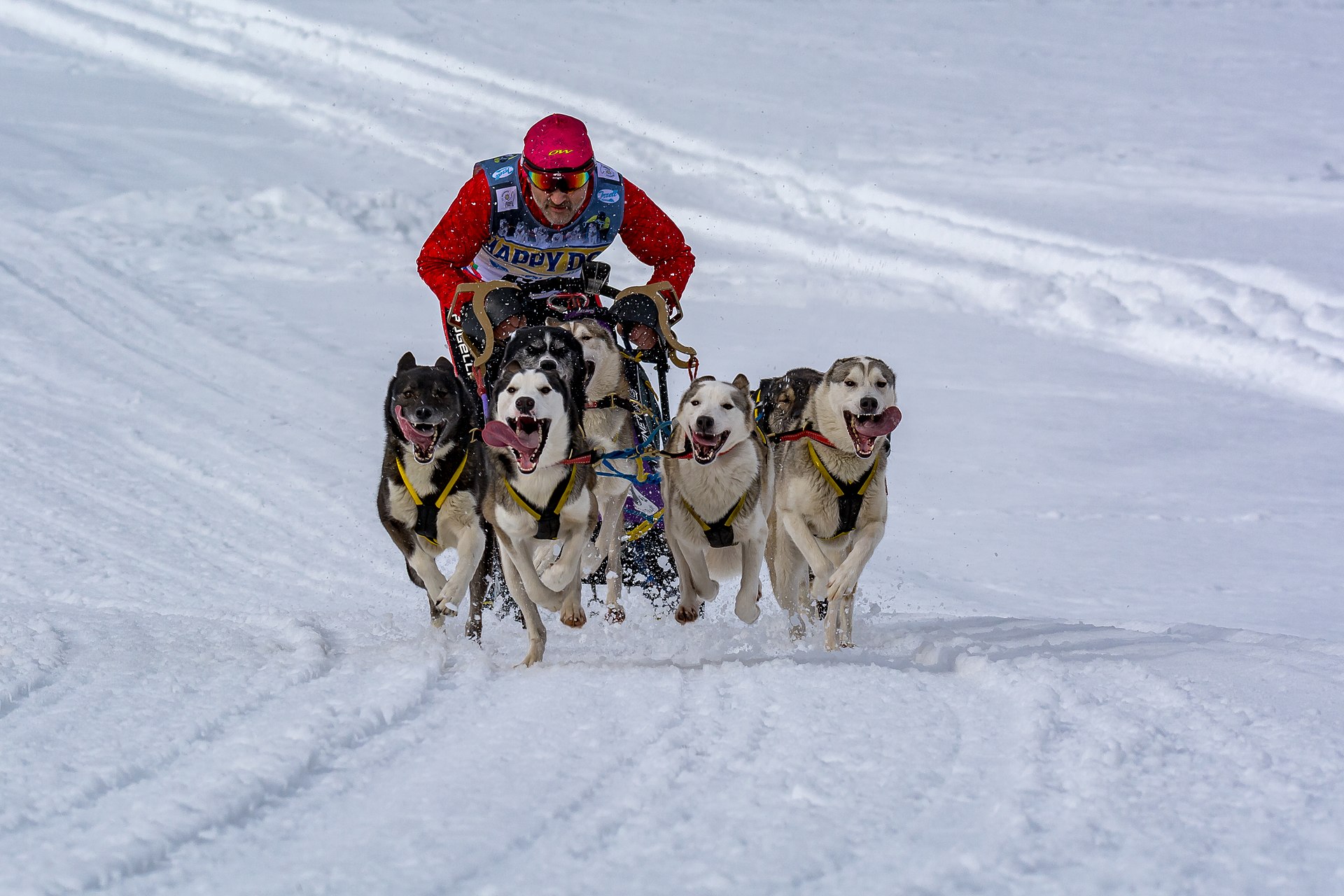
Siberian Husky
Characteristics
Temperament
Sociable, independent, non-aggressive. Poor guard dog but great family/pack companion. Strong migratory instinct: prone to escaping.
Diet
Omnivore with carnivorous tendency. Very efficient metabolism: consumes fewer calories than expected. Kibble with 22-28% protein, 12-15% fat. Double rations in winter for sledding.
The Siberian Husky is a Nordic breed originating from the arctic lands of Siberia. Selectively bred for over three thousand years by the Chukchi people as an all-purpose sled dog, it is today one of the most recognisable breeds in the world thanks to its dense coat, ice-blue (or heterochromic) eyes and its characteristic wolf-like "howl" in place of the classic bark.
Classification and category
The Siberian Husky belongs to the species Canis lupus familiaris, class Mammalia, order Carnivora, family Canidae. It is classified by the Fédération Cynologique Internationale (FCI) in Group 5 (Spitz and primitive type), section 1 (Nordic sledge dogs), standard no. 270. The breed was officially recognised by the American Kennel Club in 1930.
It is a medium-sized dog: males stand 53-60 cm at the withers and weigh 20-27 kg, females 51-56 cm and 16-23 kg. The build is compact, balanced and light in relation to the strength it expresses: the Husky is built to cover long distances at moderate speed, not for raw power.
Habitat and distribution
The breed's geographic origin lies in north-eastern Siberia, in particular in the territory of the Chukchi people, where the Husky was used as a draft dog, hunting dog and companion, indispensable for survival in the extreme conditions of the tundra. In 1908 the first specimens were imported to Alaska for sled-dog racing, where they quickly dominated the sport. The most famous episode is the "serum run" of 1925: a relay of sleds pulled by Huskies, led by the celebrated Balto and Togo, delivered the diphtheria antitoxin to Nome, Alaska, in just five and a half days, saving the town from an epidemic.
Today the Siberian Husky is a breed found worldwide, particularly popular in cold-climate countries (northern United States, Canada, Russia, Scandinavia, Germany) and in sled-dog competitions. It also adapts well to temperate climates, provided its sensitivity to heat is taken into account and fresh water and shaded areas are always available.
Diet
The Siberian Husky is an omnivore with a carnivorous tendency, with a remarkably efficient metabolism: contrary to popular belief, it consumes fewer calories than breeds of similar size, because it was genetically selected to endure long exertion on little food. High-quality kibble with a protein content of 22-28% and good fat intake (12-15%) is recommended, divided into two daily meals.
Individuals engaged in winter sledding may require 40-100% larger rations, with greater emphasis on fats as a concentrated energy source. It is important not to overfeed sedentary Huskies: they tend to eat a lot if given the chance, but they instinctively self-regulate if not forced. Water must always be available, especially in summer.
Physical features
The Siberian Husky has a double coat: a woolly, very dense undercoat that insulates it down to -60 °C, and a longer, water-repellent guard coat. Shedding is impressive: twice a year (spring and autumn) it loses its entire undercoat, leaving woolly tufts everywhere. Many colours are admitted: black and white, grey, red, sable, agouti, piebald, and the rare "all black" or "all white". Facial masks vary enormously and contribute to each dog's individual identity.
The eyes are one of the most fascinating features: they can be ice blue (the most iconic), brown, amber, heterochromic (one eye each colour) or even "parti-eye" (a single eye with two colours). The ears are triangular and erect, the tail is bushy and carried sickle-shaped but never curled over the back. The feet are oval, compact, with tight, slightly webbed toes — perfect for crossing snow.
Behaviour and curiosities
The Siberian Husky is famous for its sociable, independent and non-aggressive temperament. It is not a good guard dog: it tends to welcome anyone entering the home with curiosity rather than wariness. It loves the company of other dogs and thrives in a pack: lone specimens suffer greatly and tend to develop separation anxiety.
It is a dog that "howls" more than it barks: its classic vocalisation, inherited from the wolf, can reach impressive intensities and resemble a deep song. It has a very strong migratory instinct: escaping is the most common behavioural problem. It should never be left off-leash in unfenced areas, because it can run for kilometres without looking back. It loves to dig and to run: without adequate outlet, it can make a garden unmanageable within months. Lifespan is 12-15 years, with generally excellent health; genetic predispositions include some eye conditions (juvenile cataract, corneal dystrophy) and idiopathic epilepsy, now monitored through responsible breeding programmes.
Pros
- Bellezza inconfondibile
- Molto socievole con persone e altri cani
- Resistenza fisica eccezionale
- Non aggressivo, perfetto in branco
Cons
- Energia altissima: serve sport o lavoro quotidiano
- Grande fugace: mai libero in zone non recintate
- Mute spettacolari due volte all'anno
- Soffre il caldo e la solitudine