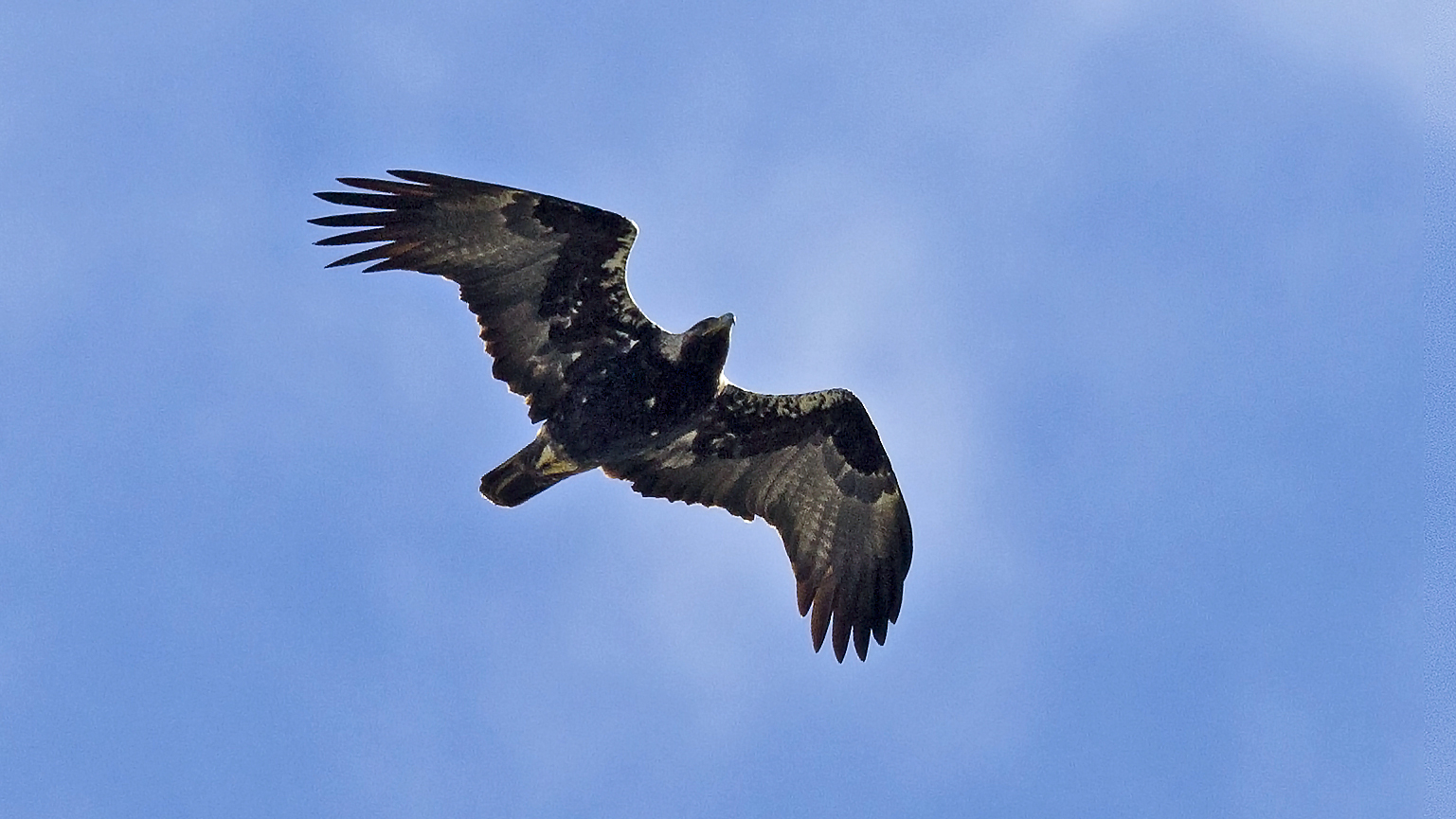
Spanish Imperial Eagle
Aquila adalberti
Characteristics
Temperament
Solitary, diurnal, lifelong monogamous. ENDEMIC Iberian Peninsula. Recognised as distinct species from Eastern Imperial Eagle only in 1995! Diagnostic white "shoulder patches" on scapulars. Apex predator, depends on European rabbit (60% diet). RECOVERY STORY: 50 pairs 1974 → 841 pairs 2023 (+1,682%). IUCN downlisted from EN to VU 2011. "Línea Vida" programme 9,000+ km power lines modified.
Diet
Obligate carnivore, apex. European rabbit 60% diet (main prey, shared with Iberian Lynx). Wild pigeon 10-15%, red-legged partridge 5-10%, Iberian hare 5%, young foxes/badgers occasional, reptiles rare, carrion 5-10%. Hunting: perch + reconnaissance flight + 80-100 km/h dive + talon capture. Requires rabbit density 5-10/ha for breeding territory.
The Spanish Imperial Eagle (Aquila adalberti), known in Spanish as Águila Imperial Ibérica, is a raptor endemic to the Iberian Peninsula — one of the rarest eagles in the world. Main characteristics:
- Endemic to Iberia: exclusively in Spain (mainly Andalusia, Extremadura, Castile, Madrid) and Portugal (smaller population)
- White "shoulder patches": distinctive white spots on the scapulars, visible in flight from below — diagnostic feature
- Wingspan: 1.9-2.2 m (slightly smaller than the Golden Eagle)
- Rabbit dependency: the European rabbit (Oryctolagus cuniculus) constitutes 60% of the diet
- Extraordinary recovery story: 50 pairs in 1974 → 841 pairs in 2023, IUCN downlisted from Endangered to Vulnerable in 2011
- Apex predator of the Iberian Mediterranean — completes the "symbiotic trio" with the Iberian Lynx and the European Rabbit
The Spanish Imperial Eagle is the Spanish national symbol of wildlife conservation. Together with the Iberian Lynx, it represents the two main conservation successes of Spain in the 21st century. IUCN status: Vulnerable (VU) since 2011 — previously Endangered from 1994 to 2011.
Classification and category
The Spanish Imperial Eagle belongs to order Accipitriformes, family Accipitridae, subfamily Aquilinae, genus Aquila. The genus comprises 11 species of "true eagles". The Spanish Imperial Eagle was recognised as a distinct species from the Eastern Imperial Eagle (A. heliaca) only in 1995! Closest relative: Eastern Imperial Eagle (Aquila heliaca). The two species separated 2-3 Mya.
Etymology: "Aquila" from Latin "eagle". "Adalberti" in honour of Adalbert of Bavaria (1828-1875), Bavarian prince and ornithologist who studied Iberian eagles. Described by Brehm in 1861.
Morphological parameters: Weight M 2.5-3.1 kg, F 3.1-4.0 kg. Length 75-85 cm. Wingspan 1.9-2.2 m. Longevity: 20-25 years natural, up to 40+ captive (record 41). Sexual maturity: 4-5 years. Reproduction: 1-3 eggs/year (avg 2). Incubation 42-44 days. Chicks at nest 70-75 days. Total dependence 12-18 months. Juvenile mortality 50-60% first year.
Habitat and distribution
Strictly endemic to Iberian Peninsula. Spain (~95% world population, ~800 pairs): Andalusia, Extremadura, Castile-La Mancha, Castile y León, Madrid. Portugal (~50 pairs, reintroduced from 2003): Alentejo, Trás-os-Montes. Habitats: dehesa (agro-silvopastoral landscapes), Mediterranean forest (oak, pine), macchia, rocky slopes (for nesting), pastures (for hunting). Avoids dense forests, urban areas, intensive monoculture. IUCN: Vulnerable (VU) since 2011 (was Endangered 1994-2011). Population: ~850 pairs (3,000-4,000 mature individuals). Trend: increasing.
Recovery history: 1900 ~2,000 pairs → 1950 ~200 → 1974 NADIR 50 → 1985 100 → 2000 200 → 2010 250 → 2020 500 → 2023 841 (DOUBLED in last 10 years!). Threats: rabbit collapse (Myxomatosis 1950s, RHDV 1980s, RHDV2 2010s — main driver), electrocution on power lines (~25% adult deaths), illegal poisoning, road accidents, dehesa habitat loss, human disturbance. CITES: Appendix I. Conservation: LIFE Adalberti, LIFE Imperial (€18M), "Línea Vida" programme (9,000+ km power lines modified), reintroductions Portugal/Castile-La Mancha/Andalusia, captive breeding, GPS satellite monitoring.
Diet
Apex predator. Diet: European rabbit (60% — main prey, shared with Iberian Lynx), wild pigeons (10-15%), red-legged partridge (5-10%), collared dove (occasional), Iberian hare (5%), young foxes (occasional), young badgers (rare), gentes (occasional), large reptiles (rare), carrion (5-10%). Hunting: perching + reconnaissance flight (300-1,000 m) + visual location (1+ km) + 80-100 km/h vertical dive + talon capture + transport to nest. Requires rabbit density 5-10/ha for breeding territory.
Physical features
Large eagle silhouette. Adult plumage: dark brown/black body, distinctive WHITE SCAPULARS ("shoulder patches" — diagnostic), brown-golden head, cream nape, banded tail (black bands, black tip), brown trousers. Juvenile: uniform reddish-brown, white shoulder patches develop in subadults (3-4 years), definitive plumage after 5th moult. Head: large hooked beak (4-5 cm), yellow cere, yellow/golden eyes. Wings: broad but shorter than Golden Eagle. Talons: posterior 5-7 cm. Tail: medium (30-35 cm), squared. Diving speed 80-100 km/h. Cruise 50-70 km/h. Vision 8× human. Grip ~400 psi.
Behaviour and curiosities
Solitary, diurnal, long-term monogamous (probably lifelong). Pair shares 50-150 km² territory all year. Nests on mature trees (preferred oaks Quercus suber/ilex, pines), rarely rocks. Nest 1.5-2 m diameter, used for decades (record 50+ years). Breeding: courtship Jan-Feb, eggs March, hatch April-May, fledge July, dependent 4-6 months more. Siblicide: first chick may kill second (15-30% nests). Juvenile mortality 50-60% first year.
Famous curiosity: "Iberian Mediterranean trio". Spanish Imperial Eagle + Iberian Lynx + European Rabbit form symbiotic trio. All three coevolved, all dependent on rabbits. "Species recognised 1995": was considered subspecies of Eastern Imperial Eagle until 1995. Closer to Golden Eagle genetically (some mt genes) than morphologically. White shoulder patches: diagnostic, develop only after 4-5 years. Recovery story: 1,682% increase in 50 years. Siblicide: cainism in nests with 2+ eggs. "Línea Vida": 9,000+ km power lines modified to prevent electrocution, 60% reduction in 20 years. Cultural icon: Spanish coins, stamps, WWF/SEO logos. Portugal reintroduction: 2003+, 50 pairs by 2024. Longevity: 25 years natural, 41 captive. Traditional nests: same nest used by successive pairs for 50+ years. Doñana: extinct locally 2002, reintroduced — 5-7 pairs by 2024.
Pros
- Endemica iconica della Penisola Iberica
- Storia di recupero straordinaria (+1.682% in 50 anni)
- Simbolo della conservazione del Mediterraneo iberico
- Primo grande rapace europeo downlistato (EN→VU 2011)
Cons
- Stato IUCN Vulnerable, popolazione ancora fragile
- Dipendenza dal coniglio (vulnerabile a RHDV)
- Elettrocuzione su linee elettriche resta minaccia
- Veleno illegale (carbofuran) ancora utilizzato in alcune zone