Photo: Cephas · CC BY-SA 3.0
Great grey owl
Strix nebulosa
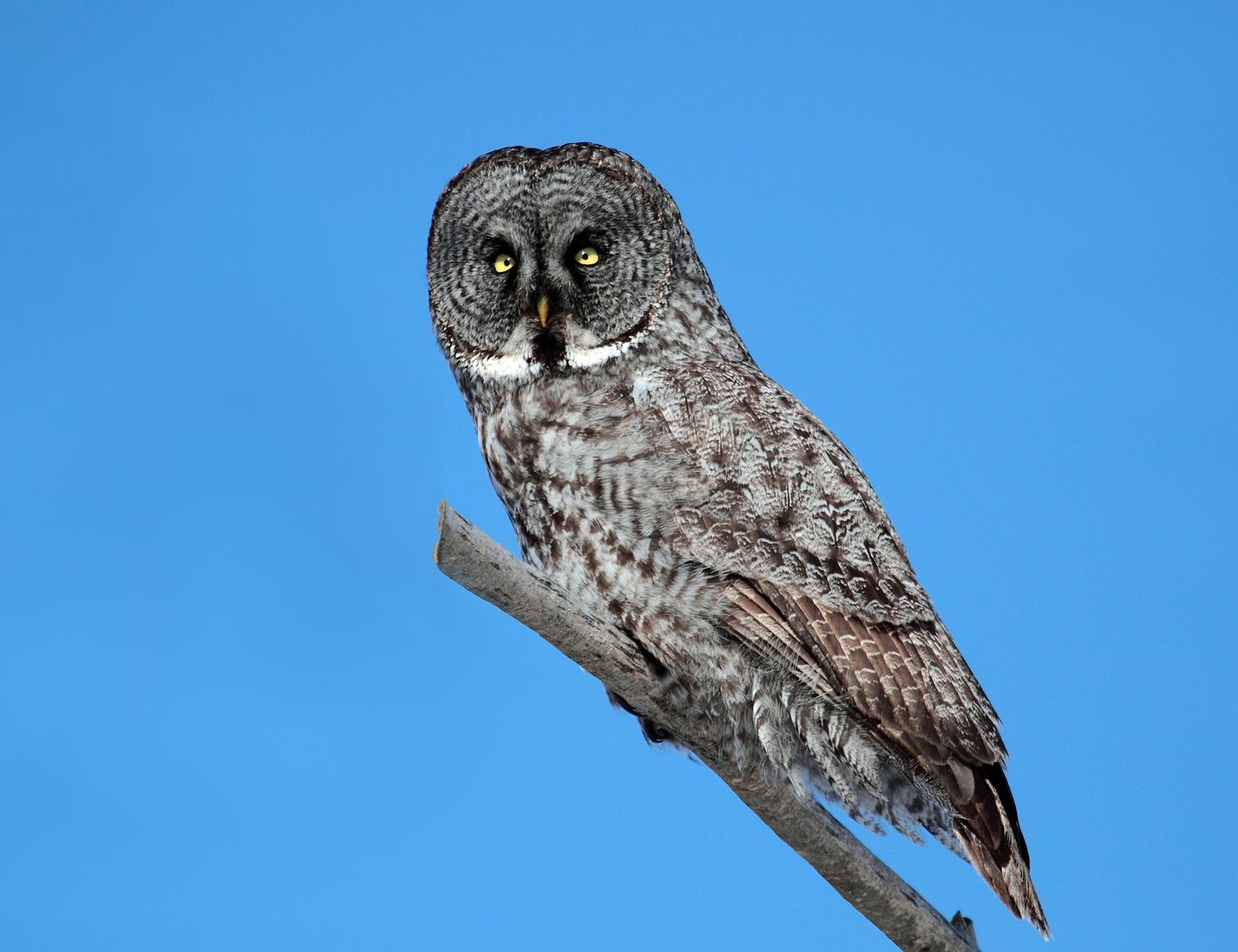
With its enormous grey facial disc and imposing appearance, the great grey owl is the world's largest owl by length, a silent hunter of the boreal forests.
Characteristics
Temperament
Nocturnal, silent, patient hunter
Diet
Carnivore: small mammals, especially voles
The giant of the boreal forests
The great grey owl is the world's largest owl in length, a nocturnal raptor of imposing and solemn appearance. Its most distinctive feature is its enormous grey facial disc, marked with concentric rings that give it a stern, attentive expression. Its eyes, a brilliant yellow, look small in comparison to its large head. Beneath the beak stands out a dark patch resembling a small beard. Despite its considerable size, it is a surprisingly light bird, because much of its bulk is made up of thick, soft plumage that insulates it from the extreme cold.
Habitat and distribution
It lives in the coniferous forests of the boreal belt, across the entire Northern Hemisphere: from Scandinavia and Russia to North America. It is the only species of its genus present in both the Old and the New World. It prefers mature forests at the edges of the tundra, interspersed with clearings and open areas where it can hunt, and it needs large trees and old abandoned nests in order to breed.
Hunting and behaviour
The great grey owl is a patient, silent hunter. It feeds mainly on small mammals, especially voles and other rodents. Its hearing is extraordinarily acute: the large facial disc works like a parabolic antenna, channelling sounds towards the ears. Thanks to this ability it can locate prey even beneath a thick layer of snow, then plunge down and seize it with its talons without seeing it. Its flight, as in many nocturnal raptors, is almost completely silent.
Curiosities
Although it looks enormous, the great grey owl weighs far less than it seems: apparently smaller owls, such as the eagle-owl, are in fact much heavier. Its apparent size is due above all to its voluminous plumage, an essential adaptation to survive the harshest winters.
Conservation
The great grey owl is classified as a species of least concern, with a wide range in the Northern Hemisphere. Its populations can fluctuate according to the availability of rodents, but the species as a whole is not considered threatened. The conservation of the great boreal forests nevertheless remains fundamental for its future.
Pros
- The world's largest owl by length
- Extraordinary hearing to hunt under snow
- Almost completely silent flight
- Wide range and unthreatened populations
Cons
- Depends on large boreal forests
- Populations tied to rodent cycles
- Needs old nests and large trees to breed