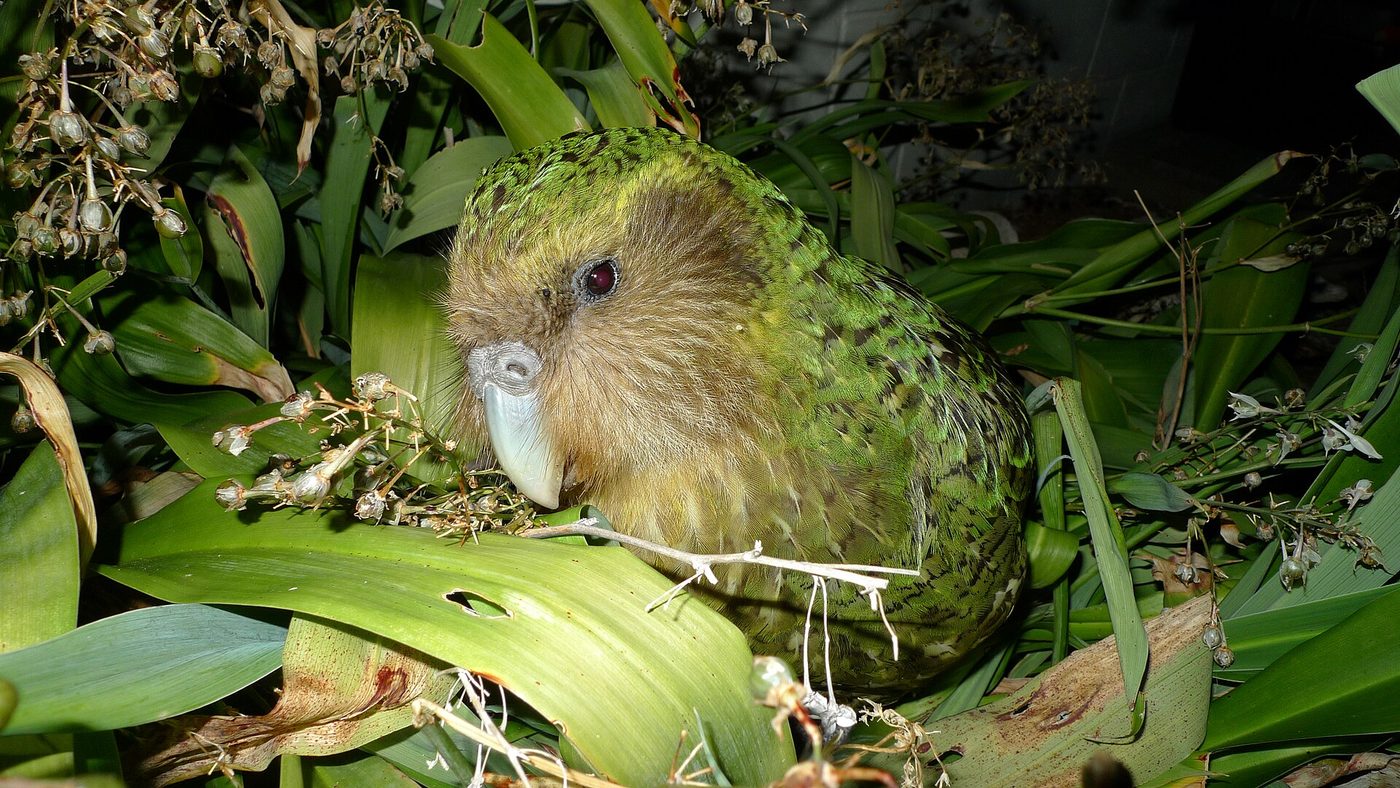
Photo: Department of Conservation · CC BY 2.0
Kākāpō
Strigops habroptila
Large, nocturnal and flightless, the kākāpō is a parrot unlike any other, endemic to New Zealand and among the rarest and most fascinating birds on the planet.
Characteristics
Temperament
Nocturnal, ground-dwelling, trusting
Diet
Herbivore: seeds, fruit, leaves, roots and bark
The parrot that cannot fly
The kākāpō is an extraordinary bird, unlike any other parrot. It is large, with soft plumage of a mossy green mottled with yellow and black, which camouflages it perfectly among the vegetation. Its face has a disc of feathers recalling that of an owl, hence the nickname 'owl-parrot'. It is the only parrot in the world unable to fly: its wings are too small to lift it and are used mainly for balance. It is also the heaviest parrot in existence.
Habitat and distribution
It is endemic to New Zealand, where it was once widespread throughout the country. Today it survives only on a few predator-free islands, where it is protected with great care. It lives in forests and dense vegetation, moving about on the ground and climbing trees skilfully with its beak and sturdy legs.
Behaviour and breeding
The kākāpō is nocturnal and mainly herbivorous: it feeds on seeds, fruit, leaves, roots and bark. It has a breeding behaviour unique among parrots: the males gather in arenas and attract the females by making a deep pulsing call, the 'booming', audible over great distances. Breeding, however, only takes place in certain years, coinciding with the abundant fruiting of certain plants, which makes the species particularly slow to reproduce.
Conservation
The kākāpō is a critically endangered species, one of the rarest birds in the world. Its inability to fly and its trusting nature have made it extremely vulnerable to predators introduced by humans, such as rats, cats and stoats. Reduced to very few individuals, it is today at the centre of one of the most intensive conservation programmes in the world: every single bird is monitored and protected, and the population, though still small, is slowly growing.
Pros
- The only flightless parrot in the world
- Very long-lived, can live for decades
- Unique behaviour and call
- Focus of an intensive protection programme
Cons
- Critically endangered species
- Vulnerable to introduced predators
- Breeds only in certain years