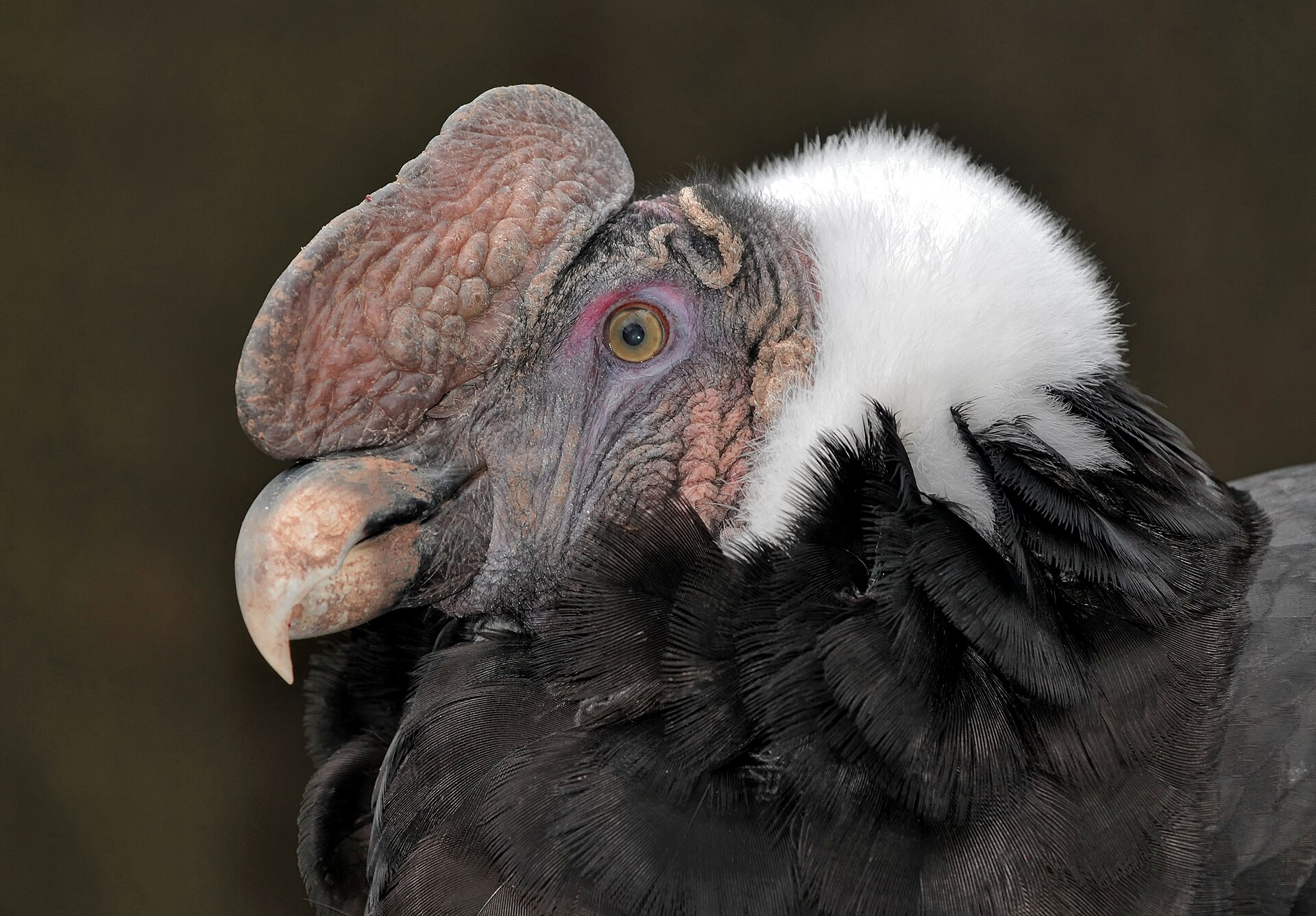
Andean Condor
Vultur gryphus
Characteristics
Temperament
Lifelong monogamous (50-70 years!), diurnal, apex scavenger. Majestic glider: 5 hours without wing beats, up to 7,000 m altitude, 200 km/day. Symbol of 4 South American countries. Sacred to the Incas. 1 egg every 2 years, very slow reproduction.
Diet
Obligate scavenger: carcasses of camelids, deer, livestock, marine mammals. NEVER hunts. Sight 10× sharper. Huge meals (3-5 kg = 20-30% weight). Survives 2 weeks without eating. Sanitary keystone species of the Andes.
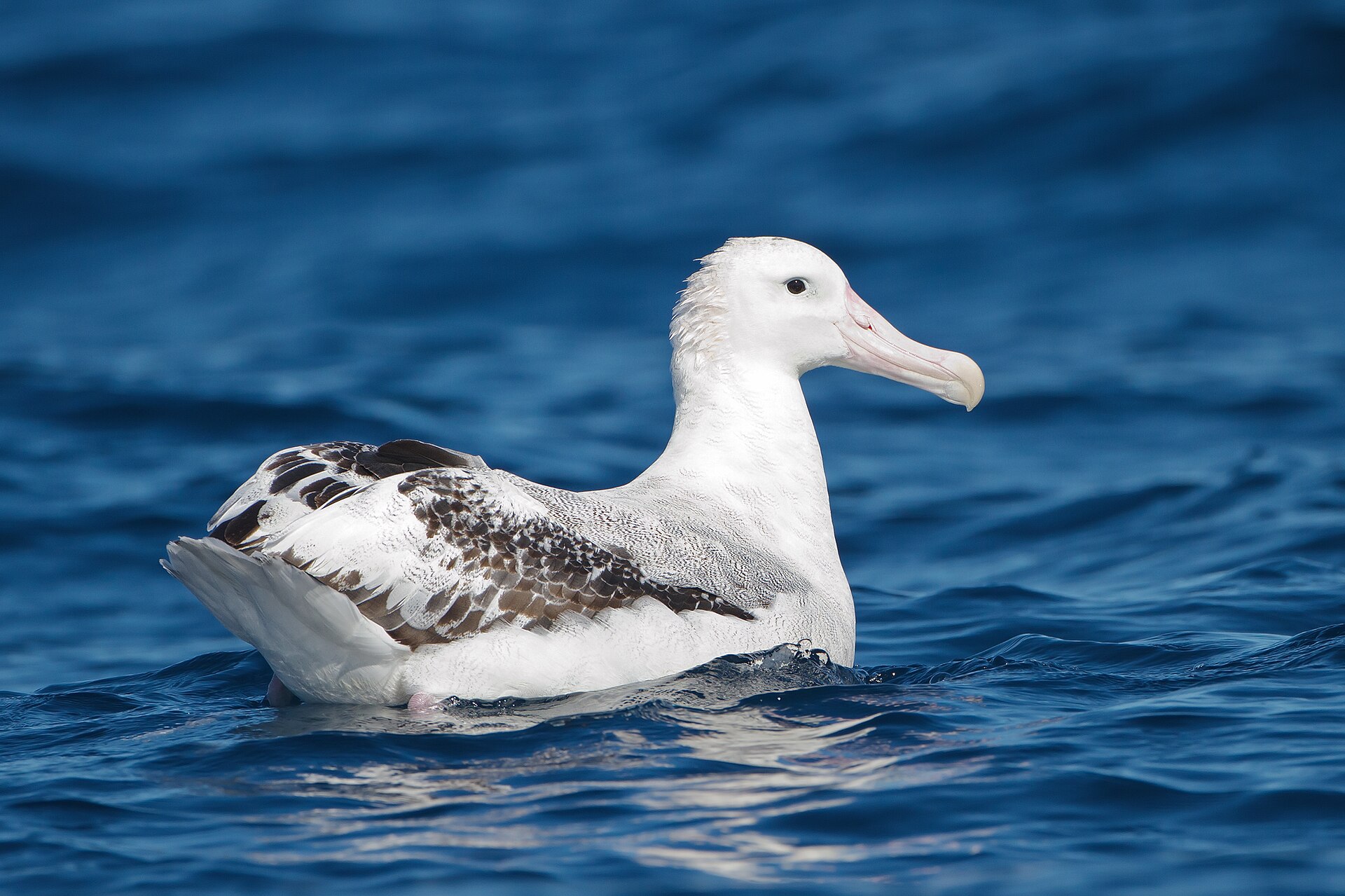
The Andean Condor (Vultur gryphus) is one of the most majestic and symbolic birds in the world: the largest flying bird on the planet by wingspan combined with weight. Its wingspan reaches 3.3 m (record 3.5 m) — comparable to that of the wandering albatross (but the condor is heavier: 11-15 kg vs 8-12 kg of the albatross). It lives exclusively along the Cordillera of the Andes, from northern Venezuela to Patagonia (Argentina/Chile), between 3,000 and 5,000 m altitude (flight record at 7,000 m, among the highest birds in the world). It is a large scavenger raptor: it does not hunt, but feeds exclusively on carcasses of large animals (camelids, deer, cows, dead livestock). Its flight is iconic: it uses thermal currents to glide without beating its wings for hours, covering up to 200 km a day. It is the national symbol of 4 countries: Argentina, Bolivia, Chile, Colombia (together with Ecuador and Peru). IUCN conservation status: Vulnerable (VU) since 2020 (previously Near Threatened), declining by 30% in the last 30 years. The global population is estimated at 6,700 mature specimens.
Classification and category
The Andean Condor belongs to the order Cathartiformes (New World vultures), family Cathartidae (American vultures), monotypic genus Vultur. It is the only species in the genus: its closest relative is the California Condor (Gymnogyps californianus), critically endangered. The Cathartidae are phylogenetically distant from Old World vultures (Accipitridae); the two families evolved independently scavenging behaviour through evolutionary convergence (separated 40-50 million years ago).
The species was scientifically described by Linnaeus in 1758. The genus name "Vultur" derives from Latin "vulture"; "gryphus" from Greek "grypos" (hooked, referring to the beak). The common name "condor" derives from Quechua "kuntur", word used by the Incas to describe the sacred bird of the mountains. There are no recognised subspecies — it is a species with a single genetic population (with slight north-south variations).
Adult dimensions are: body length 100-130 cm, wingspan 270-330 cm (verified record 350 cm, Peru 2010), weight 8-15 kg (males 11-15 kg, females 8-11 kg). Sexual dimorphism is marked in scavenger raptors: males larger and with "caruncle" (fleshy crest) on the head — unique feature, see below. Longevity is exceptional: 50-70 years in nature (one of the longest-lived birds), up to 79 years in captivity (record: "Tao Pan", specimen at the Berlin Zoo, died in 2023 at 79 years and 4 months — the oldest documented captive bird).
Habitat and distribution
The habitat of the Andean Condor is the South American Cordillera of the Andes, along its entire 7,000 km extension. It lives at 3,000-5,000 m altitude (preference), with flight record at 7,000 m (above Aconcagua, the highest mountain in the Andes). It prefers steep slopes, rocky cliffs, canyon walls for nesting and sleeping (in nests located at 80-200 m height on vertical walls, inaccessible to predators). It is found in open habitats: alpine grasslands (puna, paramo), grassy mountains, oceanic coasts (Chilean/Peruvian populations descend to sea level for scavenging carcasses of marine mammals).
The geographical distribution covers the entire Cordillera of the Andes:
- Venezuela north — northern limit (few specimens, declining)
- Colombia — historical population reduced, reintroduction programmes
- Ecuador — ~150 specimens, endangered nationally
- Peru — ~2,500 specimens, substantial population
- Bolivia — ~1,500 specimens, stable alpine populations
- Chile — ~3,500 specimens, largest population in the world, also Chilean Patagonia
- Argentina — ~3,000 specimens, Argentine Patagonia and Argentine Andes
The global population is estimated at 6,700 mature specimens and ~10,000 total (including juveniles) — IUCN 2020 data. The IUCN conservation status is Vulnerable (VU) since 2020 (downgraded from Near Threatened to Vulnerable due to accelerated decline), declining by 30% in the last 30 years. Main threats are: secondary poisoning (carcasses contaminated with lead from hunting rifles, or intentionally poisoned by herders for predator control — a single case can kill 30+ condors that share the carcass, see Mendoza episode 2018: 34 condors dead), collision with power lines (main cause of juvenile mortality), direct persecution (some herders erroneously kill condors considered livestock predators, although they are ONLY scavengers), poaching for body parts (traditional medicine: feathers for amulets, bones for "traditional remedies"), climate change (reduction of mountain thermal currents). Conservation programmes: Andean Condor Recovery Project (Argentina, Bolivia, Peru), Buenos Aires Zoo (captive breeding programme since 1991, over 100 condors reintroduced), CITES Appendix I since 1973.
Diet
The Andean Condor is an obligate scavenger: it feeds exclusively on carcasses of large animals. It NEVER hunts live prey (very rare documented exceptions). The diet includes: camelid carcasses (vicuña, guanaco, llama, alpaca — both wild and domestic), deer (huemul, taruka), domestic livestock (cows, horses, sheep — also only carcasses, not live), beached marine mammals (seals, sea lions, whales — Chilean and Peruvian coastal populations), carcasses of other large birds. Occasionally, desperate young condors may attack newborn camelid cubs (~5% of observations — it is not organised hunting).
The feeding strategy is characteristic:
- Visual search: the condor flies high (1,000-3,000 m above ground) using thermal currents, for hours. Sight is exceptional (10× sharper than ours), can spot a 1 m carcass at 5 km distance. Does NOT use smell (unlike Old World vultures: condor olfactory lobes are reduced).
- Descent in circles: having located a carcass, it descends in wide circles, alternating wing beats with glides.
- Inspection: before landing on the carcass, it flies above it for 10-30 minutes to verify there are no live predators that might attack. It is an essential survival behaviour.
- Hierarchical feeding: often multiple condors arrive; they feed in hierarchical order (larger males eat first). Interesting social piece: young condors wait for the adults, learning from their experience.
- Huge meals: a condor can consume 3-5 kg of meat in a single sitting (20-30% of body weight). Afterwards, it is almost unable to fly for hours. Sometimes it partially vomits the prey to be able to fly in emergencies.
Food requirement is only 500-1,000 g of meat per day (average). The slow metabolism allows the condor to survive up to 2 weeks without eating. Often it feeds 1-2 times/week on a large meal. Ecological function: the condor is a sanitary "keystone species" of the Andes: it rapidly removes carcasses of large animals (5-10 condors consume a 400 kg cow in 8-12 hours), preventing the spread of diseases (anthrax, tuberculosis, parasites). Its local disappearance causes accumulation of carcasses and increase of diseases in domestic mammals.
Physical features
The Andean Condor has a massive, robust body, optimised for long-duration gliding flight. Dimensions: body length 100-130 cm, wingspan 270-330 cm (record 350 cm), weight 8-15 kg, height of standing condor 1.2 m. It is the second heaviest flying bird in the world (after the great bustard Otis tarda, 18 kg), but with the largest wingspan in proportion to weight.
The head and neck are completely bare (without feathers) — adaptation for scavenging: feathers would get dirty with blood during feeding. The bare skin of the head is dark pink-red, with the ability to change colour rapidly: during excitement, fear, or mating, the head can become intense pink, purple or almost black in seconds (change based on blood flow).
The caruncle (fleshy crest) is a unique feature of the adult male: a wrinkled fleshy protuberance on the upper part of the skull, 5-10 cm long. The female does NOT have the caruncle — the most visible sexual dimorphism. The caruncle grows with age; older specimens have larger and more prominent caruncles. Function: sexual signal (females prefer males with large caruncles), status indicator in the group.
The eyes are reddish-brown, large (3 cm in diameter). Sight is 8-10× sharper than ours: can spot a 1 m carcass at 5 km distance. The beak is massive, strongly hooked, 9 cm long, light horny-grey in colour, perfectly designed to tear flesh from carcasses. It is able to cut mammal skin 1 cm thick. The nostrils are completely perforated (unique among New World raptors): you can look through the beak from one nostril to the other. Function: hygiene (reduces accumulation of blood, meat parts).
The plumage of adults is almost completely black with metallic blue-green reflections. The upper wing coverts are white: a band of white feathers on the upper part of the wings — diagnostic feature visible in flight. The "collar" around the neck is composed of soft white feathers (woolly collar). The wings are long, wide, with "fingers" at the tips (10 primary feathers separated to reduce turbulence at the tips — reduce energy consumption by 30%). The juvenile feathers are uniform brown; adult plumage develops slowly at 5-7 years. The legs are robust, dark grey in colour, with claws relatively weak for a raptor (condors do not grab live prey — claws are functionally atrophied, similar to those of a chicken rather than an eagle). Flight: the condor is an excellent glider: uses thermal currents to rise (without flapping wings for 1-3 consecutive hours!), then glides for kilometres. Cruising speed: 80 km/h; maximum speed in dive: 130 km/h. Average daily distance: 200 km, record 320 km in 24 hours.
Behaviour and curiosities
The Andean Condor is a lifelong monogamous, social at feeding sites, territorial at nests animal. Monogamy lasts the entire life (50-70 years): one of the longest relationships in the animal kingdom (comparable only to long-lived humans!). Pairs form at 5-6 years and maintain the bond until one of them dies. Partner fidelity is documented by genetic paternity studies.
The nest is located on vertical walls at 80-200 m height on rocky walls, in natural caves or inaccessible ledges. The female lays 1 SINGLE EGG every 2 YEARS (extremely slow reproduction — limits recovery capacity after crises). Incubation lasts 55-60 days, conducted by both parents in turn. The chick is born covered in soft white down, completely dependent. Slow development: at 6 months the young condor flies for the first time; it remains with the parents for 1-2 years (parents gradually cease to feed it). Sexual maturity is reached at 5-6 years in females, 6-7 in males — among the slowest in birds.
"Roosting" behaviour is very social: 10-100 condors can sleep together on the same rocky walls ("communal roosts"), gathering at sunset. The social hierarchy is complex: larger and older males occupy higher positions; younger ones the lower. During the meal: older males eat first, followed by females, then juveniles.
Famous curiosities: the condor is the national symbol of 4 countries: Argentina, Bolivia, Chile, Colombia. It appears on national shields (Bolivia, Colombia, Chile, Ecuador), banknotes, stamps, coins. In Inca mythology, the condor was one of the sacred animals of the "Three Realities": the condor represented the celestial realm (Hanan Pacha), the puma the terrestrial realm (Kay Pacha), the serpent the underworld realm (Uku Pacha). The Condor-Puma-Serpent trinity is still today a spiritual symbol of Andean populations. Historical curiosity: the "Capture of the Condor" ("Yawar Fiesta") was a traditional Andean ceremony: during independence celebrations (e.g. July 28 in Peru), a captured living condor was tied on the back of a bull and made to fly to the sky after symbolic combat (condor = Andean indigenous population, bull = Spanish oppressors). Today it is a controversial practice but still observed in remote Andean communities. Ethological curiosity: condors are among the most intelligent birds: they use tools (throw stones from high altitude to break eggs of other birds), have exceptional spatial memory (remember where seasonal carcasses are), and show mourning (visit corpses of dead partners for days). Health curiosity: lead from hunting bullets is the main cause of condor mortality: ingested through carcasses of animals shot by hunters, causes lead poisoning (saturnism) leading to death in 2-3 weeks. "Lead-free ammunition" programmes are active in many South American countries to reduce this threat. Record curiosity: the highest flight documented of a bird is 11,300 metres by an African white griffon over Mali in 1973 (not condor, but comparable); for the condor, the record is 7,000 m on Aconcagua, 2017. The longest time in the air documented is 5 hours without a wing beat for a Chilean condor (NatGeo, 2014) — phenomenon called "dynamic soaring", uses thermal currents to remain suspended.
Pros
- Più grande uccello volatore al mondo (3,5 m apertura alare)
- Longevità eccezionale: 50-70 anni natura, 79 in cattività
- Simbolo nazionale di 4 paesi (Argentina, Bolivia, Cile, Colombia)
- Uccello sacro nella mitologia Inca (trinità Condor-Puma-Serpe)
Cons
- Specie Vulnerabile IUCN (solo 6.700 esemplari maturi)
- CITES Appendice I: detenzione vietata
- Riproduzione lentissima: 1 uovo ogni 2 anni
- Molto minacciato da piombo (carcasse contaminate da munizioni)