Photo: Diego Delso · CC BY-SA 4.0
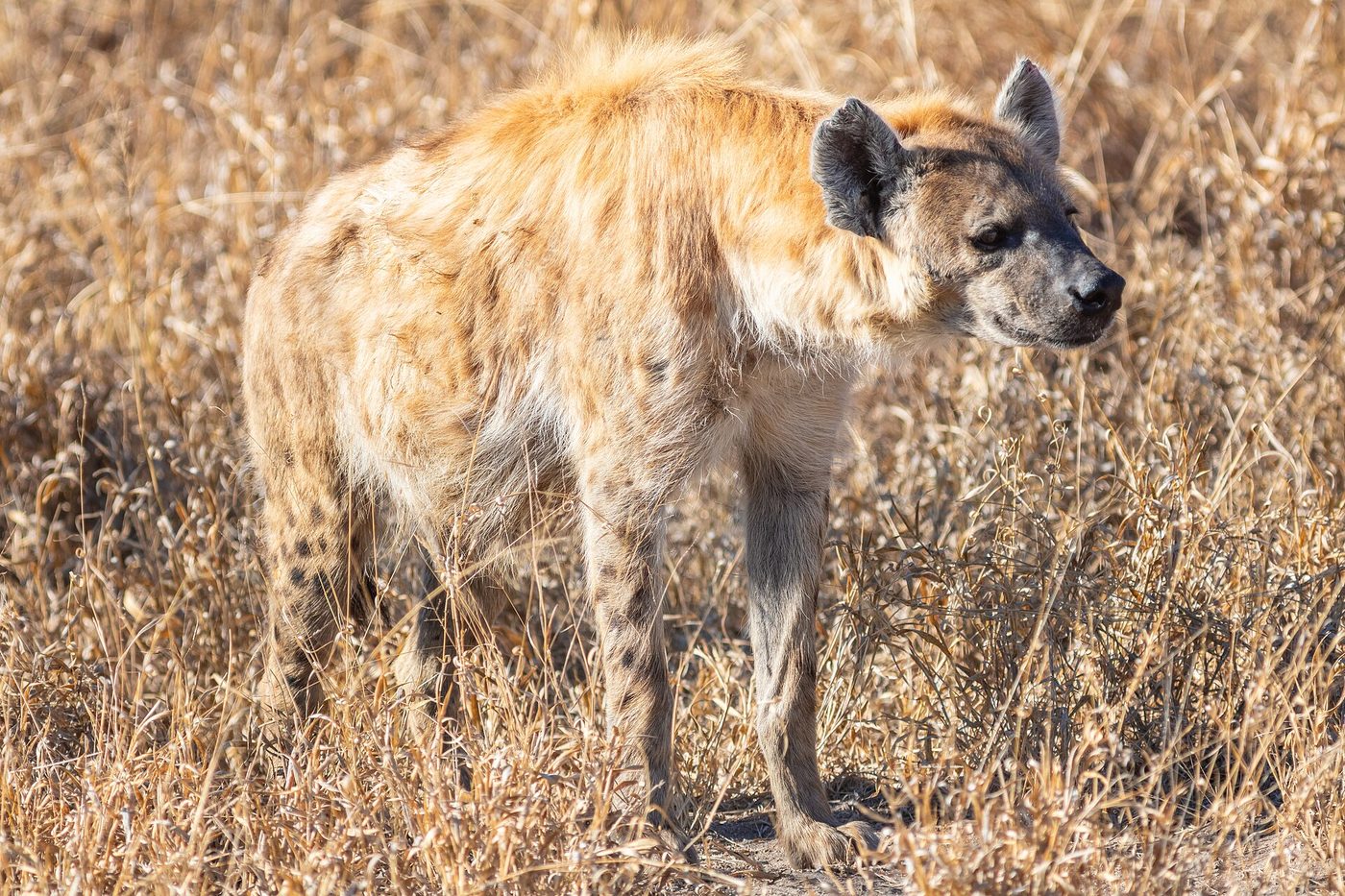
Spotted hyena
Crocuta crocuta
Intelligent, social and with an immensely powerful bite, the spotted hyena is a skilful hunter of the African savanna, with a society led by females.
Characteristics
Temperament
Social, intelligent, an active group hunter
Diet
Carnivore: hunts prey and uses carcasses
An intelligent, social predator
The spotted hyena is the largest and best-known member of the hyena family. It has a sturdy body, with a more developed front part and shorter hind legs, which give it a characteristic, slightly sloping gait. Its coat is a tawny-greyish colour, dotted with dark spots that give it its name. It is equipped with extraordinarily powerful jaws and teeth, among the strongest of land mammals, capable of crushing even the largest bones.
Habitat and distribution
It lives across much of sub-Saharan Africa, from savannas to grasslands, from scrublands to semi-desert areas. It is an adaptable animal, occupying different environments as long as they offer prey and open spaces. It is among the most widespread and successful carnivores of the African continent.
Social behaviour
Contrary to a widespread idea, the spotted hyena is not merely a scavenger: it is in fact an active, efficient hunter, obtaining much of its food by hunting in a group. It lives in large, complex clans, with a sophisticated social structure led by the females: in spotted hyenas, indeed, the females are generally larger and dominate the males. The clan communicates with a wide repertoire of calls, including the famous 'laugh', which serves to signal excitement or submission.
Curiosities
The spotted hyena is considered one of the most intelligent animals among social carnivores, with cognitive abilities that allow it to cooperate and solve problems. Its powerful digestive system allows it to make full use of carcasses, including bones and parts other predators cannot use, thus also playing a valuable 'cleaning' role in the environment.
Conservation
The spotted hyena is classified as a species of least concern and its populations are on the whole large. However, locally it can suffer from habitat loss, conflicts with humans and persecution due to prejudice and bad reputation. Understanding its ecological role is important for a balanced coexistence and for its protection.
Pros
- Skilful, social hunter, very intelligent
- Bite among the most powerful of land mammals
- Valuable 'cleaner' of the ecosystem
- Populations on the whole stable
Cons
- Victim of prejudice and bad reputation
- In conflict with humans in some areas
- Locally threatened by habitat loss