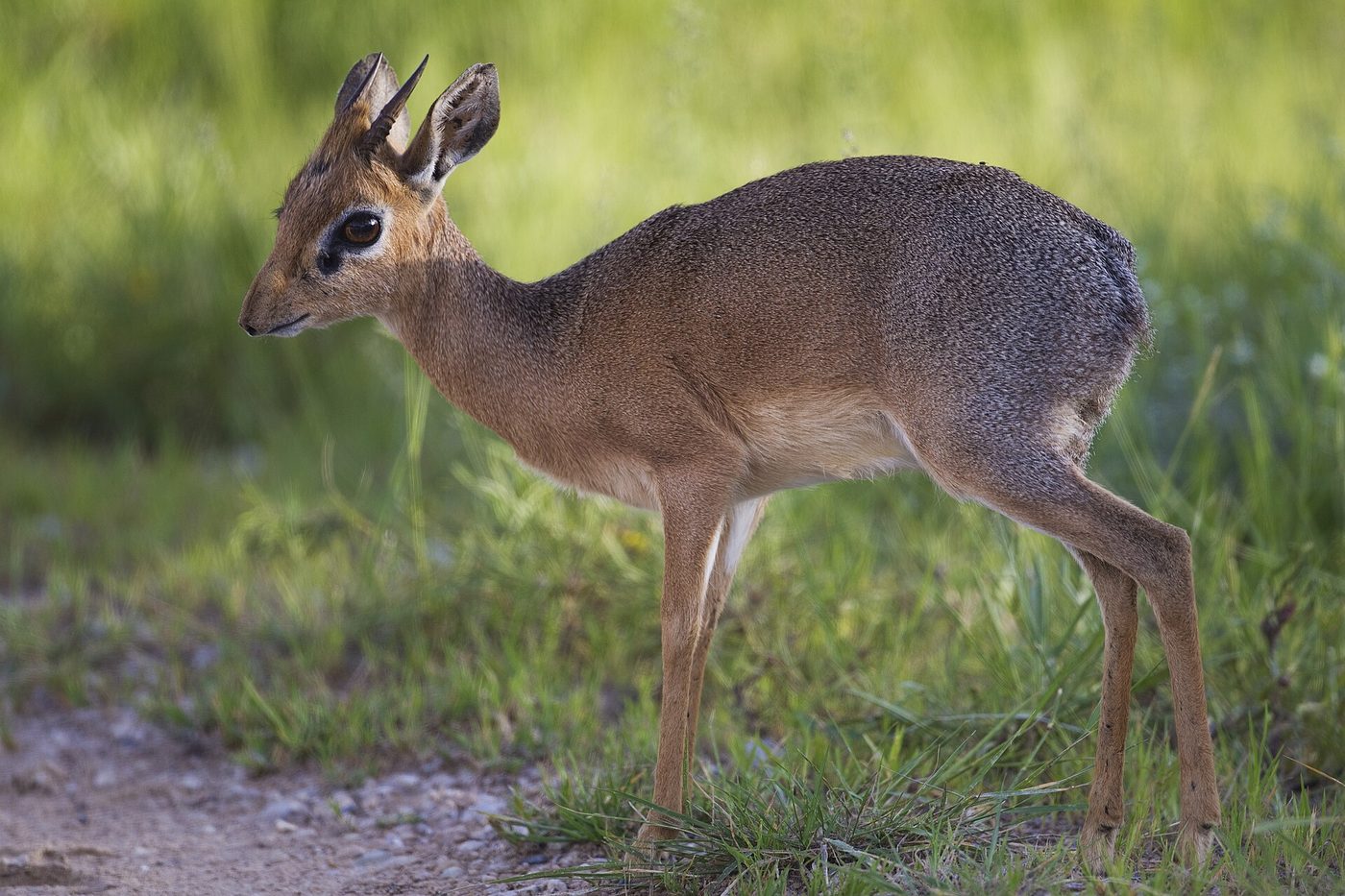
Photo: Yathin S Krishnappa · CC BY-SA 3.0
Kirk's dik-dik
Madoqua kirkii
Kirk's dik-dik is one of the world's smallest antelopes: a tiny African bovid with large eyes and an elongated, trunk-like snout.
Characteristics
Temperament
Shy and monogamous; quick and always alert.
Diet
Selective browser: leaves, shoots, fruit and tender flowers.
A miniature antelope
Kirk's dik-dik (Madoqua kirkii) is one of the smallest antelopes on the planet: barely 40 cm tall at the shoulder and around 70 cm long, it usually weighs between 2.5 and 6 kg. (Note: the body-mass value listed on Wikidata, 677.5 kg, is clearly an error — this is an animal of just a few kilograms.) Its fawn-grey coat camouflages it in the savannah, and it has large, prominent eyes and an elongated, mobile snout — almost a small trunk — that helps cool its blood and reduce water loss. Only the males bear short, spiky horns, often partly hidden by a tuft on the forehead.
Habitat and range
It lives in bushy savannah and arid country across East and southwestern Africa, from Somalia and Kenya to Namibia. It favours dense scrub and dry ground, where low vegetation provides both food and cover from predators.
Behaviour and diet
It is a selective browser, feeding on leaves, shoots, fruit and tender flowers, and draws much of the water it needs from its food — it can go long periods without drinking. It lives in monogamous pairs that defend a territory, marking it with glandular secretions. When disturbed it flees in zig-zag dashes, reaching up to 42 km/h, and gives a distinctive alarm call — "dik-dik" — from which it takes its name.
Did you know?
Its long-term pair bonds and fidelity are unusual among antelopes. In the wild it typically lives about 5 years but may exceed 10; in captivity, individuals of 16–18 years have been recorded.
Conservation
The IUCN lists it as Least Concern. It is still widespread across much of its range, though hunting and habitat loss are local pressures in some areas.
Pros
- One of the world's smallest antelopes
- Draws water from its food, drought-resistant
- Faithful, territorial monogamous pairs
Cons
- A wild animal, unsuited to domestic captivity
- Sensitive to loss of the scrub it hides in
- Locally hunted in some areas