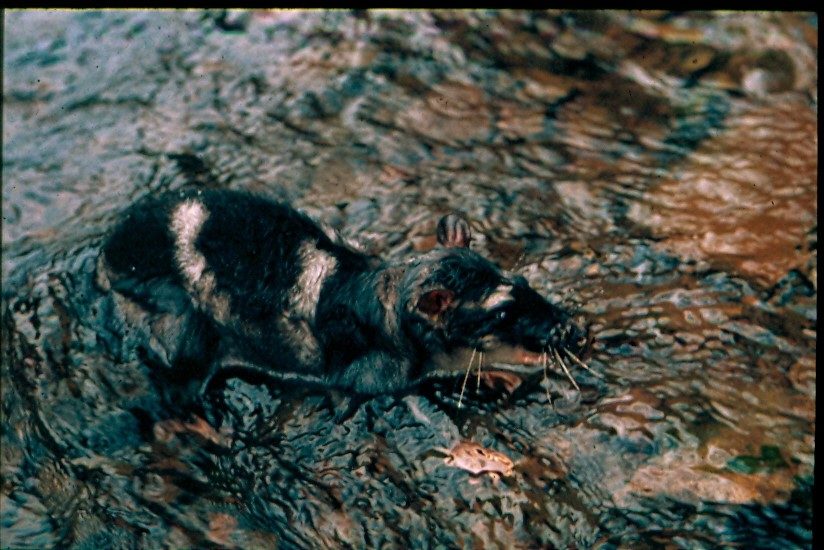
Photo: Enrique González · CC BY 4.0
Water opossum
Chironectes minimus
The only truly aquatic marsupial, the water opossum swims the rivers of Central and South America with webbed feet and a watertight pouch that shields its young underwater.
Characteristics
Temperament
Nocturnal, solitary, semiaquatic
Diet
Carnivore: fish, crayfish, crustaceans, aquatic insects
The marsupial that swims
The water opossum, or yapok, is a small marsupial about the size of a rat, weighing around 600–790 grams.
(Note: the mass value given by Wikidata, 697 kg, is plainly wrong for an animal of this size; its true weight is a little under a kilogram.)
It has a banded grey-and-black coat, a long prehensile tail and, above all, webbed hind feet that make it the marsupial best adapted to aquatic life. It is the only living marsupial in which both sexes have a pouch.
Habitat and distribution
It lives along freshwater rivers, streams and lakes, from Mexico through Central and South America to Argentina. It is closely tied to clean, well-oxygenated water, where it finds its prey.
Behaviour and hunting
It is nocturnal and semiaquatic: by day it rests in burrows dug along the banks, and by night it dives to hunt fish, crayfish, crustaceans and aquatic insects, which it seizes with its sensitive forepaws. It swims with powerful strokes of its webbed hind feet, using its tail as a rudder.
A watertight pouch
The female's pouch has a strong muscular ring that closes tightly, sealing the young in a watertight pocket while the mother swims and dives: the babies stay dry even underwater. The male also has a pouch, into which he can withdraw his scrotum to protect it while swimming.
Conservation
The IUCN lists the water opossum as Least Concern, thanks to its wide range. It does depend on water quality, however: pollution and the destruction of riverside strips threaten its populations locally.
Pros
- The only truly aquatic marsupial
- Watertight pouch that protects young underwater
- Wide range, not threatened
Cons
- Depends on clean, well-oxygenated fresh water
- Not a pet: highly specialised wild needs
- Elusive and hard to observe