Photo: Original: cliff1066™ · CC BY 3.0
Pink fairy armadillo
Chlamyphorus truncatus
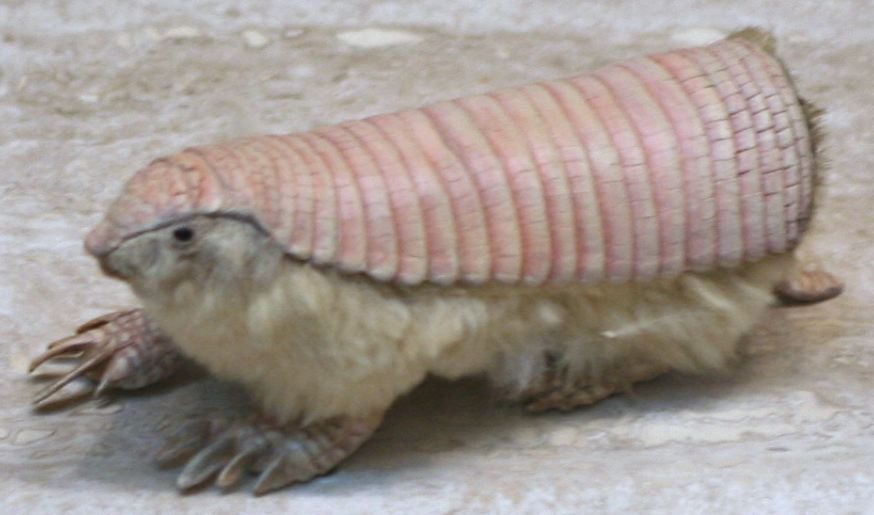
The world's smallest armadillo, the pink fairy armadillo lives buried in Argentina's sands and wears a rosy shell through which its blood flow shows.
Characteristics
Temperament
Solitary, nocturnal, fossorial and shy
Diet
Omnivore: ants, larvae, worms, roots
The smallest of the armadillos
The pink fairy armadillo is the smallest known armadillo: barely 9–12 cm long and weighing about 120 grams, it fits comfortably in one hand. Its appearance is unmistakable: the body is covered in soft white fur and topped by a thin dorsal shell of a delicate pink colour. The pink hue is not a pigment but the result of blood vessels showing through the translucent shell, which also plays a role in temperature regulation. The forelimbs bear large spade-like claws suited to digging.
Habitat and distribution
It is endemic to the arid zones and sandy scrublands of central Argentina. It lives almost entirely underground, in tunnels it constantly digs, and is therefore rarely seen at the surface. Its shy, subterranean nature makes it difficult to study.
Behaviour
It is a skilled "sand-swimmer": it moves through the loose soil by pushing it aside with its powerful front claws and compacting it with its flattened, armoured rear, which it uses like a piston. It feeds mainly on ants, larvae, worms and other invertebrates, but also on roots and plant matter. It is solitary and mostly active at night.
Curiosities
The blunt, armoured rear — the source of the scientific name "truncatus" — is used to seal the burrow entrance, plugging it like a cork. Extremely sensitive to stress, this animal survives very poorly in captivity, which is why it should never be taken from the wild.
Conservation
The IUCN lists the species as Data Deficient: its underground life and the rarity of sightings prevent any precise estimate of its numbers. Potential threats include agriculture, domestic predators and illegal collection.
Pros
- The smallest armadillo in the world
- Unique and fascinating pink shell
- Extraordinary adaptation to life under the sand
Cons
- Survives very poorly in captivity: must not be taken
- Hard to study, uncertain conservation status
- Highly sensitive to stress