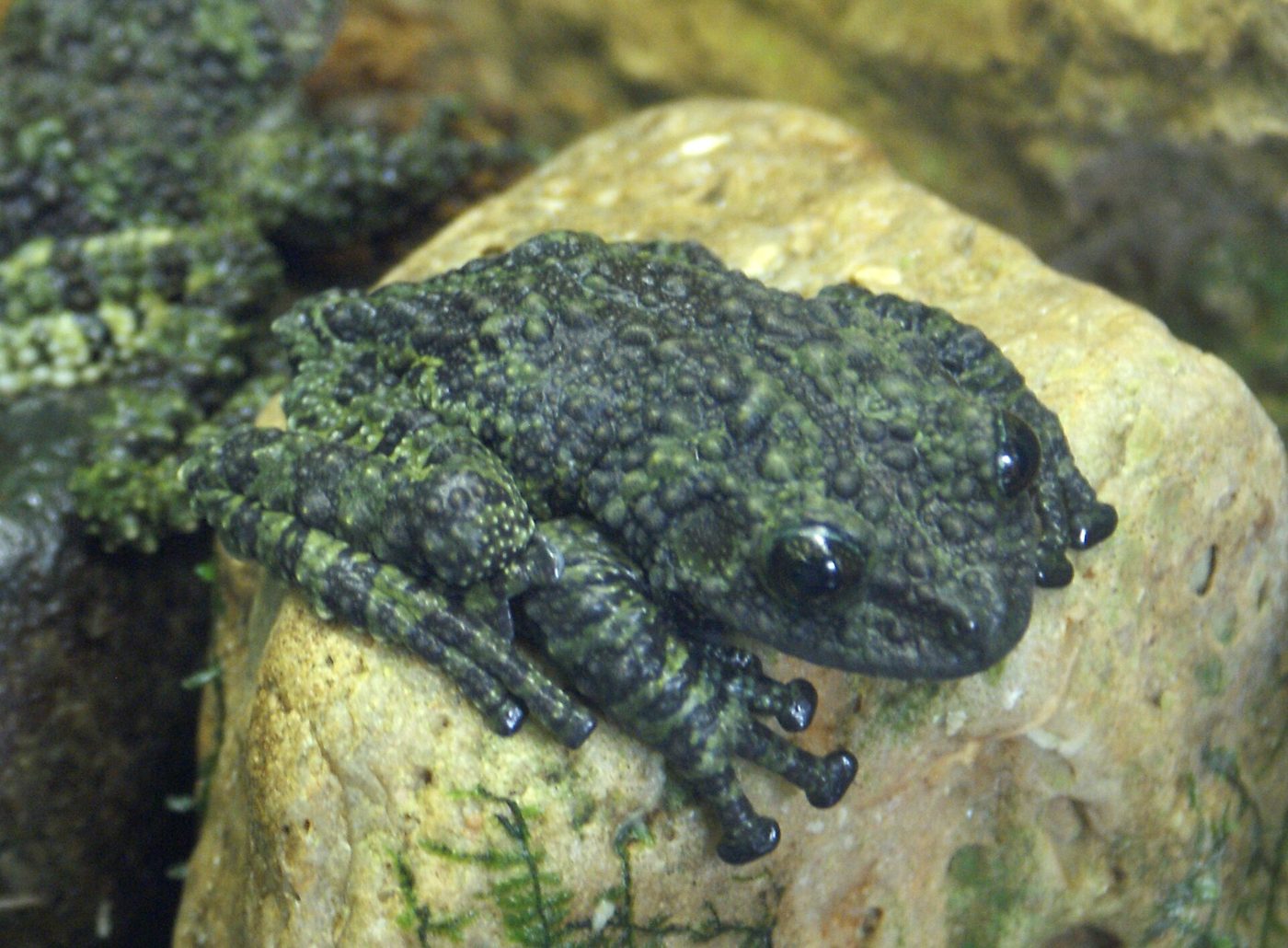
Photo: TimVickers · Public domain
Vietnamese mossy frog
Theloderma corticale
A small Asian frog with warty green-and-brown skin, the Vietnamese mossy frog blends perfectly with the moss and lichen of damp rocks.
Characteristics
Temperament
Nocturnal, shy, semiaquatic, climbing
Diet
Insectivore: insects and small invertebrates
A frog disguised as moss
The Vietnamese mossy frog is a small amphibian of striking appearance: its skin is covered in tubercles, warts and ridges of green, brown and black that mimic a cushion of moss and lichen with astonishing accuracy. This camouflage is so effective that, motionless on a vegetation-covered rock, the animal becomes practically invisible. When disturbed, it can also curl up into a ball and play dead, heightening the illusion of being just a tuft of moss.
Habitat and distribution
It lives in the humid montane forests of northern Vietnam, south-central Laos and southern China, often near streams, caves and dripping rock walls. It is closely tied to water and to cool, moist environments.
Behaviour
It is nocturnal and semiaquatic: an excellent climber and swimmer, it spends much of its time clinging to rocks near the water or partly submerged. It feeds on insects and other small invertebrates that it hunts at night. It lays its eggs on surfaces above water, so that the tadpoles, on hatching, drop into the pool below.
Terrarium care
It is prized by amphibian enthusiasts for its unique look. It needs a humid, cool paludarium with clean water, rocks and vegetation to climb and hide in. It is a relatively delicate species, suited to keepers already experienced with tropical amphibians.
Conservation
The IUCN lists the species as Least Concern. Collection for the terrarium trade and loss of forest habitat can nonetheless affect populations locally.
Pros
- Extraordinary camouflage with moss and lichen
- Unique and fascinating appearance
- Good climber and swimmer
Cons
- Delicate species: needs a cool, humid paludarium
- Not suited to terrarium beginners
- Sensitive to water quality