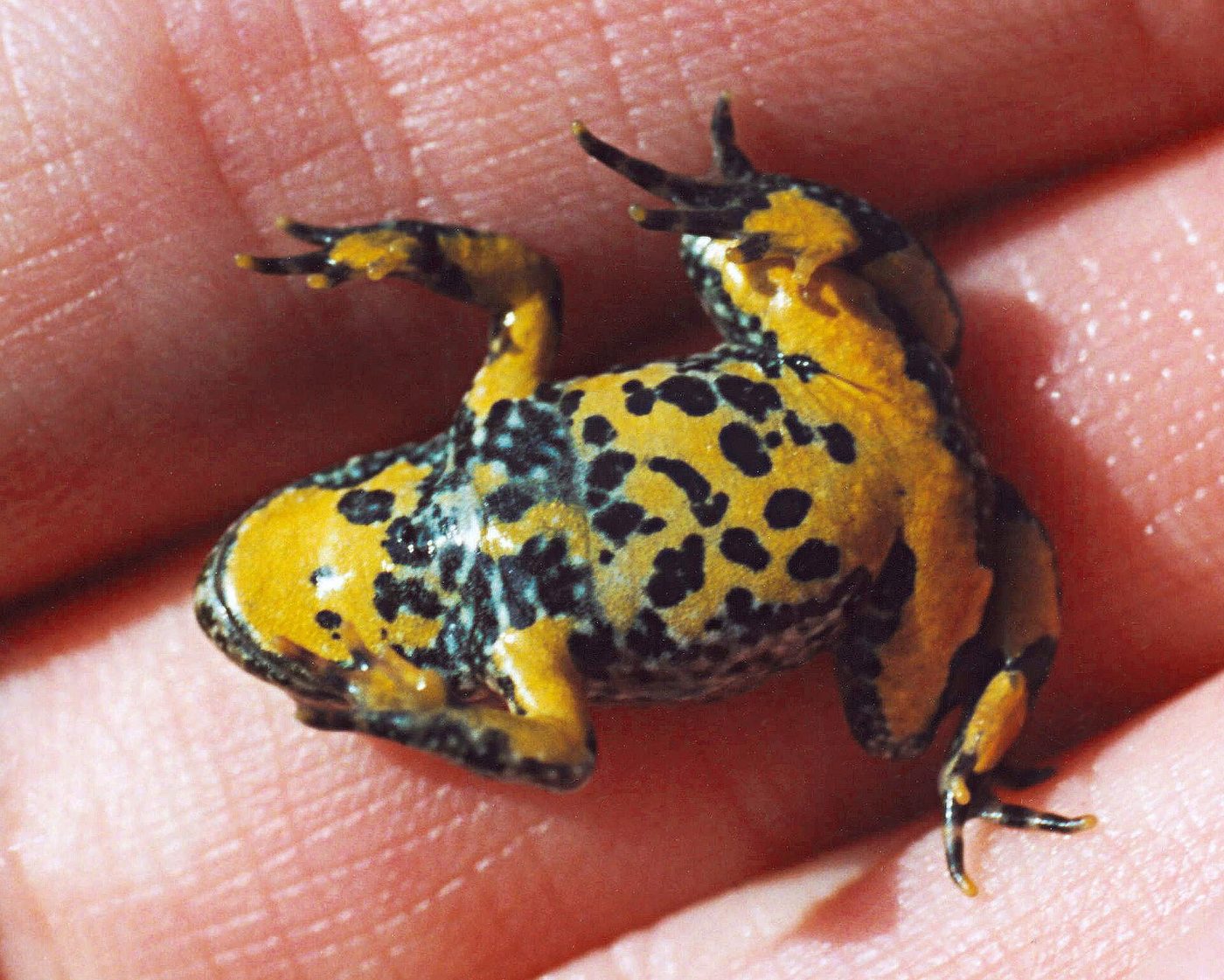
Photo: Christian Fischer · CC BY-SA 3.0
Yellow-bellied toad
Bombina variegata
The yellow-bellied toad is a small amphibian with a camouflaged back and a vivid yellow-and-black belly it flashes as a warning when threatened.
Characteristics
Temperament
Diurnal, tied to small water bodies
Diet
Carnivorous: insects, worms and small invertebrates
The yellow belly that warns predators
The yellow-bellied toad is a small anuran amphibian of the family Bombinatoridae, among the most "primitive" of the frogs. Its warty, brown-grey back is perfectly camouflaged in mud. But its real hallmark is the belly: bright yellow or orange, marbled with black, a clear aposematic signal. The pupil has a characteristic heart or triangle shape.
Habitat and range
It is widespread across much of western Europe and a few countries in eastern Europe, often in hilly and mountain areas. It favours small, temporary aquatic habitats: muddy pools, ruts, flooded tracks, troughs and ephemeral ponds, often poor in predators and rich in sunlight.
Behaviour and defence
Its most famous defence is the so-called unken reflex: when threatened, it arches its back and lifts and turns out its limbs, showing the yellow-and-black markings of the belly and the soles of the feet. At the same time, its skin secretes toxic, irritant substances. The male's call is a soft, rhythmic "oo…oo", from which its Italian name (ululone) derives.
Notable facts
The pattern of yellow markings on the belly is unique to each individual, like a fingerprint, and is used by researchers to identify single animals. It is a long-lived species: in the wild it can exceed twenty years.
Conservation
The species is listed as Least Concern by the IUCN, but populations are in slow decline in many regions due to the loss of small temporary pools. In some countries, such as Germany, targeted conservation programmes are in place.
Pros
- Spectacular unken-reflex defence
- Yellow-black belly warning unique to each individual
- Very long-lived for a small amphibian
Cons
- Skin with toxic, irritant secretions
- Declining due to loss of temporary pools