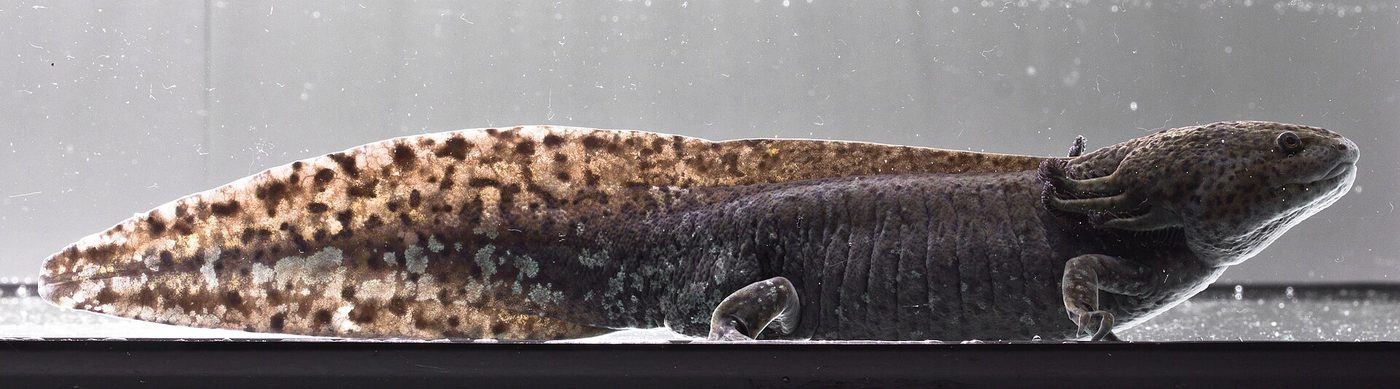
Photo: Mariblubb · CC BY-SA 4.0
Axolotl
Ambystoma mexicanum
With its eternal smile and feathery gills, the axolotl is an extraordinary amphibian: it stays 'young' all its life and can regenerate whole limbs.
Characteristics
Temperament
An aquatic amphibian, calm and mostly nocturnal. Solitary; it keeps its larval traits for life and has extraordinary regenerative abilities.
Diet
Carnivore: small invertebrates, worms and larvae, sucked in with a quick suction of the mouth.
The salamander that never fully grows up
The axolotl is a salamander native to Mexico, famous for its unusual and fascinating appearance. It has a tapered body, four slender legs, a long fin-like tail and, above all, three pairs of feathery external gills that fan out on either side of the head like a crown. Its wide, upturned mouth gives it an expression resembling a perpetual smile. Its colour ranges from the wild olive-brown to the pale pink or white of bred specimens.
An eternal 'youth'
The axolotl's most extraordinary feature is neoteny: unlike most amphibians, which change from aquatic larvae into terrestrial adults, the axolotl keeps its larval traits for life, including its external gills, and never leaves the water. It reaches sexual maturity while remaining, in a sense, at the 'tadpole' stage. It is as if a frog stayed a tadpole forever, while still becoming adult and able to breed.
The master of regeneration
The axolotl possesses an ability that fascinates scientists all over the world: it can regenerate lost body parts with unique precision. If it loses a leg, it grows a new one, complete with bones, muscles and nerves, without scars. It can regenerate not only limbs, but also parts of the heart, the eyes and even the brain. This is why it is one of the most studied animals in research on tissue regeneration.
An inhabitant of vanished lakes
In the wild the axolotl lives only in a small area of Mexico, the canals and lakes that once surrounded the ancient Mexico City. It feeds on small invertebrates, worms and larvae, which it sucks in with a quick suction of the mouth.
Conservation
The axolotl is classified as critically endangered and is nearly extinct in the wild. Its natural habitat has been almost completely destroyed by urban expansion, pollution and the introduction of predatory fish. Paradoxically, while it risks disappearing in the wild, the axolotl is bred all over the world in aquariums and laboratories. Saving the wild populations remains a crucial challenge.