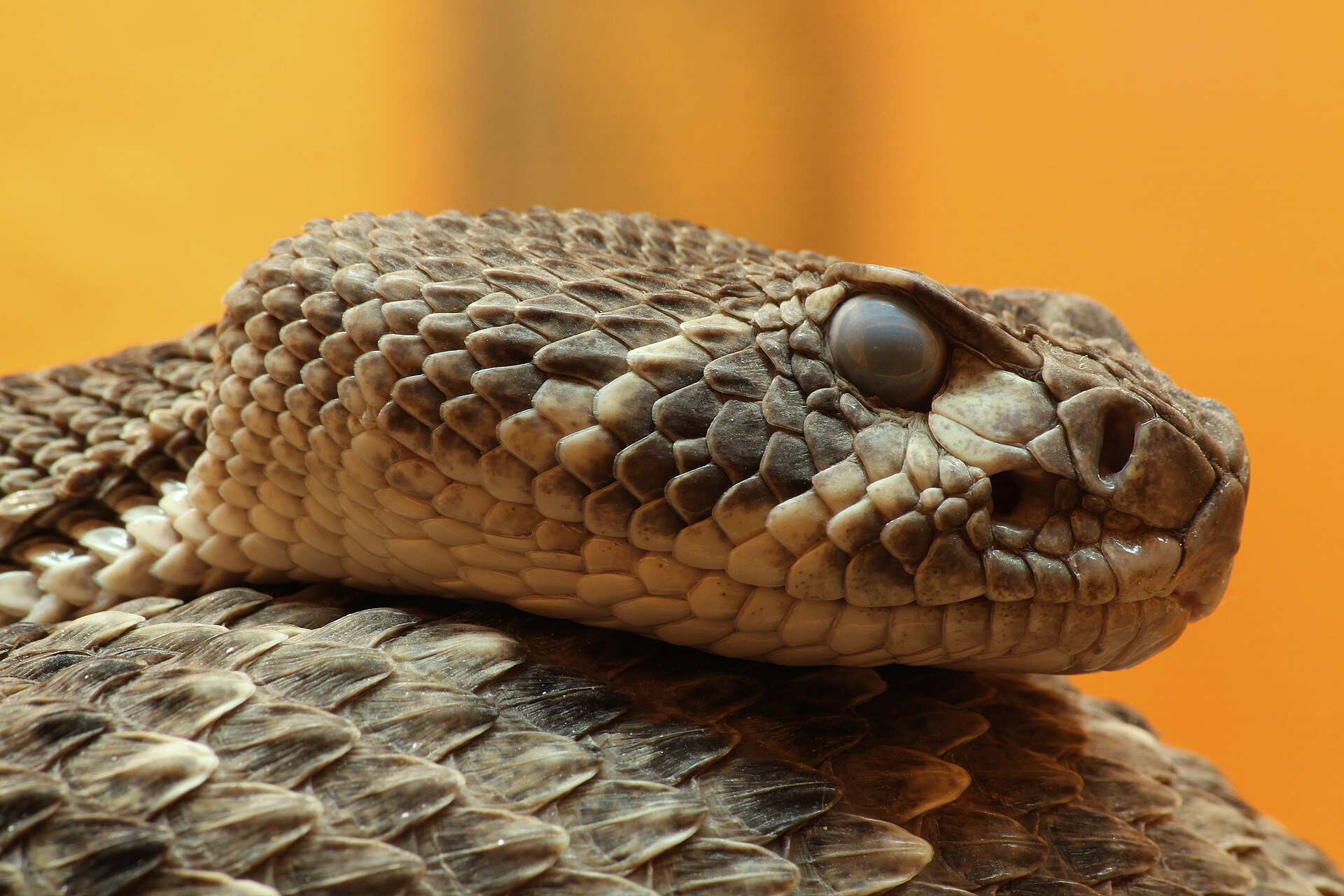
Western Diamondback Rattlesnake
Crotalus atrox
Characteristics
Temperament
Solitary, nocturnal-crepuscular, ectothermic. Pit viper with caudal rattle (warning signal). Bite speed 2.5 m/s (fastest vertebrate movement). Powerful hemotoxic venom (1-2% mortality with antivenom).
Diet
Strict carnivore: rodents (cotton rats, deer mice, rabbits, gerbils, kangaroo rats), ground birds, lizards. Ambush hunting: 2.5 m/s bite speed. Only 1-2 prey/month. Survives 2 years without eating.
The Western Diamondback Rattlesnake (Crotalus atrox), also known as the Texas Rattlesnake, is one of the most iconic and symbolic venomous snakes of North America. It belongs to the Viperidae family (vipers) and to the Crotalinae subfamily (pit vipers, equipped with thermo-sensitive organs between eyes and nostrils). It is famous for the characteristic "rattle" on the tail, formed by keratinous segments that vibrate producing the famous "rattle" — a sonic warning to discourage predators. Widespread in the south-western United States and northern Mexico, it is the most deadly rattlesnake in the USA: responsible for about 30% of annual venomous bites on the continent. It weighs 2-7 kg, average length 120-180 cm (record 213 cm). Its venom is a powerful hemotoxin that destroys tissues, but with modern antivenoms human mortality is 10-20%. The species is classified as Least Concern (LC) by IUCN, but very popular in western films and frontier legends.
Classification and category
The Western Diamondback Rattlesnake belongs to the order Squamata, suborder Serpentes, family Viperidae, subfamily Crotalinae, genus Crotalus. The genus comprises about 36 species of "rattlesnakes", all endemic to the Americas; C. atrox is one of the largest and most widespread. The genus name derives from Greek "krotalon" meaning "rattle"; the species name "atrox" means "fierce, cruel" in Latin. The species was scientifically described by Spencer Fullerton Baird and Charles Frédéric Girard in 1853 based on specimens collected in western Texas and northern Mexico. Dimensions: average length 120-180 cm, verified record 213 cm (Big Bend National Park, Texas, 1970); weight 2-7 kg in adults, with a record of 8.2 kg. Sexual dimorphism is reduced: males and females have similar dimensions. Longevity is 15-20 years in the wild, 25-30 years in captivity documented.
Habitat and distribution
The habitat of the Western Diamondback Rattlesnake consists of deserts, semi-arid prairie, juniper woodlands, rocky cliffs, canyon banks. It tolerates extremely hot and dry environments: optimal body temperature 27-32°C; can withstand 40°C but actively seeks shade in such conditions. It prefers rocky hiding places for refuge and thermoregulation, and openings in the ground for the small burrows. It also adapts to agricultural and urban areas where human presence has reduced natural predators: in Texas, Arizona, New Mexico, urban encounters are frequent (gardens, garages, cellars, swimming pools).
The geographical distribution covers the South-West of the United States (Texas, Oklahoma, New Mexico, Arizona, southern Colorado, south-eastern California, southern Nevada, southern Utah, Arkansas) and northern Mexico (Sonora, Chihuahua, Coahuila, Tamaulipas, Nuevo León, San Luis Potosí, Querétaro, Hidalgo). It is found up to 2,000 m of altitude on the mountains of the Texas Hill Country. The total population is estimated at millions of specimens; the species is classified as Least Concern (LC) by IUCN since 2007. Threats include: habitat loss due to urbanisation, intentional killings for fear or for the "Rattlesnake Roundup" (popular events in Texas and Oklahoma where thousands of specimens are captured and killed each year for their skins and tourist festivals), road kill (the main cause of mortality in Arizona), skin trade (for cowboy boots, belts, accessories), hunting for meat (eaten in some US states). Despite the threats, the species is only locally declining.
Diet
The Western Diamondback Rattlesnake is a strict carnivore, primarily a nocturnal-crepuscular predator. The diet is composed mainly of small mammals: cotton rats (Sigmodon), deer mice (Peromyscus), rabbits (Sylvilagus), ground squirrels, gerbils, kangaroo rats, prairie dog pups. It also eats ground-dwelling birds (quail, pheasants, gallinaceous birds), lizards (large species such as Sceloporus), occasionally bird eggs. Young adults consume mainly lizards and small rodents; large adults specialise in rodents and rabbits. Food requirements are low: an adult consumes 1-2 prey per month (vs. daily doses in mammalian predators) thanks to slow ectothermic metabolism.
The hunting technique is ambush: the snake hides in a strategic position (near rodent paths, at water sources, under rocks), waits for hours or days, and attacks with a lightning venomous bite. Bite speed is 2.5 m/s, the fastest movement ever documented in a vertebrate. After the bite, the rattlesnake releases the prey (to avoid suffering defensive blows) and follows the olfactory trace through the forked tongue and Jacobson's organ (vomeronasal palatine organ), finding the dead prey after 5-30 minutes. The venom is a powerful hemotoxin composed of: metalloproteinases (degrade tissues, blood vessels), phospholipase A2 (destroy cell membranes), serine-proteases (coagulate and then anti-coagulate the blood), vasoactive peptides. A single lethal dose is 10-15 mg (of 250-700 mg producible per bite). Effects on humans: intense pain, massive swelling, tissue necrosis, internal haemorrhages, shock, renal failure. Digestion is extraordinarily slow: a 200 g prey is digested in 5-7 days; bones are completely dissolved by gastric acids. The snake can survive over 2 years without eating (in captivity with stress).
Physical features
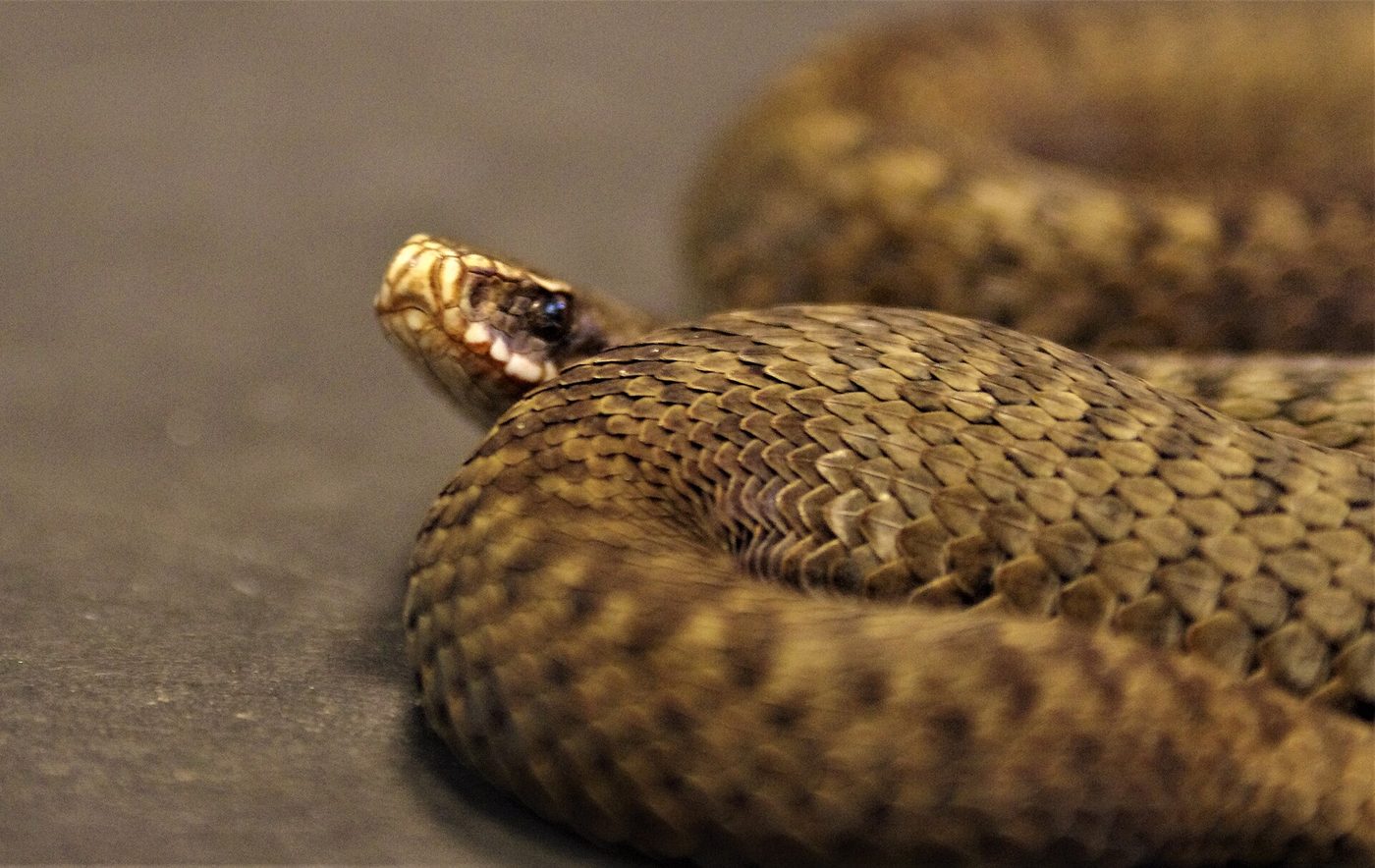
The Western Diamondback Rattlesnake has a robust, cylindrical, muscular body, with triangular section in some points. The length in adults is 120-180 cm (record 213 cm). The weight of large adults is 2-7 kg. The head is triangular, wide, well distinct from the neck — characteristic of vipers. The muzzle is rounded, with wide scales on the eyebrows that give a "frowning" appearance. The teeth include 2 retractable fangs 1-2 cm long, similar to hypodermic needles, connected to venom glands; when the snake does not attack, the fangs are folded against the palate.
The scaly coat is the most recognisable feature: base colour grey-brown, brown-yellowish or reddish (varies with the environment), with 32-44 "diamond"-shaped spots (rhombus) on the back, of darker colour bordered by a light line, hence the name "Diamondback". The tail ends with 2-8 alternating black and white rings ("racing" rings), pattern unique among South-West rattlesnakes. Everything culminates in the rattle: a keratinous structure composed of interconnected hollow segments at the end of the tail. The snake is born with a single "prebutton"; with each moult (3-4 times a year in the young, 1-2 times a year in adults) a new segment is added at the base. When the snake vibrates the tail (50-100 Hz), the segments collide producing the characteristic "rattle" similar to a shower, audible at 30 metres. An adult rattlesnake can have 10-15 segments, but they frequently break. Loreal pits: between the eye and the nostril there are two thermo-sensitive pits, thermoreceptor organs capable of perceiving thermal variations of 0.003°C — seeing the "heat" of warm-blooded prey in the dark. The pupils are vertical and elliptical (typical of nocturnal snakes). The eye colours are yellowish-grey. The forked tongue collects odour molecules from the air; when withdrawn into the mouth, it inserts them into the palatine Jacobson's organ to "smell" in stereo.
Behaviour and curiosities
The Western Diamondback Rattlesnake is a solitary, nocturnal-crepuscular, ectothermic animal. During the day it hides under rocks, in abandoned burrows of other animals, in crevices. It is mainly active in the evening and at night in summer (to avoid high temperatures), while in spring and autumn it is also active during the day. For thermoregulation it warms up in the sun in the morning and then seeks shade. When temperature drops below 10°C (in winter) it enters brumation (the reptile analogue of hibernation): it gathers in communal dens ("hibernacula") often used by dozens of other rattlesnakes and different snake species for generations. Hibernacula are always in the same place (inherited), and snakes return there every year guided by pheromones.
Reproduction is in spring (March-May). Males fight ritually for the right to mate: they rise vertically, intertwining their bodies, and try to throw the rival to the ground (combat called "combat dance"). They do not bite each other. After mating, the female carries the embryos internally for 6-7 months (ovoviviparous development): she gives birth to live young directly (4-25 cubs at a time) in summer-autumn. The young are 25-35 cm long at birth, already venomous (in fact, some studies suggest they are more toxic than adults due to higher concentration), and completely self-sufficient. The mother provides no parental care (exception among Viperidae: some species yes). Sexual maturity: 3-4 years.
Famous historical and cultural curiosities: the Western Diamondback Rattlesnake is one of the most iconic symbols of the American Southwest and Texas. It appears in the historic "Don't Tread On Me" flag (1775, American Revolutionary flag by Christopher Gadsden) — one of the most famous political symbols in US history. Rodeo curiosity: the "Rattlesnake Roundup" is an annual event in Texas (Sweetwater since 1958, the largest, ~6,000 snakes captured per year) and Oklahoma. Considered a traditional rural sport, it is today controversial: animal rights activists denounce the cruelty (the snakes are killed, skinned alive in some cases), while supporters emphasise the role of population control in rural areas. Ethological curiosity: the rattlesnake never attacks first unless approached at 50-100 cm. The majority of bites (70%) occur during: attempt to catch the snake, accidental trampling (in gardens or construction sites), children playing near rocks. Prevention strategies: do not walk barefoot in Texan prairies, do not insert hands under rocks or logs, wear high boots, make noise while walking. Neuroscientific curiosity: the bite speed of rattlesnakes is extraordinary: 2.5 m/s — faster than a human eyelash blink (0.3 sec); it is the fastest voluntary movement ever documented in a vertebrate. Medical curiosity: modern antivenom (CroFab, produced from sheep) has been available in all US Southwest hospitals since 2000. Rattlesnake bite mortality has dropped to 1-2% of serious incidents (vs. 25% before 1900). Intervention time: antivenom must be administered within 6-12 hours of the bite. Linguistic curiosity: in Texas the rattlesnake is also called "buzztail" or "buzz-worm", reference to the sound. The term "rattlesnake" dates back to 1620 (Captain John Smith, Virginia). Curiosity about the evolution of the rattle: the evolutionary origin of the rattle is debated. Hypotheses include: (1) evolution from a caudal vibration mechanism already present in other snakes as a warning, (2) adaptation to discourage large herbivores (bison) that could trample snakes at pasture, (3) sexual selection of males.
Pros
- Simbolo iconico del Sud-Ovest americano (bandiera 'Don't Tread On Me')
- Velocità di morso più rapida nei vertebrati (2,5 m/s)
- Longevità eccellente (15-30 anni)
- Importante regolatore delle popolazioni di roditori
Cons
- Veleno emotossico altamente pericoloso per l'uomo (mortalità 10-20% senza antiveleno)
- Detenzione privata vietata o regolamentata strettamente in molti Paesi
- Responsabile del 30% dei morsi venenosi annuali in USA
- Vittima del 'Rattlesnake Roundup' (~6.000/anno solo a Sweetwater Texas)