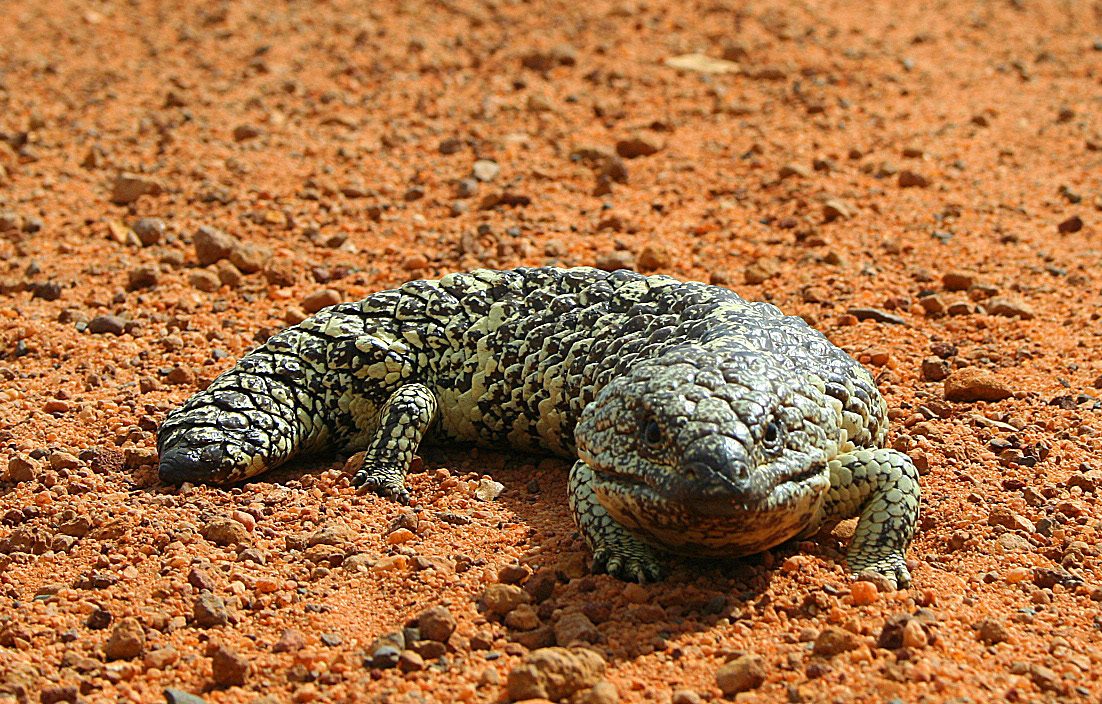
Photo: Bäras · CC BY-SA 3.0
Shingleback lizard
Tiliqua rugosa
A slow Australian lizard with thick pine-cone-like scales and a stumpy tail that mimics its head, the shingleback forms faithful pairs that last for years.
Characteristics
Temperament
Very slow, placid, diurnal, ground-dwelling
Diet
Omnivore: plants, fruit, snails, insects
A reptile shaped like a pine cone
The shingleback, also called the bobtail or sleepy lizard, is a large blue-tongued skink with an unmistakable look: its body is covered in thick, protruding scales that resemble a pine cone or roof shingles. The tail is short, stumpy and rounded, so much so that it looks like the head: this "two-headed" appearance confuses predators, who cannot tell which way the animal will dart. Like its relatives, it displays a vivid blue tongue when threatened.
Habitat and distribution
It is endemic to southern and western Australia, where it inhabits grasslands, dry scrub and semi-desert. It is a ground-dwelling animal that moves slowly and spends much time basking in the sun — hence its English nickname of sleepy lizard.
Behaviour and reproduction
It is omnivorous: it feeds on plants, flowers, fruit, snails and insects. Its most remarkable trait is pair fidelity: male and female form monogamous bonds that can last many years, reuniting each breeding season with the same partner. It is viviparous and gives birth to a few young that are very large relative to the mother.
Curiosities
Some individuals can live for several decades, making it one of the longest-lived lizards. Its slowness and reluctance to flee often make it a victim of road traffic when it crosses roads to warm up on the asphalt.
Conservation
The IUCN lists the species as Least Concern: it is common and widespread. The main local threats are road deaths and illegal collection for the exotic pet trade.
Pros
- Faithful monogamous pairs lasting even decades
- Unique pine-cone look and decoy tail
- Very long-lived and docile
Cons
- Frequent victim of road traffic
- Not a common pet: specialised needs
- Affected by illegal collection