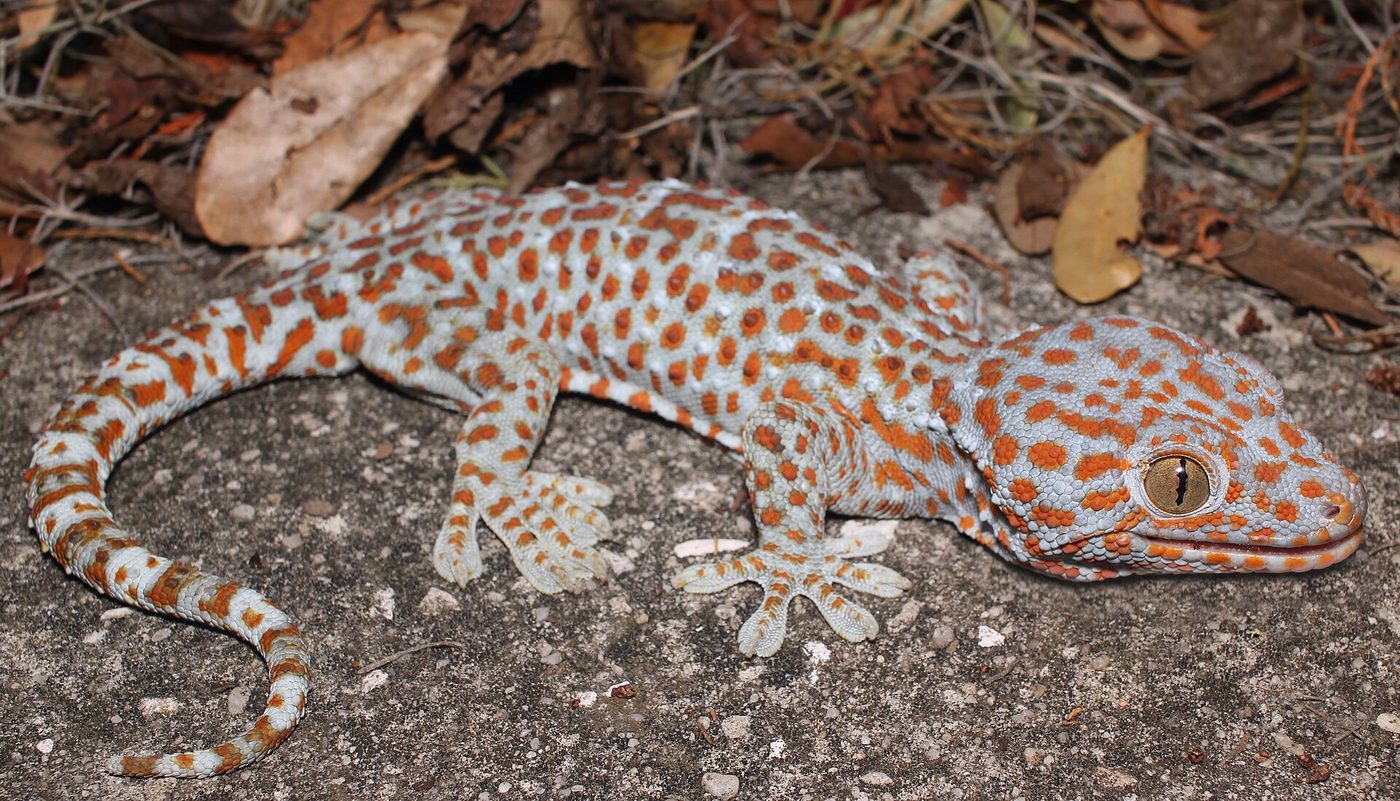
Photo: MH Herpetology · CC BY-SA 4.0
Tokay gecko
Gekko gecko
Large, striking and with an unmistakable call, the tokay gecko is one of the biggest geckos in the world, recognisable by its blue-grey coat dotted with orange.
Characteristics
Temperament
Nocturnal, territorial, not very tame
Diet
Carnivore: insects, invertebrates and small vertebrates
A large, colourful gecko
The tokay gecko is one of the largest geckos in the world, capable of reaching a length of over 30 centimetres. Its coat is unmistakable: a blue-grey background scattered with orange or reddish spots, with large eyes with a vertical pupil that reveal its nocturnal habits. Like all geckos, it has special adhesive lamellae under its toes that allow it to climb easily even on smooth, vertical surfaces, upside down. Its name comes from the loud, repeated call of the male, which recalls the syllables 'to-kay'.
Habitat and distribution
It is native to Southeast Asia and some Pacific islands, where it inhabits tropical forests, but it has also adapted well to the proximity of humans: it is not uncommon to find it on the walls of houses, where it hunts the insects attracted by the lights. It is an arboreal and nocturnal animal, which by day takes refuge in cracks and crevices.
Behaviour and feeding
The tokay gecko is a voracious hunter: it feeds mainly on insects and other invertebrates, but larger prey can include small vertebrates. It is known for its bold, territorial character: if threatened or seized, it does not hesitate to bite hard, and its bite is surprisingly powerful for a reptile of this size. It frequently gives its characteristic call, especially at night.
Care and conservation
It is classified as a species of least concern, with a wide distribution. However, in some areas it is collected in large numbers for the exotic-pet trade and for traditional medicine, a pressure that needs to be monitored. In captivity it needs a tall, warm and humid terrarium, with hiding places and surfaces to climb on, and it is more suited to those with experience, given its rather untame temperament. (Note: the weight value on Wikidata, 60 kg, is clearly wrong; the real weight is around 150–400 grams.)
Pros
- Among the largest geckos in the world
- Colourful, unmistakable coat
- Excellent climber on any surface
- Useful controller of insects
Cons
- Bold character, powerful bite
- Not well suited to beginners
- Collected for trade and traditional medicine