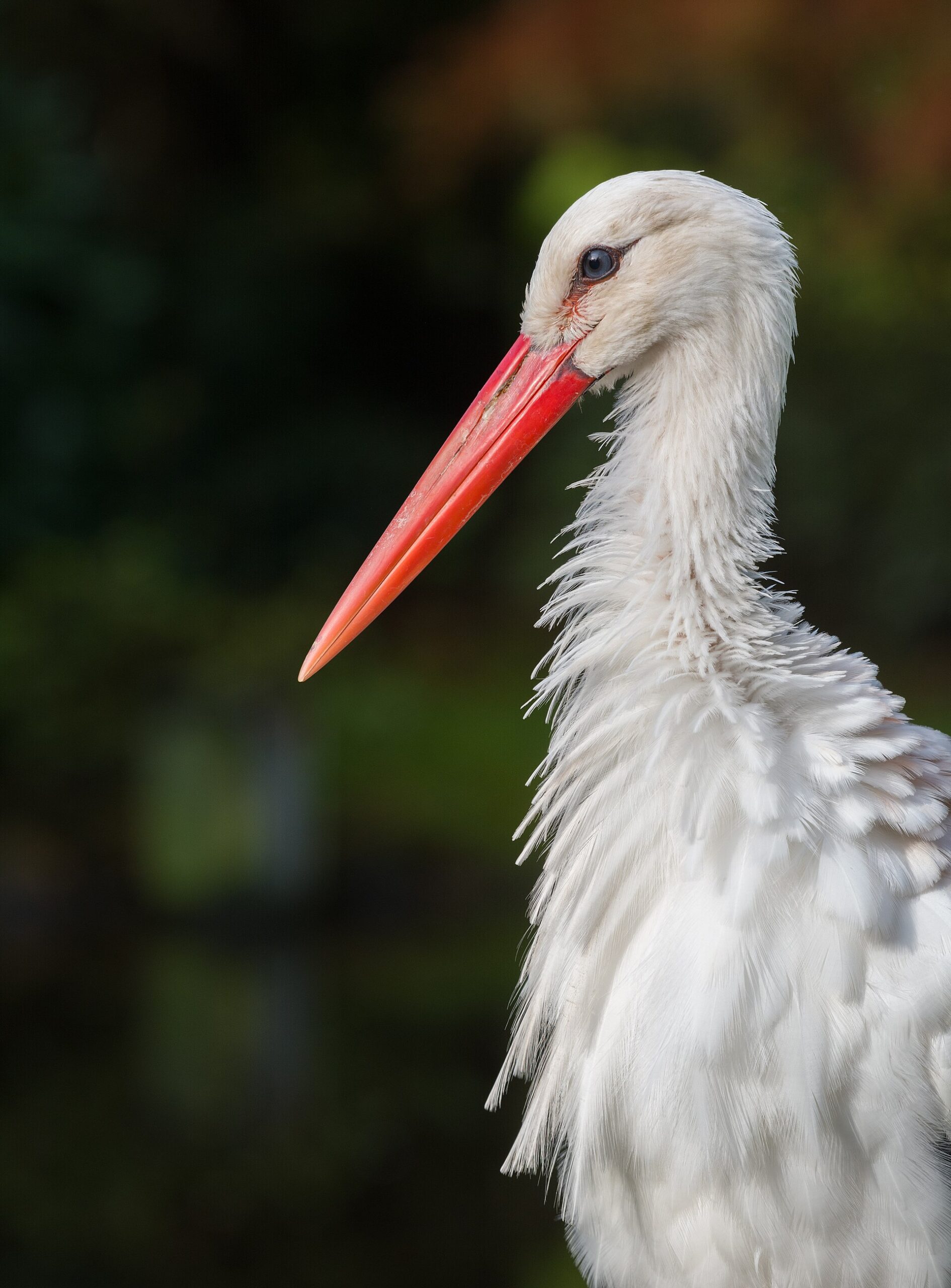
White Stork
Ciconia ciconia
Characteristics
Temperament
Long-distance migrator (10,000-20,000 km Europe-Africa). Almost mute: communicates with "bill-clattering" by striking mandibles. Monogamous, huge nests (2 m, up to 500 kg) on house roofs, faithful to nest for decades. Social during migration, territorial at the nest. Origin of "stork delivering babies" folklore.
Diet
Opportunistic carnivore. Insects (grasshoppers, locusts — biological control in Africa), frogs, lizards, small rodents, snakes (even venomous), earthworms. "Sight" hunter standing in meadows. Lightning-fast beak (closure in 25 ms). 60-100 g/day (800 g/chick during nesting).
The White Stork (Ciconia ciconia) is a large Ciconiiformes bird recognisable by its white plumage with black primary flight feathers, the long straight red beak (15-20 cm), and the red legs. It is one of the most iconic birds of European folklore: according to tradition, storks bring newborns in their beaks and linen bundles — a myth originating from the fact that storks nest on the roofs of houses where there is greater human fertility. Imposing measurements: height 100-115 cm, wingspan 195-215 cm, weight 2.3-4.4 kg. It is a long-distance migrator: every year it travels 10,000-20,000 km between European breeding grounds and wintering quarters in sub-Saharan Africa, using 3 main routes: Strait of Gibraltar (western populations) and Bosphorus-Red Sea (eastern populations). Although a large bird, it is silent: it does NOT sing, but produces a characteristic "bill-clattering" by loudly striking the two mandibles of its beak. It is the national symbol of Lithuania, Poland and Belarus. IUCN status: Least Concern (LC), with a global population estimated at 500,000-700,000 individuals, increasing thanks to reintroduction programmes.
Classification and category
The White Stork belongs to the order Ciconiiformes (storks — formerly classified as "Wading birds"), family Ciconiidae, genus Ciconia. The family Ciconiidae comprises 19 species distributed across all continents except Antarctica. Ciconia ciconia was scientifically described by Linnaeus in 1758. It is closely related to:
- Black Stork (Ciconia nigra): smaller, black with white belly, ancient forests
- Oriental Stork (Ciconia boyciana): black beak, China/Russia, EN
- African White Stork (Ciconia microscelis): geographical variant, sub-Saharan Africa
- African Marabou (Leptoptilos crumeniferus): large African scavenging stork
There are 2 recognised subspecies:
- C. c. ciconia: the nominal subspecies, Europe, western Asia, north-western Africa
- C. c. asiatica: slightly larger, from Central Asia to the Caucasus
The morphological parameters are: height 100-115 cm (very long legs); wingspan 195-215 cm (record 218 cm); weight 2.3-4.4 kg (M slightly larger than F); beak 14-20 cm; tail 21.5-26.5 cm. The longevity: 20-25 years in nature, up to 35 years in captivity (record 39 years — Prague Zoo). Sexual maturity: 3-5 years. The sexual dimorphism is minimal: M and F almost identical (M slightly larger). Reproduction: monogamous, form a pair for life (though not strictly — can change partners if one dies or does not return from migration).
Habitat and distribution
The White Stork prefers open habitats: wet grasslands, marshes, alluvial meadows, rice paddies, savannas, agricultural land with ponds and ditches. Unique feature among large birds: strong commensalism with man. Storks often nest on the roofs of houses, on chimneys, on bell towers, on power line pylons in rural villages. This anthropophilic association has existed for at least 2000 years — the Romans already noted storks on houses. Today, in some regions (Alsace, southern Spain, Poland), over 80% of nests are on human structures: roofs, electric poles, artificial platforms installed for them. The nests are monumental: piles of branches and sticks, up to 2 m in diameter and 3 m in height, weight 250-500 kg! They are reused year after year, expanded each season; some historic nests (Alsace, Poland) are over 100 years old, passed down through generations. They are protected by law in many countries.
Distribution: the White Stork nests in Europe (Spain, Portugal, eastern France, Germany, Poland, Baltic countries, European Russia, Balkans, Italy in expansion), western Asia (Turkey, Caucasus, Israel), North Africa (Morocco). The wintering areas are in sub-Saharan Africa: Sahel, East Africa (Sudan, Ethiopia, Kenya, Tanzania), West Africa, Southern Africa.
The migration is one of the most spectacular phenomena of natural aviation. The White Stork is a thermo-soaring migrator: instead of beating its wings (too energy-expensive for its weight), it exploits ascending thermal currents over land to glide at altitudes of 2,000-3,000 m. For this reason, it crosses seas at the narrowest points where currents continue:
- Western route: from the Strait of Gibraltar (Spain → Morocco): populations from Iberia, France, western Germany
- Eastern route: from the Bosphorus (Turkey → Sinai → East Africa): populations from eastern Germany, Poland, Balkans, Russia (530,000+ birds/year!)
Migration speed: 100-200 km/day; the total journey lasts 30-45 days. Storks do NOT fly at night and do not cross large seas (thermal currents cease over water). In the last 30 years, an increasing fraction of western storks NO LONGER migrates: with climate change and landfills full of food in Spain and Portugal, some populations winter in Iberia (phenomenon called "migration shortcut"). Global population: 500,000-700,000 individuals (BirdLife 2019), increasing by 30% since 1990. IUCN status: Least Concern (LC). However, regional declines in the Netherlands, Belgium, part of Germany. Successful reintroduction programmes in Switzerland, Netherlands, Italy.
Diet
The White Stork is an opportunistic carnivorous predator. It hunts standing in meadows, marshes and rice paddies, walking slowly or waiting motionless, then striking with its beak in a flash. Diet varies seasonally:
- Insects: grasshoppers, locusts, beetles, dragonflies, flies (main diet in spring-summer)
- Earthworms and worms: after heavy rains, in flooded meadows
- Amphibians: frogs, toads, salamanders (preferred prey in wetlands)
- Reptiles: lizards, snakes (even venomous, up to common viper — apparently immune)
- Rodents: mice, voles (important in cultivated fields)
- Small fish (rarely — they are not good fishermen in deep water)
- Young birds: chicks of other species (occasional)
- Crustaceans: freshwater shrimps
Hunting technique: the stork is a "sight" hunter. It does not dig into the ground; it detects prey by sight at 5-15 m. The beak functions as a lightning-fast clamp: it closes in 25 milliseconds, one of the fastest jaw closures in vertebrates. Quantity: 60-100 g of food per stork/day (during chick-feeding periods, the intake rises to 800 g/day for each of the 3-5 chicks, total 4-5 kg for the pair). Storks are often attracted to controlled fires and tractors ploughing: fires drive out insects and tractors expose earthworms — "easy" foraging strategy. In Africa, during wintering, storks follow swarms of locusts, eating thousands a day (important biological control of locusts).
Ecological peculiarity: the stork is important to farmers — it controls locusts, grasshoppers, mice in crops. In Poland and Belarus, farming families historically encourage storks to nest on their roofs (brings luck AND practical utility).
Physical features
The White Stork is a large bird with an unmistakable profile: long neck, very long legs, long straight beak, upright posture. The plumage:
- Body: pure white, glossy
- Primary and secondary flight feathers: black (at rest they form a black "blanket" on folded wings)
- Beak: bright red, 14-20 cm long, straight, pointed
- Legs and toes: bright red
- Facial skin (lores): black
- Eyes: dark brown
Young have less intense colouring: brown beak (becomes red at 2 years), pink-grey legs, less glossy white feathers.
The flight is the stork's moment of glory. Unlike many birds, it flies with its neck extended forward (not in an "S" like herons) and its legs extended backward. The large wings allow masterful gliding flight: the stork can remain in the air for hours without flapping its wings, exploiting thermals and updrafts. The cruising speed is 35-50 km/h; in migration, exploiting currents, it can do 200-500 km/day. It flies only by day; at night it perches standing.
Special anatomy: the legs are very long (40-50 cm), allowing walking in shallow water and meadows. The toes have a slight membrane at the base (not fully webbed like waterfowl); the claws are straight, not curved. The beak has a perfect "clamp" shape: the upper mandible is rigid, the lower one mobile, they close with great force and precision. Peculiarity: the stork is almost mute — it does not have a functional syrinx (singing organ). It communicates with the characteristic "bill-clattering": it rapidly strikes the two mandibles of the beak, producing a "ta-ta-ta-ta" crackling sound audible at 100 m. Used as a greeting to the partner, threat signal, communication between adults and chicks.
Behaviour and curiosities
The White Stork is a social bird during migration (flies in flocks of hundreds/thousands), but monogamous and territorial during nesting. The males arrive first at the nest (February-March) and rebuild it; the females arrive 1-2 weeks later. The greeting ritual to the partner is iconic: both birds raise their necks backward, almost touching the tail with the nape, and clatter their beaks vigorously — the famous "up-down display". During courtship, the male offers branches to the female as "gifts" for the nest.
Reproduction: the female lays 3-5 white eggs (record 7). Incubation: 32-33 days, shared between both parents (rare among birds). The chicks are born altricial: blind, naked, completely dependent. They grow rapidly; by the 25th day they are already almost as big as adults. The parents feed them regurgitating food from the beak. Cruel but adaptive behaviour: fratricidal infanticide — if food is scarce, the weaker chick is expelled from the nest by its siblings or thrown out by the parents to concentrate resources on the strong. Only 2-3 chicks out of 5 reach fledging on average. The chicks fly at 58-64 days; they stay with their parents for another 2-3 weeks before independence. The first migration is autonomous: the young migrate WITHOUT their parents (the parents leave first), guided only by genetic instinct — one of the most surprising phenomena in the animal world.
Famous curiosities: the myth of the "newborn brought by the stork" is the most famous folklore associated with this species. Probable origins:
- Storks nest on the roofs of farmhouses, where human couples are numerous (correlation between family fertility and stork presence)
- Storks return from migration in spring, period of summer births (9 months after autumn copulation)
- The white colour is a symbol of purity/motherhood
- In pre-Christian Germanic folklore, storks were sacred to the goddess Freya (fertility)
- The first literary reference to the myth is by Hans Christian Andersen in the fairy tale "The Storks" (1839), in which storks "take newborns from lakes" to bring them to families
Bill-clattering curiosity: storks are practically mute. Their syrinx is reduced. They communicate with beak striking: two main forms — "welcome clattering" between partners (long, slow), and "threat clattering" to intruders (short, fast). Chicks begin clattering at 2 weeks of age to beg for food. Historical migration curiosity: the heavy migration corridors over Turkey (Bosphorus) and Israel are famous observation points. Birding Israel counts 500,000 storks crossing in 6 weeks (September). Nest curiosity: the oldest known nest is in Strasbourg, Alsace: documented from 1452, rebuilt every year. Anthropic communication curiosity: in German and Dutch villages, "Storchennest" — platforms for storks on roofs — are installed to attract breeding pairs, a symbol of luck. Survival curiosity: juvenile mortality is very high (60-70% in the first year). Causes: predation (crows, hawks), death on electric wires (cause #1 of adult mortality), pesticide poisoning in wintering grounds, illegal hunting in the Mediterranean. "Auguste" curiosity: a stork ringed in Germany in 1822 (ancient record) travelled over 700,000 km in 30 years of migrations. Religious curiosity: in Christianity, the stork is a symbol of purity, filial devotion and family love. The storks "care" for their elderly parents in the nests (myth): hence the idiom "stork devotion". "Klepetan and Malena" curiosity: the most famous stork couple in the world. Klepetan is a male stork from Croatia who for 20+ years has flown from Africa each year to return to his partner Malena, injured and unable to migrate. Story picked up by international media, symbol of eternal love. Strasbourg curiosity: the iconic symbol of Alsace and Strasbourg is the white stork. Strasbourg has active reintroduction programmes and in 1948 there were only 9 pairs, today there are 600+. Spain curiosity: in Andalusia, storks have not migrated for about 20 years. The open-air landfills of Madrid and Seville offer abundant food all year, and the mild temperature allows wintering. Studies have shown birds that regularly fly to landfills to feed, even during nesting (50+ km/day). Poland curiosity: Poland hosts 25% of the world population of White Storks (~50,000 pairs). The village of Żywkowo has more storks than humans (40 pairs vs 30 inhabitants), the highest ratio in the world. National symbol curiosity: Poland (informal national symbol), Lithuania (official national bird since 1973), Belarus (official national bird since 1996), Czech Republic, Croatia (Slavonia area), Hungary (rural areas), Spain (Estremadura), Germany (Alsace/Brandenburg), Netherlands. Musical curiosity: Tchaikovsky in Swan Lake contains references to storks as migratory symbols. Aesop curiosity: the fable "The Fox and the Stork" (~ 6th century BC) — the fox offers broth in a flat plate (impossible for the stork to drink); the stork reciprocates by offering food in a narrow bottle (impossible for the fox). Moral: treat others as you would like to be treated.
Pros
- Icona del folklore europeo (neonati, Pasqua, Esopo)
- Importante per gli agricoltori: controllo di locuste, cavallette, topi
- Migratore spettacolare a lunga distanza (10.000+ km)
- Nido fedele per decenni, anche tramandato di generazione in generazione
Cons
- Vulnerabile ai cavi elettrici (causa #1 mortalità adulta)
- Declini regionali significativi (Paesi Bassi, Belgio)
- Mortalità giovanile 60-70% nel primo anno
- Dipendenza dalle discariche (alcune popolazioni hanno smesso di migrare)