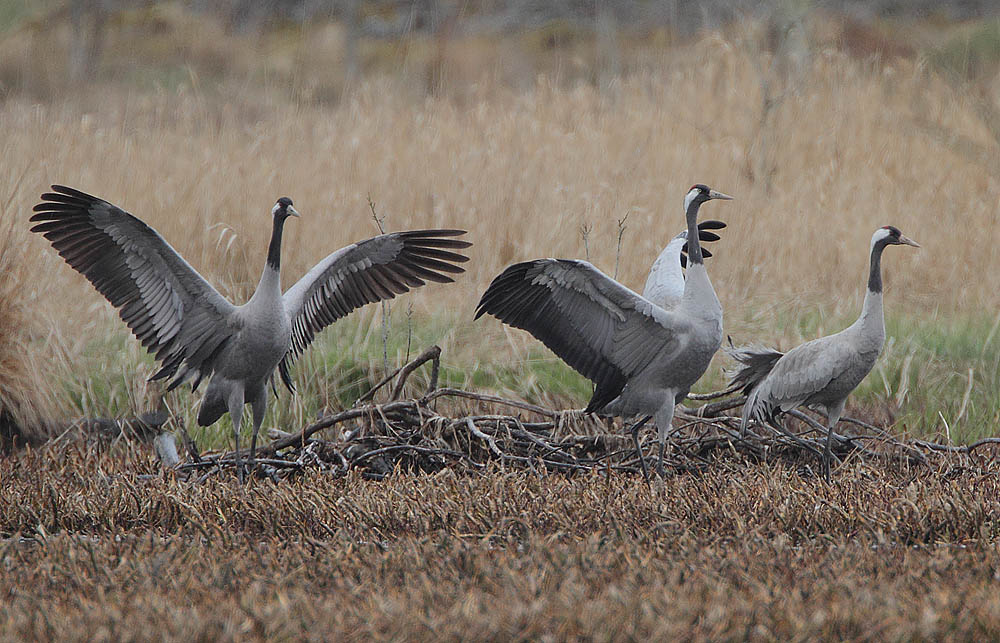
Common Crane
Grus grus
Characteristics
Temperament
A large wild bird, diurnal, social and migratory, NOT a pet. It forms stable, lasting pairs and is very long-lived. Outside the breeding season it is extremely gregarious, gathering in great flocks both at night roosts in safe wetlands and in the fields where it feeds. It is famous for its elaborate courtship "dances" (leaps, bows, wing-flapping) and for its loud trumpeting calls, produced by a very long, coiled trachea. Vigilant and wary, it depends on the tranquillity of wetlands and stopover areas along migratory routes. It should be observed and protected in the wild: the protection of its environments was decisive for its recovery in Europe.
Diet
Omnivorous and opportunistic, with a diet that varies with the seasons: the plant component prevails (roots, tubers, shoots, seeds and especially cereals, including stubble and field residues during migration and wintering), supplemented by insects and other invertebrates (important in the breeding season) and occasionally small animals (amphibians, small reptiles, small mammals). It feeds on the ground, walking slowly and probing the soil with its sturdy bill. Unlike herons, more carnivorous and fish-eating, the crane eats much plant matter and in the cold months exploits cultivated fields, feeding in great flocks during migration.
The Common Crane (Grus grus), also known as the Eurasian crane, is one of the largest and most elegant migratory birds of Eurasia: a majestic wading bird, the star of some of the continent's most spectacular natural phenomena. Famous for:
- The imposing size: over a metre tall, with a wingspan of about two metres
- The "dances": elaborate courtship displays of leaps, bows, pirouettes and wing-flapping
- The migrations in V-formation: great flocks crossing the sky in spring and autumn
- The loud bugling: a powerful call heard kilometres away
- The elegant plumage: ash-grey, with a black-and-white neck and a red patch on the head
- The symbolic value: in many cultures it represents longevity, vigilance and good fortune
IUCN status: Least Concern (LC), with recovering populations in Europe. It enters the portal among the waders, alongside the Grey Heron, the White Stork, the Black Stork and the Shoebill: it thus enriches the group of large long-legged birds tied to wetlands and open environments.
Classification and category
The Common Crane belongs to the order Gruiformes, family Gruidae (the true cranes), genus Grus. The species is Grus grus. In the portal it is placed among the waders, the group of large long-legged birds. It is important to tell it apart from other large waders with which it can be confused, some present in the portal: herons (like the Grey Heron) — in flight they hold the neck folded in an "S", while the crane always flies with its neck outstretched forward; moreover the crane has the characteristic red crown patch and the "bustle" of feathers on the back; storks (White and Black) — they have a heavier, coloured bill and different plumage; they too fly with the neck outstretched, but have a different build and pattern; the crane is recognized by its ash-grey body, the black neck with a white stripe, the red patch on the head and the showy tuft of arched feathers drooping over the tail (the "bustle"). The combination of large size + grey plumage + red crown patch + bustle on the back + neck-outstretched flight is the crane's "identity card". Etymology: the name comes from the Latin grus, of onomatopoeic origin, imitating its trumpeting call; not to be confused with the mechanical "crane" (the lifting machine), which takes its name precisely from this long-necked bird. Parameters: Height usually about 1-1.3 m. Wingspan about 1.8-2.4 m. Weight about 4.5-6 kg. Longevity: a very long-lived bird, able to live several decades (often 20-30 years, even more in captivity). Reproduction: it nests on the ground in wetlands, usually laying two eggs; it forms stable, lasting pairs.
Habitat and distribution
The Common Crane is a great migrant, and its life is divided between northern breeding areas and more southern wintering quarters: breeding (in the bogs, marshes and wetlands of northern and eastern Europe and Asia); wintering (in southern Europe, North Africa and part of Asia); migration (it gathers in great numbers at some famous stopover areas — in France, Spain, Hungary, Germany and elsewhere). Preferred habitats — open, wet environments: wetlands (marshes, bogs, lake and river shores, where it nests and shelters); and fields and grasslands (during migration and wintering it feeds in open agricultural areas). It is a diurnal, social and migratory bird. Outside the breeding season it is extremely gregarious: it gathers in great flocks that can number thousands of individuals, both at night roosts in safe wetlands and in the fields where it feeds by day. Its seasonal migrations, with the sky streaked by long V-formations and the air full of bugling, are one of the most loved and awaited natural spectacles. IUCN status: Least Concern (LC). After historical declines due to hunting and wetland loss, in Europe the crane has known a notable recovery, thanks also to the protection of stopover and breeding areas. It remains sensitive to the disappearance of wetlands and to disturbance at concentration sites, crucial during migration.
Diet
The Common Crane is omnivorous and opportunistic, with a diet that varies with the seasons and environments: plant material (roots, tubers, shoots, seeds and especially cereals — including stubble and field residues during migration and wintering); insects and other invertebrates (important above all in the breeding season); and small animals (occasionally amphibians, small reptiles, small mammals). Features of its feeding behaviour: it feeds on the ground (walking slowly in fields and wetlands, probing the soil with its sturdy bill); a marked plant component (unlike herons — more carnivorous and fish-eating — the crane eats much plant matter, and in the cold months exploits cultivated fields); and group foraging (during migration and wintering it feeds in great flocks, with many eyes watching for danger). Crucially, its very habit of feeding in cereal fields has let the crane thrive along migratory routes, but it can sometimes create friction with agriculture in the areas of greatest concentration.
Physical features
The Common Crane is a slender, elegant bird with a noble bearing. The plumage and colours — the distinguishing trait: an ash-grey body, sometimes with darker shades; a black neck with a white stripe running behind the eye and along the neck; a bare red patch on the crown; a showy "bustle" — long inner wing feathers, arched and drooping, forming a kind of feathery tail. The wader structure: long legs, suited to walking in shallow water and fields; a long neck and a straight, pointed bill; large wings for long-range migratory flight. The voice: a loud, trumpeting call, produced thanks to a very long, coiled trachea that amplifies the sound and makes it audible at great distance.
Curiosities and behaviour
The Common Crane has always been one of the most charm- and symbolism-laden birds, the star of natural spectacles that have struck the human imagination since antiquity.
The dance of the cranes: cranes are famous for their elaborate "dances", displays of leaps into the air, bows, pirouettes, wing-flapping and tossing of twigs or grass; these dances strengthen the bond between partners and are part of courtship, but sometimes involve several individuals in a group; it is one of the most spectacular behaviours in the bird world. The long-necked trumpet: the crane's loud trumpeting call is made possible by an extraordinary anatomical feature: the trachea is very long and folded on itself, coiled within the breastbone, a bit like a brass instrument; this "internal trumpet" amplifies the sound, letting the call carry for kilometres. The great V-migrations: twice a year cranes make long migrations, crossing Europe in great flocks arranged in the characteristic "V" formations or long oblique lines; flying in formation reduces fatigue, because each bird exploits the slipstream of the one ahead; the passage of the cranes, with the sky full of bugling, is an awaited and celebrated event in many regions. Neck-outstretched flight: a simple way to tell a crane from a heron in flight is to look at the neck; cranes (like storks) fly with the neck fully outstretched forward, while herons fold the neck in an "S", with the head almost resting on the shoulders. The symbol bird: in many cultures the crane is a powerful symbol; for its longevity, pair fidelity and vigilance it is associated, in East and West, with longevity, good fortune, wisdom and attention; it appears in the myths, legends, art and poetry of numerous civilizations. The machine "crane": the mechanical crane, the great lifting machine of construction sites, takes its name precisely from this bird: its long "neck" reaching upward reminded people of the crane's slender neck. Behaviour and conservation: social, long-lived and tied to stable partners, the crane depends closely on wetlands for nesting and on safe stopover areas during migration; the protection of these environments was decisive for its recovery in Europe; watching a flock of migrating cranes, or witnessing their dances, remains one of the most thrilling experiences of birdwatching, and a symbol of the beauty that nature conservation can preserve.
Pros
- Grande uccello maestoso ed elegante, simbolo di longevità e buon auspicio
- Protagonista di spettacoli naturali unici: danze di corteggiamento e migrazioni in V
- Richiamo trombettante inconfondibile, udibile a chilometri
- In ripresa in Europa grazie alla protezione delle zone umide
Cons
- È un grande uccello selvatico e migratore, NON un animale da compagnia
- Dipende strettamente dalle zone umide e dalle aree di sosta, sensibili al disturbo
- Nei grandi raduni può creare attriti con l'agricoltura (campi di cereali)
- Molto vigile e prudente: va osservata a distanza per non disturbarla