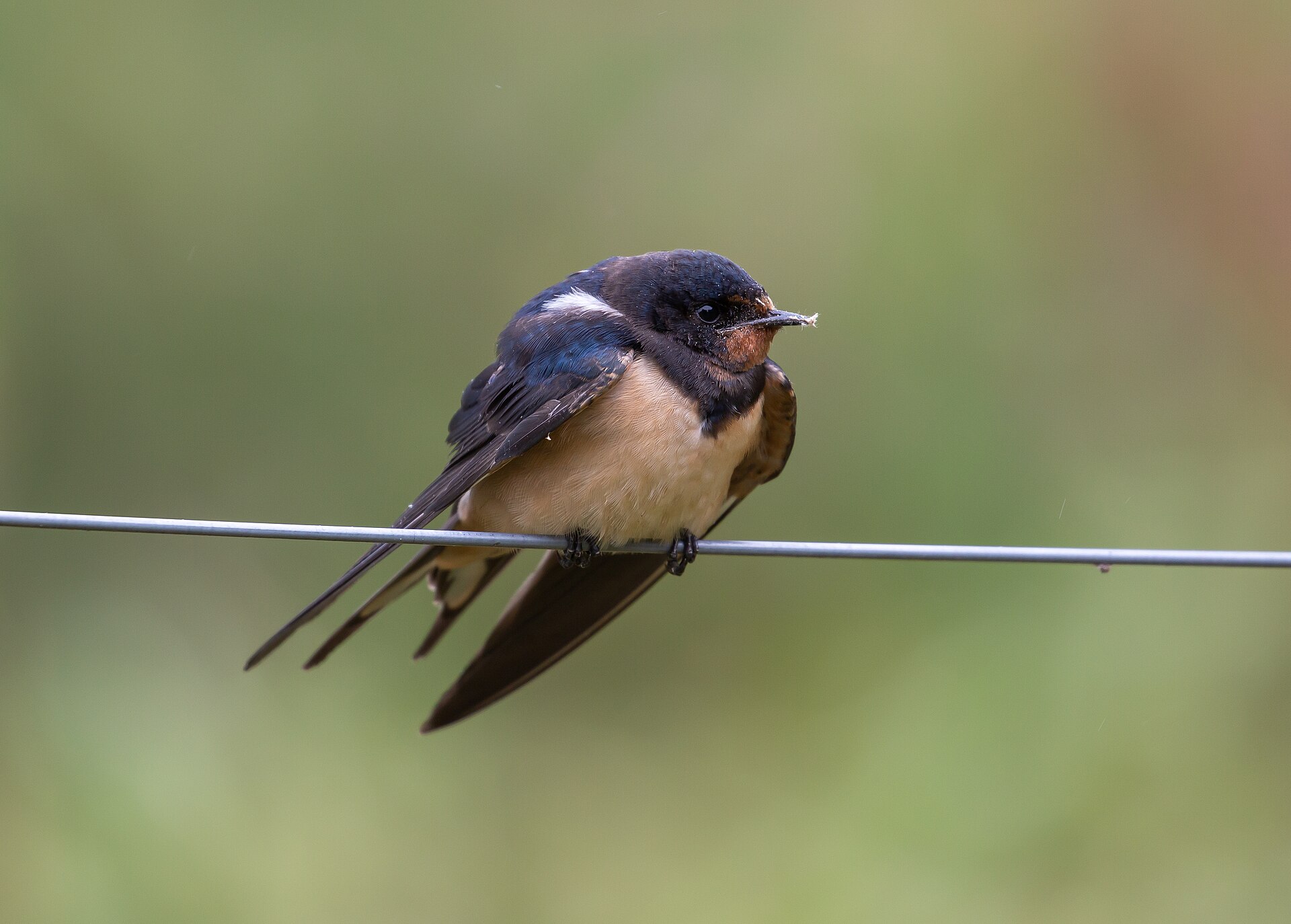
Barn Swallow
Hirundo rustica
Characteristics
Temperament
A social, lively, tireless wild bird, strongly tied to humans: it readily nests inside stables, barns and under eaves, and shows great fidelity to its nest, returning to it year after year. Diurnal and gregarious, especially on migration it gathers in large groups on wires. An acrobat of the air, it spends much of its life in flight. It is NOT a cage bird: it is protected, migratory wildlife, to be welcomed and safeguarded by protecting its nests and rural habitats. Its presence has always been considered a good omen.
Diet
An aerial insectivore: it hunts almost exclusively on the wing. It feeds on flying insects — flies, midges, mosquitoes, small beetles, dragonflies and many others — caught in the air with the mouth wide open as it dashes low over fields and water. It drinks and bathes "on the wing", skimming the water surface without landing. It flies higher in fine weather and lower in humid air, following the insects (hence its reputation as a "rain omen"). By devouring huge quantities of insects, including mosquitoes and pests, it is a valuable natural ally of the farmer.
The Barn Swallow (Hirundo rustica) is one of the best-known, most beloved and meaning-laden birds in the whole world: the small, elegant migrant whose appearance announces spring. Famous for:
- The herald of spring: its annual return has always been the sign of the warm season's arrival
- The forked tail: long and deeply forked, with thin "streamers", unmistakable in flight
- The colours: glossy metallic blue-black back, brick-red forehead and throat, pale underparts
- Acrobatic flight: it hunts insects on the wing with lightning turns, often skimming the ground or water
- The mud nest: it builds a cup of mud pellets under eaves, in stables and on beams
- The great migration: it travels thousands of kilometres to sub-Saharan Africa and back
IUCN status: Least Concern (LC), but declining in many areas. The Barn Swallow opens the Swallows group in the portal and is one of the first small "garden and countryside" songbirds: alongside the corvids (Common Raven, Eurasian Jay), it brings the voice of the smaller, more familiar passerines, those that have always shared houses and skies with humans.
Classification and category
Order Passeriformes (the passerines or "songbirds", the largest order of birds), family Hirundinidae (the swallows and martins), genus Hirundo. In the portal it is placed in the Swallows group. It is useful to tell it apart from similar birds it is often confused with: the house martin (Delichon urbicum) is a stockier swallow, with a white rump and a less forked tail, which makes closed nests on the outer walls of houses; the sand martin (Riparia riparia) is a small brown swallow that nests by digging tunnels in sandy banks; the swift (genus Apus), though similar, is NOT a swallow: it belongs to a different order (the Apodiformes, like the hummingbirds) and has scythe-like wings and an even faster, dashing flight. The true Barn Swallow (Hirundo rustica) is recognized by its red throat, very long forked tail and habit of nesting inside stables and barns. Etymology: "Hirundo" is simply Latin for "swallow"; "rustica" evokes the countryside and rural life, the species' favoured environment. Parameters: Length about 17-19 cm (including the tail streamers). Wingspan about 32-35 cm. Weight just 16-22 g. Longevity on average short, but a swallow can live several years, with records over 10. Reproduction: it builds a cup nest and usually lays 4-5 eggs, often with two broods a season; both parents feed the young with thousands of insects.
Habitat and distribution
The Barn Swallow is one of the most widely distributed birds on the planet: it breeds across much of the Northern Hemisphere — Europe (including Italy), Asia, North America and North Africa — and winters in the Southern Hemisphere, in particular sub-Saharan Africa for the European populations. Preferred habitats — it is closely tied to rural environments and humans: open countryside, meadows, pastures and farmland, where it hunts insects; stables, barns, porches, eaves and farmhouses, where it nests; and the vicinity of water (ponds, rivers), useful both for insects and for the mud of the nest. The Barn Swallow is a strongly migratory and human-loving species: it has tied its fate to that of human farming, nesting since time immemorial in our rural buildings. For this very reason it is greatly affected by changes in agriculture: the disappearance of old stables, intensive farming and the decline of insects have reduced swallows in many regions. IUCN: Least Concern globally, thanks to its vast range. However, in Europe and Italy many populations are in decline, and the swallow has become a symbol of the biodiversity crisis in the countryside; it is a protected species.
Diet
The Barn Swallow is the aerial insectivore par excellence: it hunts almost exclusively on the wing. It eats: flying insects (flies, midges, mosquitoes, small beetles, dragonflies and a great variety of others), caught strictly in the air, with the mouth wide open while flying. Hunting techniques: the hunting flight (it dashes low over fields and water with very fast turns and acrobatics, intercepting insects in flight); "drinking on the wing" (it drinks by skimming the water surface without landing, and bathes the same way); and adapting to the weather (it flies higher in fine weather, when insects rise, and lower when the air is humid, so much so that its flight height is a popular "omen" of rain). Crucially, by devouring huge quantities of insects, including mosquitoes and flies, the Barn Swallow is a valuable ally of people and farmers. A single swallow family can catch tens of thousands of insects in a season, a natural "pest control" service of great value.
Physical features
A small, slender bird perfectly built for flight. Colours and plumage: glossy metallic blue-black upperparts, shining and iridescent; brick-red forehead and throat, separated from the pale breast by a blue-black band; cream-white underparts. The body and tail: a streamlined, aerodynamic body, with long pointed wings; a long, deeply forked tail, with thin side "streamers" and white spots, acting as a rudder for acrobatics; a small bill but a very wide mouth, ideal for "scooping up" insects in flight. Performance: fast, agile, acrobatic flight, with very tight turns; great stamina (able to travel thousands of kilometres on migration); and a twittering song, cheerful and continuous, often given from wires and perches.
Behaviour and curiosities
The Barn Swallow is a social, diurnal bird, often seen in groups, especially before migration, when dozens or hundreds gather on wires. It is closely tied to human places and shows remarkable fidelity to the nest site: many swallows return, year after year, to exactly the same stable, the same nest.
The herald of spring: few presences are as associated with spring as the return of the swallows; hence the famous proverb "one swallow does not make a spring": the sighting of a single swallow is not enough to guarantee winter is over; their mass arrival, instead, has always been celebrated as the true sign of the warm season renewing. The great traveller: the Barn Swallow is one of the most extraordinary migrants; European swallows, at the end of summer, set off for sub-Saharan Africa, crossing the Mediterranean and the immense Sahara desert, then return in spring, often to the very same mud nest; a journey of many thousands of kilometres, made twice a year by a little bird of about twenty grams — one of the wonders of the natural world. The mud nest: the swallow builds its nest with a surprising technique; it gathers hundreds of small mud pellets, kneads them with saliva and grass and applies them one by one against a wall or beam, forming a sturdy cup it then lines with feathers and soft materials; this nest, built sheltered inside stables, barns and porches, is often reused and repaired for years. The winged "barometer": an old folk belief links the swallows' flight to the coming weather: "low swallows, rain on the way"; there is truth to it: in the humid air before rain, many insects fly lower, and the swallows, to hunt them, follow them flying close to the ground; in fine, dry weather, insects and swallows rise higher; the swallows' flight, in short, "follows" the insects, and thus indirectly the weather. The symbol of home and good luck: in very many cultures the swallow is a positive symbol: of good fortune, of faithfulness (because it always returns to the same nest), of home and return; it is an emblem dear to sailors, who tattooed it as a wish to return home safe and sound; having swallows nesting under one's roof is, in many traditions, a sign of good omen, and so their nests are often protected and respected. The farmer's friend: feeding almost exclusively on insects caught in flight — including flies, mosquitoes and crop pests — the swallow has always played a valuable, free role in insect control in the countryside; this is why its decline, linked to intensive agriculture, the disappearance of old stables and the general fall in insects, is a loss not only of beauty but of a useful natural ally.
Pros
- Uccello amato e simbolico: araldo della primavera, di casa e di buon auspicio
- Alleata gratuita dell'agricoltore: divora enormi quantità di insetti e zanzare
- Straordinaria migratrice (fino all'Africa) e acrobata del volo
- Legata da millenni all'uomo, indicatore della salute delle campagne
Cons
- NON è un animale da gabbia: è fauna selvatica protetta e migratrice
- In calo in Europa per agricoltura intensiva, perdita di stalle e declino degli insetti
- Dipende dagli edifici rurali per nidificare: soffre ristrutturazioni e nuovi materiali
- I nidi sotto le tettoie possono sporcare, ma vanno tutelati per legge