Harpy Eagle
Harpia harpyja
Characteristics
Temperament
Solitary, lifelong monogamous, diurnal. APEX PREDATOR of neotropical canopy. Talons 12-13 cm (longer than grizzly bear!), grip strength 500+ psi. Carries prey of 15-18 kg in flight (DOUBLE own weight). Hunts howler monkeys, sloths, coatis. Diagnostic erectile crest. Territory 30-100 km²/pair. Very slow reproduction: 1 chick every 2-3 years.
Diet
Obligate carnivore, hypercarnivore. Preys on howler/spider/capuchin monkeys (~50% diet), sloths (30-40%), coatis, kinkajous, opossums, agoutis, pacas, iguanas, macaws, toucans. Technique: high perch + 80-90 km/h dive + tight turns + lethal talons. Force 500+ psi perforates 8 kg monkey skull instantly. 1-2 large prey/week. Transport up to 15-18 kg.
The Harpy Eagle (Harpia harpyja), known in Spanish as Águila Harpía, is the most powerful raptor of the Americas and one of the strongest in the world. It is characterised by rear talons of 12-13 cm — longer than those of a grizzly bear — and the ability to lift prey weighing 15-18 kg in flight (more than its own weight). It is the undisputed queen of the canopy of neotropical rainforests: hunts howler monkeys, spider monkeys, sloths, coatis, agoutis, opossums, kinkajous, iguanas, attacking them directly on branches at 30-40 m height. Very strong sexual dimorphism: females (7-9 kg) are double the males (4-5 kg). Length: 90-105 cm; wingspan: 1.8-2.2 m (relatively "short" for the weight — adaptation to canopy for tight turns between trees). The Harpy Eagle is famous for:
- Giant talons: 12-13 cm — the largest of any living eagle
- Erectile crest: tuft of black feathers on the nape, raised in alarm
- Sharp eyesight: 8× that of humans, detects prey at 200+ m
- Very slow reproduction: 1 chick every 2-3 years (slowness record among eagles)
- Huge nest: 1.5-2.5 m in diameter, built 30-50 m high on Brazil nut, Kapok
- National symbol: national animal of Panama
Distribution: from southern Mexico to northern Argentina, exclusively in primary lowland tropical rainforests. IUCN status: Vulnerable (VU) — globally declining due to deforestation, habitat fragmentation, persecution, hunting. Estimated world population: 20,000-50,000 mature individuals.
Classification and category
The Harpy Eagle belongs to the order Accipitriformes, family Accipitridae, subfamily Harpiinae, genus Harpia. The genus Harpia is monotypic: it includes only one living species, Harpia harpyja. Closest relatives: the other "canopy eagles" of the tropics:
- Harpyopsis novaeguineae — New Guinea Eagle
- Morphnus guianensis — Crested Eagle
- Pithecophaga jefferyi — Philippine Eagle (Critically Endangered)
These four species are called "tropical forest eagles": all have evolved independently to hunt large arboreal prey in the canopy. It is an example of evolutionary convergence: the niche is the same (apex canopy predator), but the four eagles derive from distinct lineages.
Etymology: "Harpia" from the Greek "harpê" (harpy, mythological creature half woman half bird, predator — reference to ferocity). "harpyja" Latinisation of the Greek. The species was scientifically described by Linnaeus in 1758.
The morphological parameters (very strong sexual dimorphism):
- Weight M: 4-5 kg
- Weight F: 7-9 kg (record 10 kg, in captivity)
- Head-tail length: 86-105 cm (F larger)
- Wingspan: 1.8-2.2 m (relatively short for the weight)
- Rear talons: 12-13 cm (record among eagles!)
- Beak: 5-7 cm, very strong
Longevity: 25-35 years in nature, up to 40+ years in captivity (record 54). Sexual maturity: 4-5 years. Reproduction: 1 chick every 2-3 years — one of the lowest rates among eagles. Incubation: 56 days. The chick remains in the nest 6-7 months, then depends on parents for another 6-12 months (total emancipation: 12-18 months).
Habitat and distribution
The Harpy Eagle inhabits exclusively primary tropical rainforests of the lowlands of the New World. Historical distribution:
- Southern Mexico: Veracruz, Oaxaca, Chiapas (northern limit)
- Central America: Belize, Guatemala, Honduras, Nicaragua, Costa Rica, Panama
- Amazon: Colombia, Venezuela, Guyana, Suriname, French Guyana, Brazil, Ecuador, Peru, Bolivia
- Northern Argentina: Misiones (southern limit, residual populations)
Current distribution is fragmented and reduced:
- Mexico: EXTINCT in many areas, ~50-100 individuals remaining
- Central America: isolated fragments, total population few hundreds (Panama 300-500, Costa Rica <50)
- Brazilian Amazon: main population, ~10,000-20,000 individuals
- Argentina: Critically Endangered, ~20 individuals remaining in Selva Misionera
Preferred habitats:
- Lowland rainforest: 0-1,500 m altitude, giant trees (40-50 m tall)
- Varzea forest: seasonally flooded forest
- Terra firme forest: non-flooded, evergreen forest
- Does NOT tolerate: secondary forest, monocultures, savannas, deforested areas
The Harpy Eagle needs extensive primary forests to hunt. A single individual requires a territory of 30-100 km². Fragmentation = unsustainable population.
IUCN status: Vulnerable (VU) since 2007. Demographic trend: declining. Estimated global population: 20,000-50,000 mature individuals (underestimated, more realistic estimates 5,000-10,000). Threats:
- Deforestation: the Amazon loses 11,000+ km²/year (2022) — critical habitat destroyed
- Direct hunting: persecution by farmers (chicken/pig predation), trophies, ceremonial covers for feathers
- Capture for illegal trade: chicks taken for exotic pet trade
- Fragmentation: forest divided into too-small patches to sustain populations
- Road accidents: rare but documented
- Secondary poisoning: prey contaminated by pesticides
CITES: Appendix I — international trade prohibited. Conservation: protection through national parks (Soberanía-Panama, Manú-Peru, Yasuní-Ecuador, Tortuguero-Costa Rica). Peregrine Fund has reintroduction programmes in Belize, Panama, Brazil.
Diet
The Harpy Eagle is a mandatory apex predator of the neotropical canopy. The diet consists mainly of large arboreal mammals:
- Monkeys: howler monkeys (Alouatta), spider monkeys (Ateles), capuchin monkeys (Cebus), squirrel monkeys (Saimiri), saki lemurs (Pithecia) — constitute ~50% of the diet
- Sloths: three-toed sloth (Bradypus), two-toed sloth (Choloepus) — 30-40% of the diet
- Coatis (Nasua)
- Kinkajous (Potos flavus)
- Opossums (Didelphis, Caluromys)
- Agoutis and Pacas (on the ground)
- Green iguanas (Iguana iguana)
- Large birds: macaws, toucans, curassows (Cracidae)
- Snakes: occasional (boa)
- Wild boar cubs (Tayassu): occasional on the ground
The hunting technique is spectacular:
- Perching: perches on a high branch (35-50 m), perfectly still for hours
- Scanning: observes the undergrowth and the adjacent canopy — extremely sharp binocular vision (8× human)
- Launch: dives from the perch with vertical acceleration, wings folded to body
- Approach: flies through the branches with tight turns thanks to short, wide wings — long tail = rudder
- Attack: dives on the prey from behind or laterally, talons open
- Capture: talons pierce the prey instantly, often killing by cardiac arrest from shock + perforation
- Transport: carries the prey to the nest or to an elevated perch — can carry prey of 15-18 kg in flight (more than its own weight!)
Strength features: the rear talons of the Harpy Eagle (12-13 cm) are the longest of any living eagle — longer than those of a grizzly bear! The compression force of the talons exceeds 500 psi (3,500 kPa) — can instantly perforate the skull of an 8 kg howler monkey. Each leg is almost as large as a man's hand.
Feeding frequency: 1-2 large prey/week. A sloth prey (5-7 kg) or howler monkey (6-9 kg) sustains an adult eagle for 3-5 days. Parents hunt for the chick for 6 months in the nest + 6 months after fledging (12 total months of parental care!). This is why reproduction is so slow.
Physical features
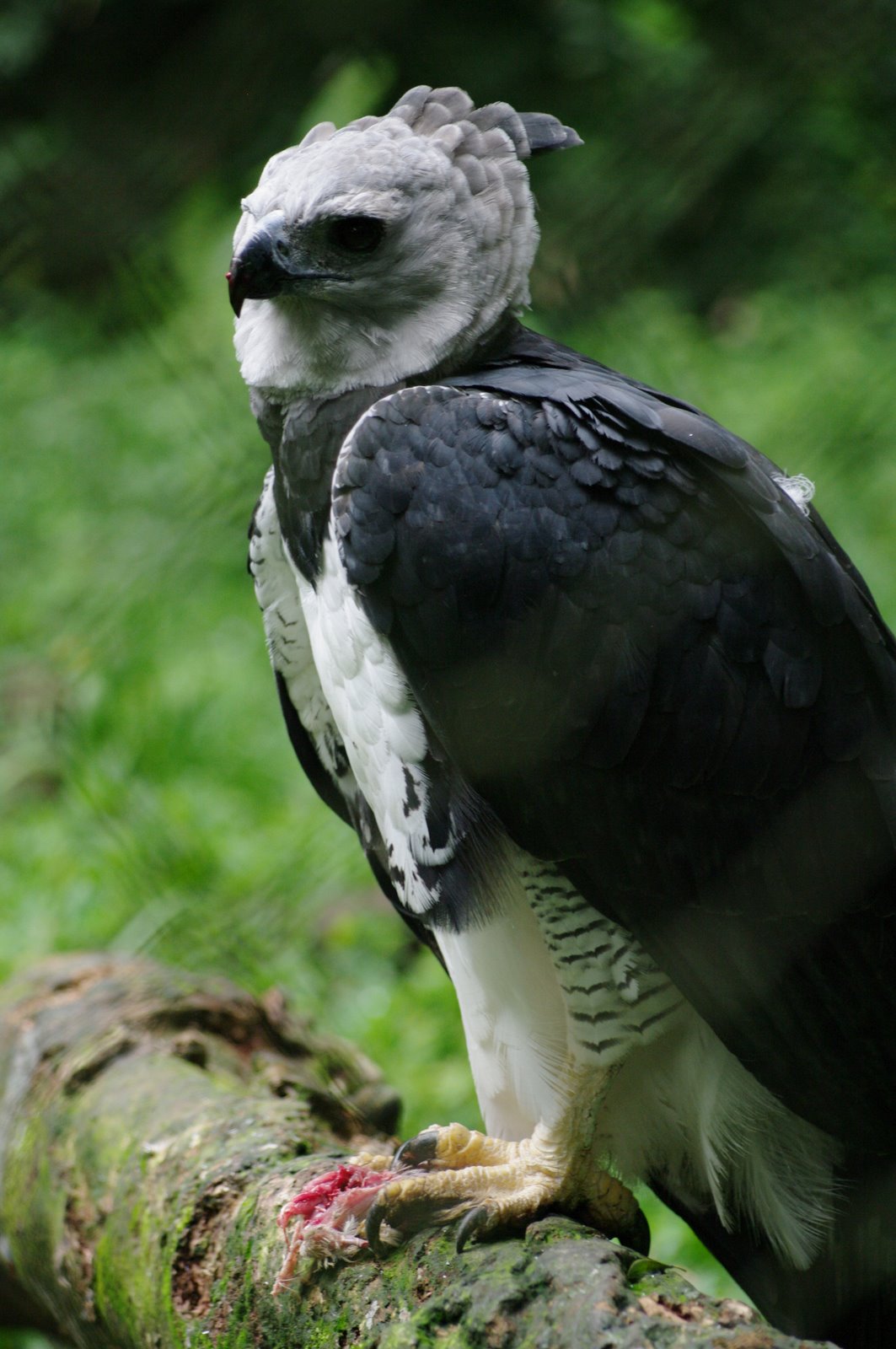
The Harpy Eagle has a stocky and powerful silhouette, perfectly adapted to flight between trees. Physical features:
Plumage:
- Adult:
- - Head: light grey, with erectile black crest ("double tuft" on nape)
- - Chest and belly: pure white
- - Back, wings, tail: slate black, with dark grey shades
- - Chest band: distinctive black collar between white chest and grey neck
- - Thighs: striped black-and-white ("barred trousers")
- - Tail: black with 3-4 wide grey stripes
- Young (first 4 years): head, chest, belly almost completely white, back and wings light grey. Definitive plumage after the fifth moult
The head is large, "facial", with "feline" expression:
- Erectile crest: 2 tufts of long black feathers on the nape, raised when alert or excited — diagnostic feature
- Eyes large, black, frontal (excellent binocular vision)
- Beak hooked, black, very strong (5-7 cm)
- Cere: yellow at the base of the beak
- Facial disc: similar to an owl — concentrates sounds to the ears
"Canopy predator" anatomy:
- Wings: relatively SHORT compared to weight (1.8-2.2 m) — adaptation for tight turns between branches. Golden Eagle has 2.5+ m wingspan with similar weight
- Tail: LONG, wide, marked by bands — acts as a rudder in flight
- Legs: ENORMOUS, yellow, feathered down to toes — as big as a man's hand
- Rear talons: 12-13 cm, black, curved (record among eagles)
- Front talons: 5-7 cm
- Tarsi: 5-6 cm thick (more than a human wrist)
Physiological features:
- Diving speed: 80-90 km/h in vertical immelmanns
- Cruise speed: 50-60 km/h between trees
- Vision: 8× that of humans, excellent frontal binocular vision, distinguishes prey at 200+ m
- Hearing: excellent, facial disc concentrates sounds
- Vocalisations: relatively silent outside the breeding period. Call: "weeeeeeeoooo" shrill, descending
- Talon grip strength: 500+ psi (perforates howler monkey skull instantly)
Behaviour and curiosities
The Harpy Eagle is solitary, long-term monogamous (probably for life), diurnal. Hunts exclusively in sunlight. Huge territory: 30-100 km² per pair. Territorial marking: vocalisations, presence on the nest. Pairs stay far from conspecifics.
Reproductive behaviour: the pair builds a huge nest (1.5-2.5 m in diameter, 1.5 m in height) on gigantic tall trees — preference for Brazil nut (Bertholletia excelsa), Kapok (Ceiba pentandra), Almendro (Dipteryx panamensis). Nest position: 30-50 m above ground, on main fork of the trunk. The same nest is used for 10-20 years, expanded every year.
Reproductive cycle: elegant courtship ceremonies (flight loops, twig supply). A single egg is laid (rarely 2, but the second chick dies). Incubation 56 days, done mainly by the female. Male hunts, brings food. The chick is born covered in white down, completely defenceless. Grows in the nest for 6-7 months — one of the longest nest stays among eagles. After fledging, still depends on parents for 6-12 months of learning. Total parental care: 12-18 months → the pair can reproduce only every 2-3 years. This reproductive slowness is the species' main vulnerability.
Famous curiosity: the "strongest raptor of the Americas". The Harpy Eagle is not the largest eagle in the world (Philippine Eagle and Steller's Sea Eagle are larger by total weight), but it is the most powerful by weight/grip force ratio. Talons are 12-13 cm long — longer than those of a grizzly bear (8-10 cm) — and compression force (500+ psi) can instantly perforate the skull of an 8 kg howler monkey. Flight carrying capacity: 15-18 kg — double its own weight!
Sexual dimorphism curiosity: the Harpy Eagle has one of the most marked sexual dimorphisms among birds: females weigh almost double the males (F 7-9 kg vs M 4-5 kg). Females hunt larger prey (adult sloths, howler monkeys), males hunt smaller prey (birds, capuchin monkeys, opossums). Division of labour that avoids intersexual competition.
Erectile crest curiosity: the "double crest" of black feathers on the nape is one of the most distinctive traits. Raised in alarm, excitement or territorial defence — looks like a second pair of "ears" (vaguely feline). Never seen in young until 3-4 years of age. Function: visual display to intimidate competitors and potential prey.
National symbol of Panama curiosity: the Harpy Eagle has been national animal of Panama since 2002. Appears on the national coat of arms, on 1 Balboa coins, and in various institutional symbols. The "Águila Harpía" programme of the Smithsonian Tropical Research Institute (Panama) has bred and released dozens of specimens in Panamanian forests since 2000.
Indigenous culture curiosity: Amazon tribes have venerated the Harpy Eagle for millennia:
- Maya: associated with the sun and sky gods. Feathers used by nobles and shamans in ceremonial headdresses
- Aztecs: warrior symbol (analogue to the golden eagle in other rituals)
- Inca: messenger between the earthly and celestial world
- Modern Amazon tribes: Kayapó, Yanomami, Asurini — feathers are still used in ceremonies. Tribal leaders boast "Harpy scalps"
Huge nest curiosity: Harpy Eagle nests are among the largest among birds — 1.5-2.5 m in diameter, built with huge branches, at 30-50 m height. The same pair uses the same nest for decades. Studies at Mamirauá (Brazil) have documented active nests for 20+ years. The nest grows every year by accumulation of new branches. When a nest is abandoned, it is often colonised by owls, toucans or parrots.
Longevity curiosity: documented longevity record: 54 years in captivity (Zoo de Salvador, Brazil, 1958-2012). In nature: 25-35 years. For comparison: Golden Eagle 30-32, Bald Eagle 28, Steller's Sea Eagle 25. The Harpy Eagle is one of the longest-lived eagles.
Name "Harpy" curiosity: the Eagle takes its name from the Harpies of Greek mythology — monstrous creatures, half woman half bird, who kidnapped people and food. The name reflects the lethal ferocity and the ability to "abduct" prey from the canopy. Linnaeus chose the name in 1758.
"Monkey neighbour" curiosity: the Harpy Eagle hunts the primate by definition of the Americas. Howler monkeys (Alouatta), which can weigh 8-9 kg and are among the largest primates of the New World, are common prey. This creates a coevolutionary arms race: howler monkeys have developed very powerful voices for social alarms (their howling is heard at 5 km!), gregarious behaviours, and specific anti-predator behaviours when the Harpy is sighted.
"Most powerful vs largest" curiosity: the Harpy Eagle is the most powerful raptor by weight/strength ratio but NOT the largest:
- Philippine Eagle (Pithecophaga jefferyi): 4.7-8 kg, 90-100 cm, wingspan 1.8-2.2 m. Critically Endangered. Largest in length
- Steller's Sea Eagle (Haliaeetus pelagicus): 5-9 kg, 85-105 cm, wingspan 2.2-2.5 m. Largest in wingspan and average weight
- Harpy Eagle: 4-9 kg, 90-105 cm, wingspan 1.8-2.2 m. Most powerful in grip/weight ratio
The Harpy Eagle compensates the relatively short wingspan with muscular power and giant talons.
Vision curiosity: the Harpy Eagle has vision 8× that of humans. Can detect a monkey or a sloth from 200+ m, spot minimal movements in the canopy. Has 2 foveas per eye (humans: 1) — a binocular fovea (sharp frontal vision) and a lateral fovea (lateral vision for movements).
"Invisible messenger" curiosity: the Harpy Eagle is famous for its ability to remain still for hours on a branch, perfectly camouflaged thanks to the white-grey plumage that blends with the sky behind. Monkeys often do not spot it until the moment of attack. Studies with hidden cameras have documented 4-6 hour sessions of total immobility (a record among raptors).
"Falcon of the King" curiosity: in Amazon cultures, the Harpy Eagle is called "aguilucho real" (royal eagle) or "águila Cuy" — reference to its dominance over the canopy. Only the Anaconda (Eunectes murinus) competes for the title of "apex predator" of the Amazon forest, but at different ecological levels (Anaconda in rivers, Harpy in the canopy).
"Harpy forest" curiosity: the presence of the Harpy Eagle is a key indicator of an intact primary forest ecosystem. It is an umbrella species: protecting the Harpy = protecting millions of km² of tropical forest + all the species that inhabit it. It is estimated that the loss of an active Harpy is ecologically equivalent to the loss of 100 km² of functional primary forest.
Reintroduction curiosity: the Peregrine Fund (Boise, USA) has developed since 1996 captive breeding and reintroduction programmes of Harpy Eagle in Belize, Panama, Brazil. Chicks raised in captivity are released in protected forests. Success: in 2023, over 80 individuals were released with 1-year survival of 75% — one of the highest rates for a large raptor reintroduction programme.
Pros
- Rapace più potente delle Americhe (artigli 12-13 cm)
- Simbolo nazionale del Panama dal 2002
- Indicatore chiave di foreste primarie intatte (specie ombrello)
- Longevità tra le più alte tra aquile (54 anni record)
Cons
- Stato IUCN Vulnerable, popolazioni in declino
- Riproduzione lentissima (1 cucciolo ogni 2-3 anni)
- Dipende strettamente da foreste primarie estese
- Vittima di deforestazione massiccia in Amazzonia