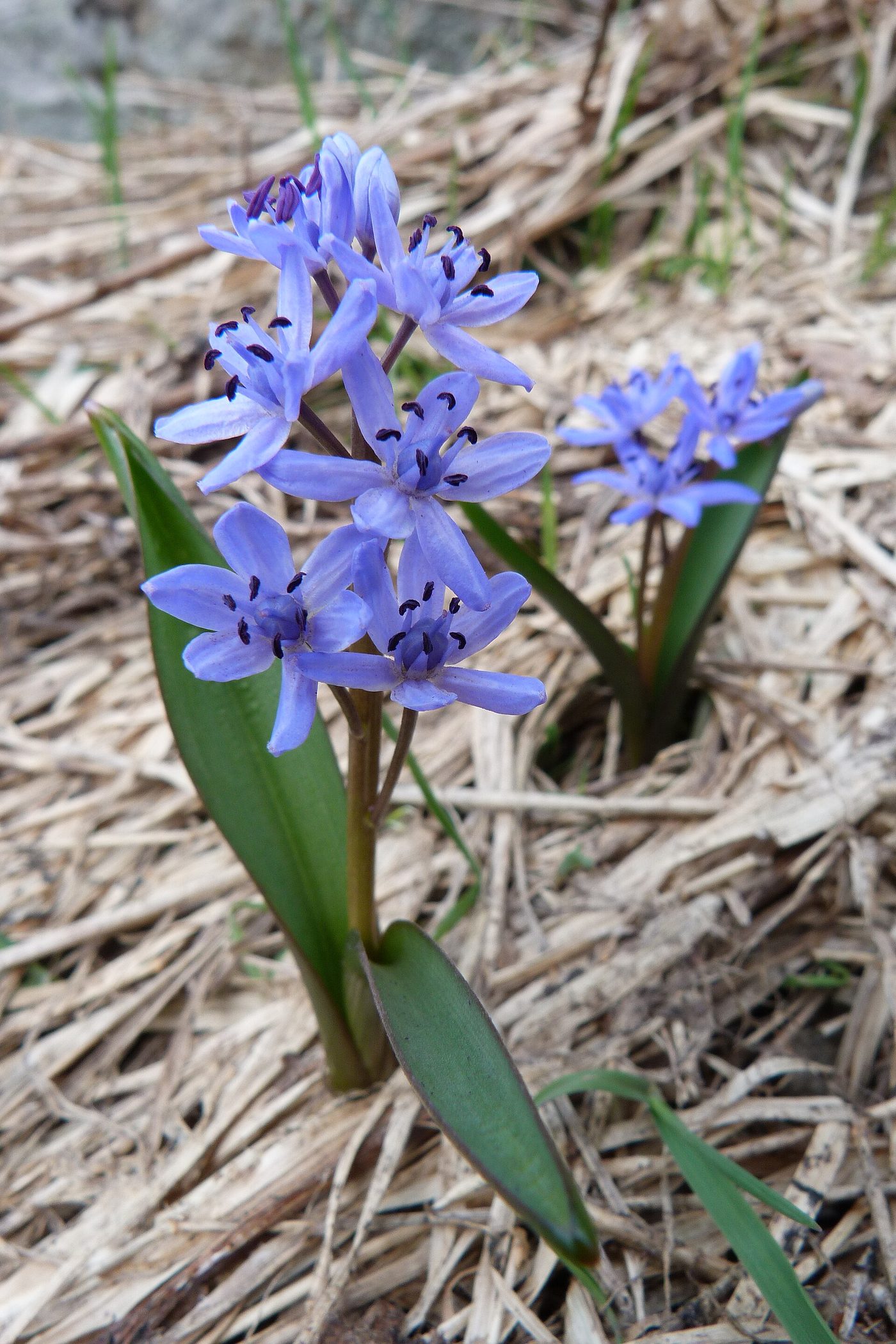
Photo: Florian Grossir · CC BY-SA 3.0
Alpine squill
Scilla bifolia
The alpine squill is a small bulb that in late winter carpets woodlands with delicate blue stars, among the first flowers to bloom.
Characteristics
Description
The alpine squill is a small herbaceous perennial bulb of the asparagus family, 10-20 centimetres tall. From each bulb come just two narrow, strap-shaped leaves and a short stem bearing a small cluster of star-shaped flowers, an intense blue-violet, more rarely white or pink. It is among the first flowers to appear, often as early as late winter.
Habitat and distribution
It is native to central and southern Europe and western Asia. It grows wild in cool, shady woods, clearings and mountain meadows, from the lowlands to two thousand metres, where it makes the most of spring light before the trees come into leaf.
Cultivation
It is a very easy, hardy bulb, ideal for woodland gardens, borders and shady corners. It wants part shade and a cool, humus-rich, well-drained soil. The bulbs are planted in autumn; after flowering the plant enters summer dormancy. It naturalises easily, forming blue carpets over time.
- Plant the bulbs in autumn, a few centimetres deep
- Let the foliage die down after flowering
- Do not disturb the bulbs once established
Facts and cautions
Its early flowering makes it a valuable nectar source for the first bees. Like many bulbs, the bulb is toxic if eaten, so it should be grown with care where there are children and pets.
Flowering season
Practical tips
Water needs: Moderate in spring, low in summer — always check soil moisture before watering.
Prefers Part shade or gentle sun: provide the right light and rotate the plant for even growth.
Recommended soil: Cool, humus-rich, well-drained. Refresh the substrate every 1-2 years.
Dust the leaves with a damp cloth to support photosynthesis.
Feed during the growing season (spring-summer) and stop in winter.
Pros
- Among the first flowers to bloom in late winter
- Very easy and hardy, naturalises by itself
- Valuable nectar source for the first bees
Cons
- Bulb toxic if eaten
- Foliage disappears in summer
- Short, early flowering