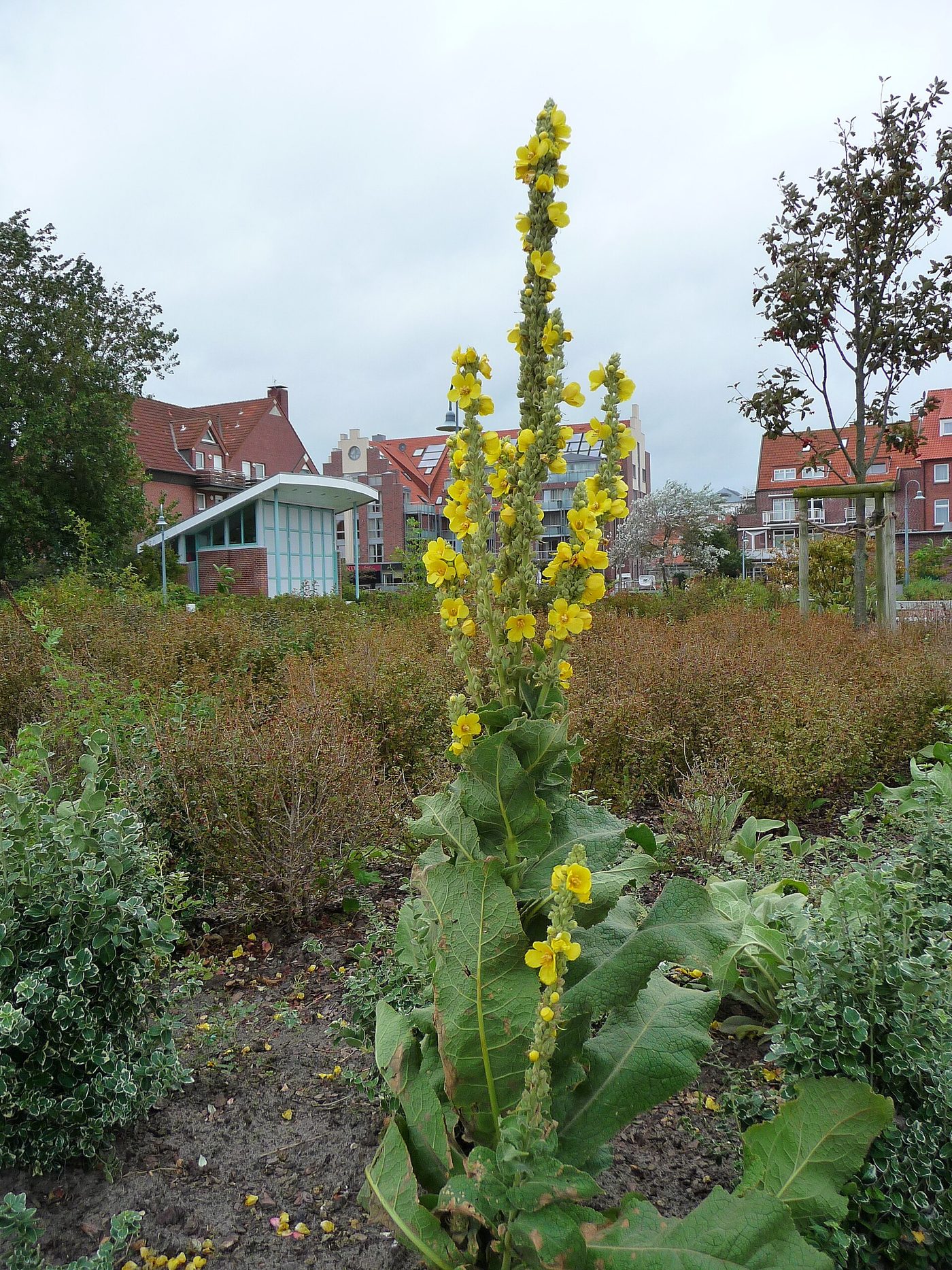
Photo: 4028mdk09 · CC BY-SA 3.0
Great mullein
Verbascum thapsus
Great mullein is a bold biennial with large felted leaves and a tall candle of yellow flowers that towers over roadsides and waste ground.
Characteristics
Description
Great mullein is an unmistakable biennial herb. In its first year it forms a large, flat rosette of oval leaves, thick and covered with dense, silvery-grey down that makes them as soft as felt. In the second year a single sturdy stem rises up to two metres, ending in a crowded spike of five-petalled yellow flowers. The flowers open a few at a time along the candle throughout the summer.
Habitat and distribution
Native to Europe, Asia and North Africa, it has naturalised across much of the temperate world, from the Americas to Oceania. It is a pioneer of disturbed ground, growing on roadsides, waste land, quarries and stony, sun-baked slopes where few other plants take hold.
Traditional uses
It has a long history in folk medicine: flowers and leaves were used in infusions to soothe coughs and respiratory complaints. In the Middle Ages the dried stalk, soaked in fat, served as a torch, the origin of several of its many common names.
Cultivation
It is extremely easy and suited to naturalistic gardens and dry areas. It wants full sun and a poor, well-drained soil; it tolerates drought well and dislikes rich, moist ground. It is propagated from seed and readily self-sows.
- Sow in summer for flowering the following year
- Leave the dry spikes: they are decorative and feed birds
- Do not fertilise: it prefers lean soils
Did you know?
The woolly leaves were once used as makeshift insoles or as tinder to start fires. The plant is much visited by bees and other pollinating insects. The seeds contain mildly toxic compounds and should not be eaten.
Flowering season
Practical tips
Water needs: Low — always check soil moisture before watering.
Prefers Full sun: provide the right light and rotate the plant for even growth.
Recommended soil: Poor, stony, well-drained. Refresh the substrate every 1-2 years.
Dust the leaves with a damp cloth to support photosynthesis.
Feed during the growing season (spring-summer) and stop in winter.
Pros
- Tough and drought-resistant, thrives in poor soil
- Long summer flowering loved by pollinators
- Architectural shape, spikes decorative even when dry
Cons
- Lives only two years, though it self-seeds
- Can become weedy on disturbed ground
- Hairy leaves may irritate on contact