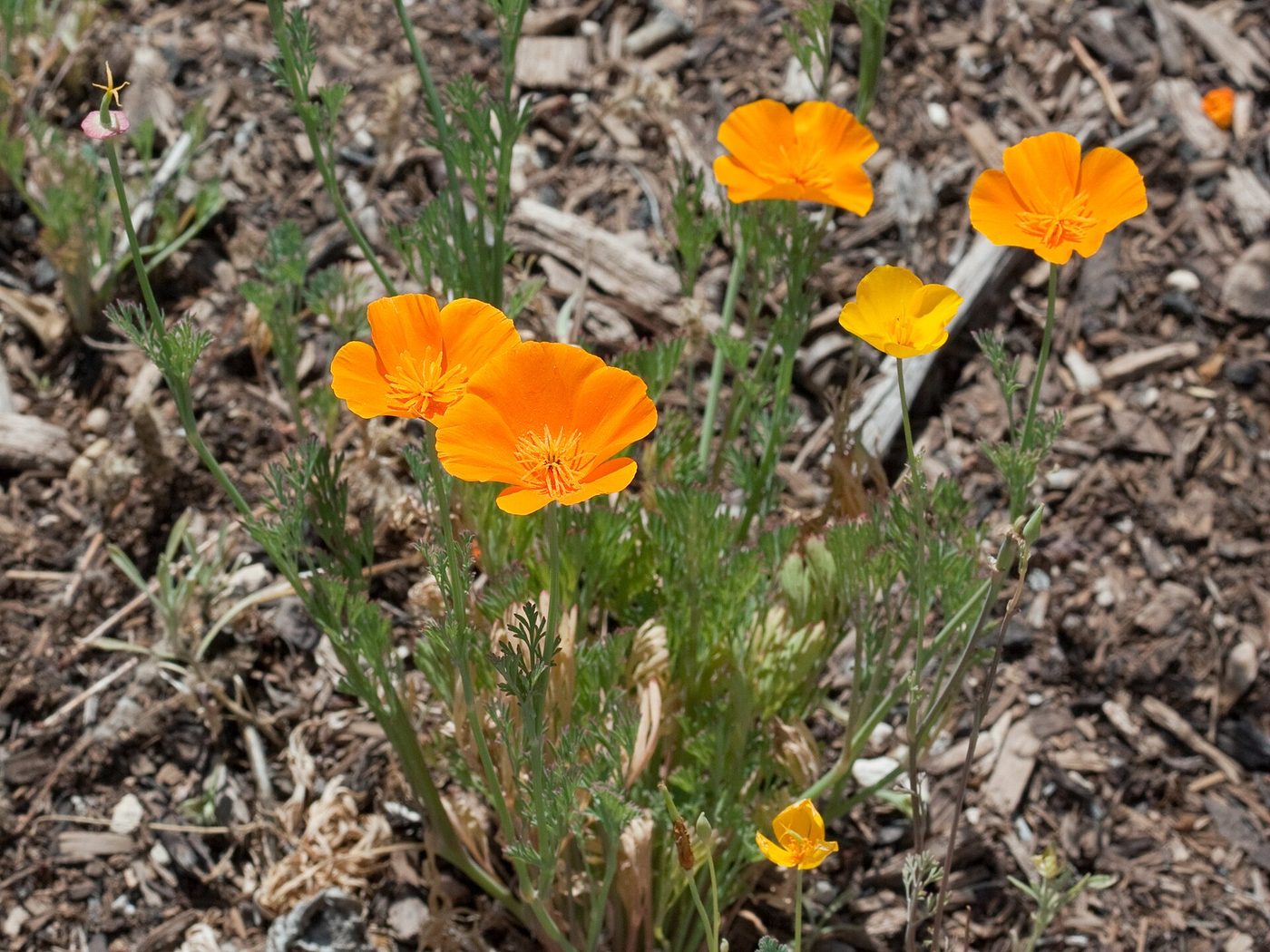
California poppy
Eschscholzia californica
The California poppy is a flower with silky golden-orange petals that carpets sunny grasslands with light, and is the state flower of California.
Characteristics
Cups of sun in the meadow
The California poppy is a herbaceous plant of the poppy family, Papaveraceae. Its flowers are cups of four silky, luminous petals in brilliant shades of orange, golden-yellow and sometimes red. The leaves are finely divided, of a glaucous blue-green. The flowers open in the sun and close at night and on cloudy days, a behaviour that in German earned it the nickname "little nightcap".
Origin and habitat
It is native to the western United States and Mexico, particularly California and Baja California, and has naturalised in many parts of the world, including Australia, South Africa and Europe. It grows wild in grasslands, slopes and sunny disturbed ground.
Cultivation
It is very easy to grow and very hardy. It wants full sun and a poor, sandy, well-drained soil; once established it is extremely drought-resistant. Sow it directly where it is to grow in spring, as it dislikes transplanting. It flowers for a long season, from summer into autumn, and self-seeds generously, reappearing each year.
Notable facts
It has been the official state flower of California since 1903, and its mass flowering paints whole hillsides orange in the famous super blooms. It had various uses in Native American herbalism. The plant contains alkaloids and is regarded as mildly toxic if eaten in quantity.
Care
It needs very little attention: no feeding, sparing watering and full sun. Removing faded flowers prolongs the bloom, but leaving a few allows self-seeding for the following year.
Flowering season
Practical tips
Water needs: Low, very drought-resistant — always check soil moisture before watering.
Prefers Full sun: provide the right light and rotate the plant for even growth.
Recommended soil: Poor, sandy and well-drained. Refresh the substrate every 1-2 years.
Dust the leaves with a damp cloth to support photosynthesis.
Feed during the growing season (spring-summer) and stop in winter.
Pros
- Long, luminous golden flowering
- Very drought-resistant
- Self-seeds, extremely easy to grow
Cons
- Dislikes transplanting
- Mildly toxic if eaten in quantity