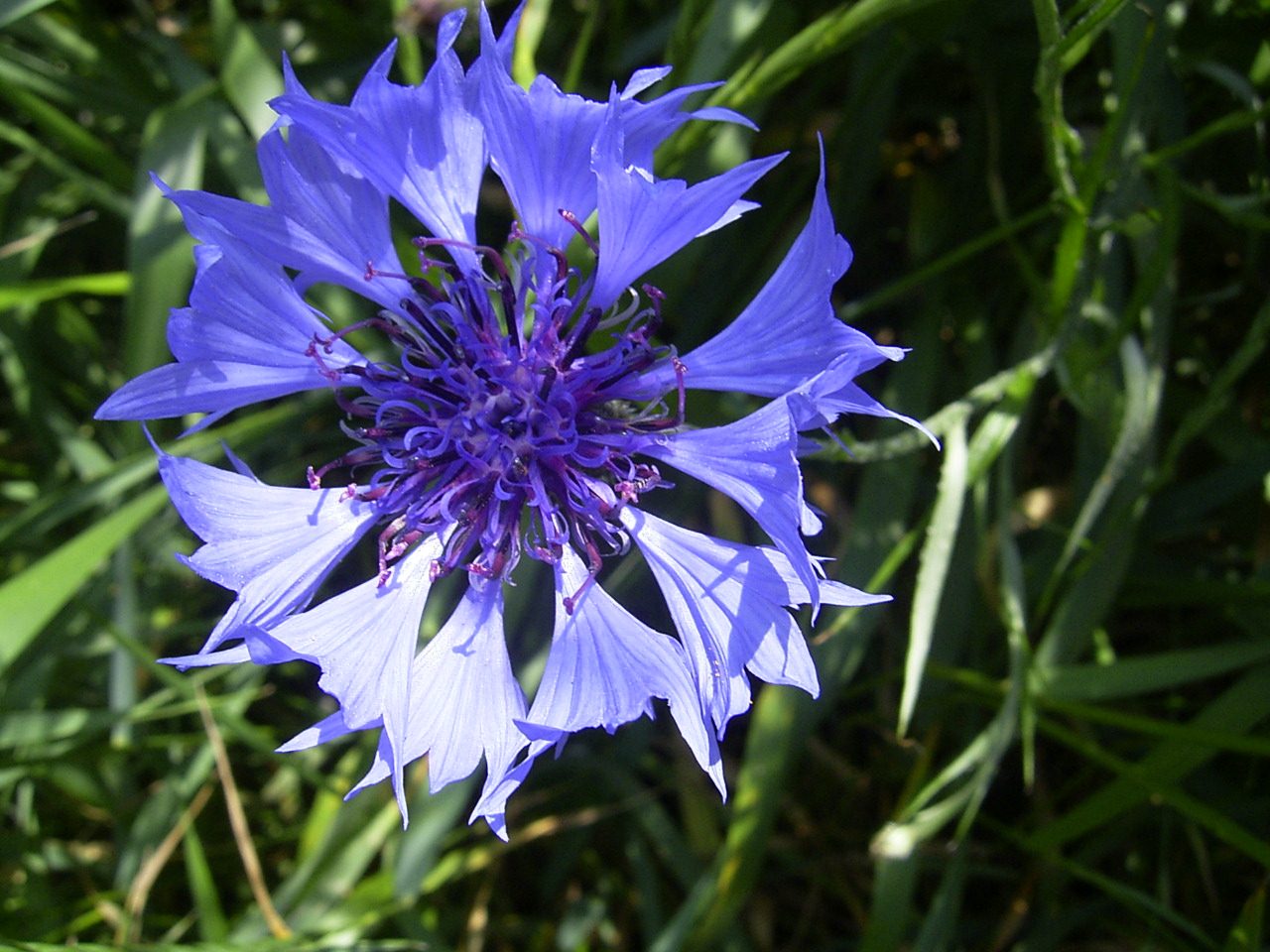
Photo: TeunSpaans · CC BY-SA 3.0
Cornflower
Centaurea cyanus
The cornflower is a delicate annual of the fields, famous for its intense blue colour, once a common weed among cereal crops.
Characteristics
The blue of the wheat fields
The cornflower is an annual herb of the daisy family, Asteraceae. It is famous for its intensely vibrant blue flowers, among the purest in the plant world, gathered in heads with fringed, tubular outer florets. The stems are slender, upright and branching, covered with fine greyish down, with narrow lance-shaped leaves. There are also cultivated varieties with pink, white and purplish flowers.
Origin and habitat
Native to Europe, it once grew abundantly as a weed in cereal fields, hence the name cornflower and its classification among arable plants. It favours open, sunny, well-drained ground, even poor.
Cultivation
It is very easy to grow from seed, sown in autumn or spring directly where it is to grow, in full sun. It is hardy, cold-resistant and tolerates drought well. It flowers for a long time in summer and is a valuable nectar source for bees, bumblebees and butterflies. It self-seeds readily.
Uses and facts
The flowers are edible and used to decorate dishes, salads and desserts; dried, they colour herbal and tea blends. The cornflower has strong symbolic value: it is a national flower in several countries and a memorial emblem in France. Due to intensive agriculture and herbicides, in the wild it has become much rarer than in the past.
Care
It needs little attention: sparing watering and no waterlogging. Removing faded flowers prolongs the bloom, while leaving some to ripen allows self-seeding for the following year.
Flowering season
Practical tips
Water needs: Low, drought-tolerant — always check soil moisture before watering.
Prefers Full sun: provide the right light and rotate the plant for even growth.
Recommended soil: Well-drained, even poor and stony. Refresh the substrate every 1-2 years.
Dust the leaves with a damp cloth to support photosynthesis.
Feed during the growing season (spring-summer) and stop in winter.
Pros
- Intense blue, among the purest in nature
- Valuable nectar source for pollinators
- Easy, hardy and self-seeding
Cons
- Annual: must be resown each year
- Has become rare in the wild