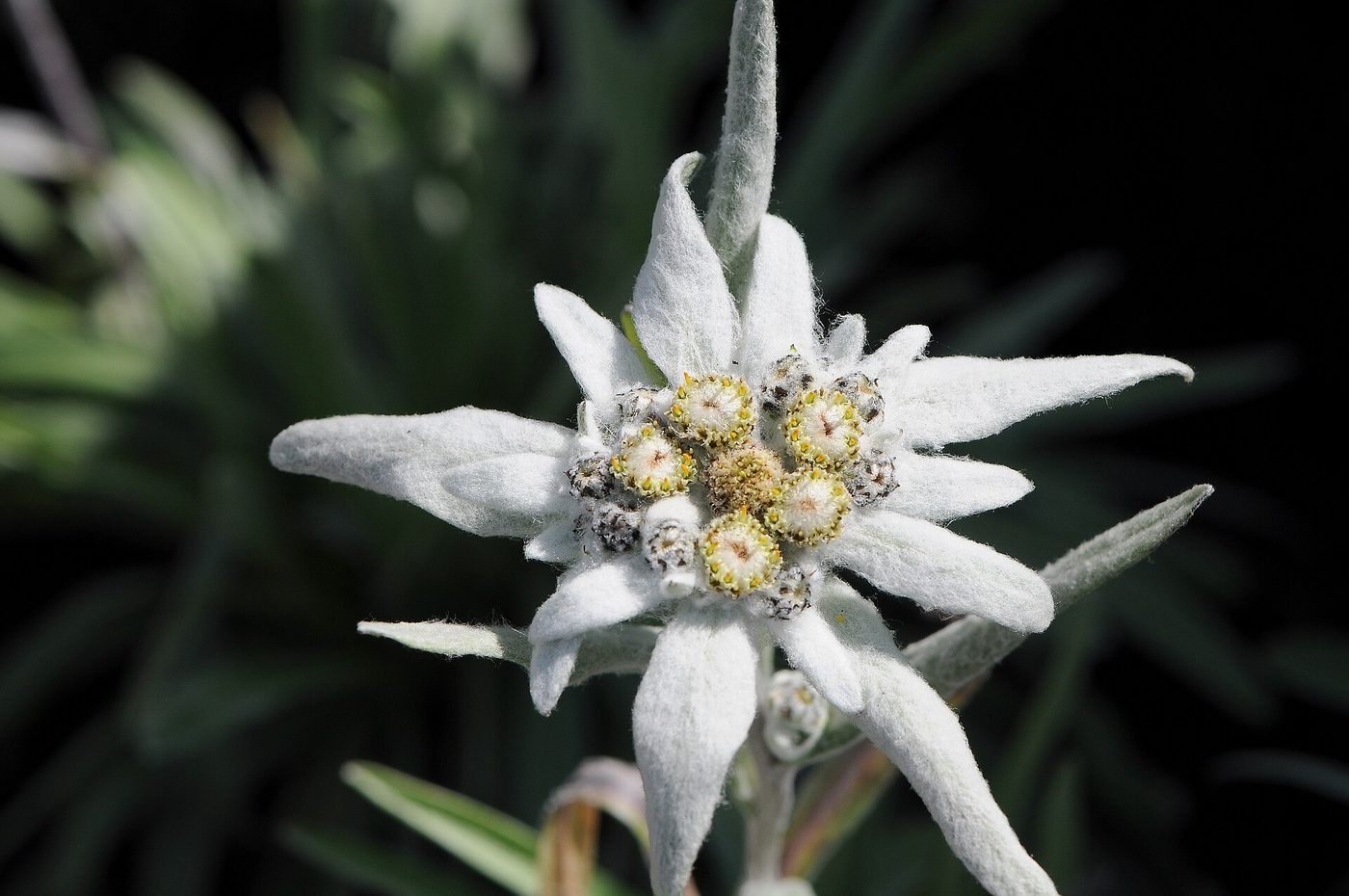
Photo: Böhringer Friedrich · CC BY-SA 2.5
Edelweiss
Leontopodium nivale
A symbol of the mountains, edelweiss grows among high-altitude rocks, wrapped in a white woolly down that protects it from the cold and the intense sun.
Characteristics
The flower of the peaks
Edelweiss, also known by its Italian name stella alpina, is perhaps the most famous and beloved mountain flower. What looks like a single white star-shaped flower is in reality a cluster of small yellow flowers at the centre, surrounded by modified leaves, called bracts, arranged in a star pattern and covered with a dense, soft white down. It is precisely this woolly, almost velvety appearance that makes it unmistakable and gives it a unique charm among the rocks of high altitudes.
Habitat and distribution
It grows on the mountains of Europe, in particular the Alps and other ranges, generally at high altitude, often above the tree line. It prefers calcareous soils, rocky grasslands, ledges and sunny slopes where few other plants can survive. It is a species adapted to an extreme environment of intense cold, wind, strong solar radiation and a short growing season.
Adaptations and cultivation
The famous white down is not just beautiful: it is a true protective 'coat'. By trapping a layer of air and reflecting light, it protects the plant from temperature swings, dehydration and the intense ultraviolet rays typical of high mountains. Edelweiss can also be grown in lowland rock gardens, provided it is given full sun, very well-draining and poor soil, and waterlogging, its main enemy, is avoided.
Curiosities
For centuries edelweiss has been a symbol of purity, courage and love of the mountains. In the past, picking it in the rugged places where it grows was considered a test of daring, so much so that it became linked to many alpine legends. It has become a cultural icon, present in coats of arms, songs and traditions of mountain regions.
Conservation
Precisely because of its charm, edelweiss was in the past picked excessively, endangering many populations. For this reason it is today a protected species in much of the alpine regions, where picking it in the wild is forbidden. Admiring and photographing it without tearing it up is the best way to help preserve it for those who come after us.
Flowering season
Practical tips
Water needs: Low, fears waterlogging — always check soil moisture before watering.
Prefers Full sun: provide the right light and rotate the plant for even growth.
Recommended soil: Very well-draining, poor, preferably calcareous. Refresh the substrate every 1-2 years.
Dust the leaves with a damp cloth to support photosynthesis.
Feed during the growing season (spring-summer) and stop in winter.
Pros
- Symbol flower of the Alps, of great charm
- Hardy and resistant to cold and intense sun
- Suited to rock gardens
- Non-toxic
Cons
- Fears waterlogging
- Slow growth
- Protected species: forbidden to pick in the wild