Photo: © Pierre André · CC BY-SA 4.0
King protea
Protea cynaroides
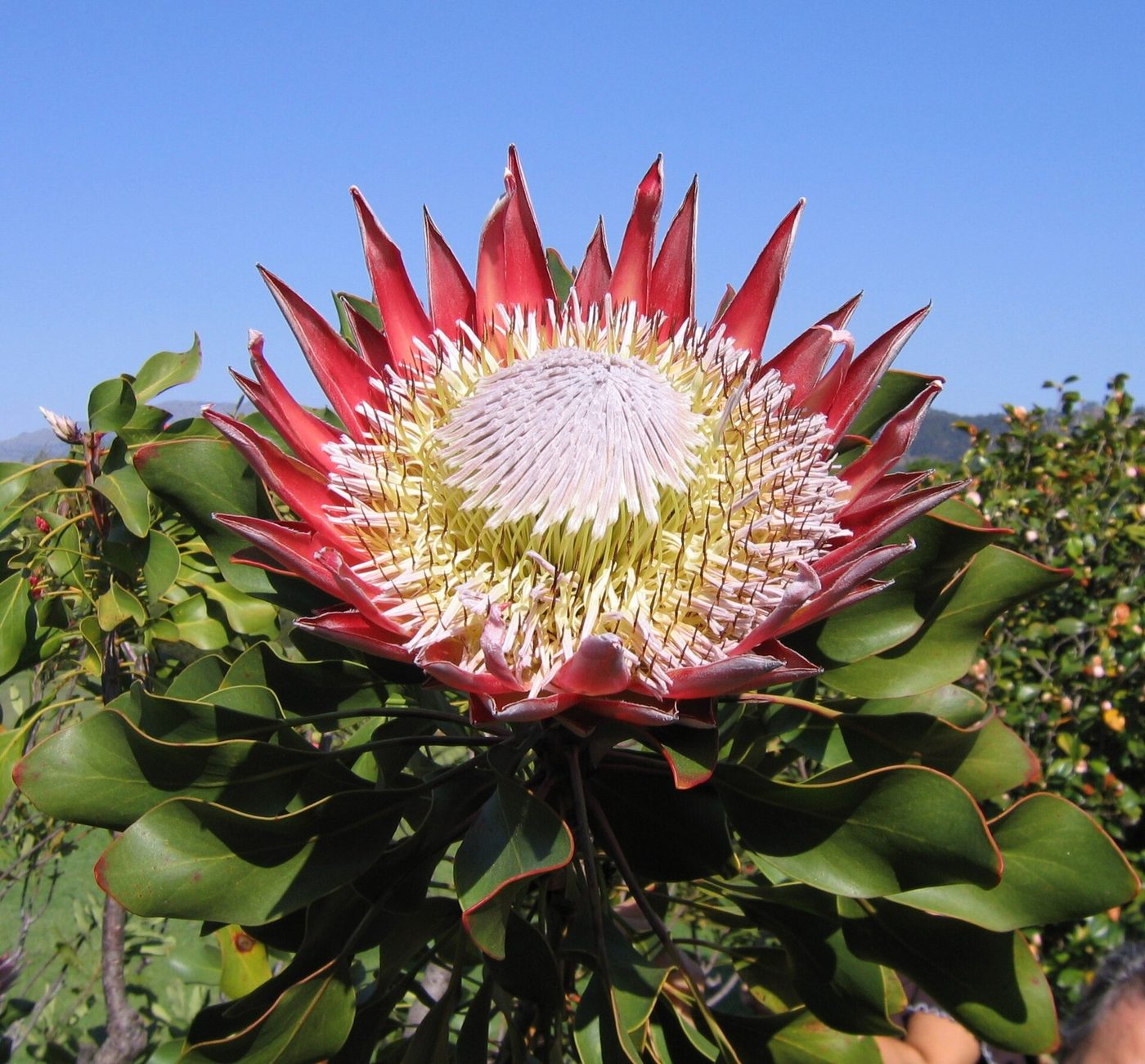
With its enormous cup-shaped flower surrounded by pointed bracts, the king protea is one of the most spectacular flowers in the world and a symbol of South Africa.
Characteristics
A gigantic, spectacular flower
The king protea, or giant protea, is a shrubby plant famous for its extraordinary flower, one of the largest and most striking in the plant world. What looks like a single, enormous corolla is in fact a cup-shaped inflorescence: a dense heart of small central flowers surrounded by a ring of leathery, pointed bracts, pink, red or cream in colour, which form a kind of crown. The flower can reach considerable size, even more than a hand's breadth across. Its leaves are leathery, oval and of an intense green.
Origin and habitat
The king protea is native to South Africa, where it grows in the Cape region, in a unique environment characterised by a shrubby vegetation called fynbos. It is perfectly adapted to a climate with hot, dry summers and mild winters, and to poor, acidic soils. It is the national flower of South Africa, of which it is a much-loved symbol.
Adaptations and cultivation
This plant is a masterpiece of adaptation to difficult environments. Like many fynbos plants, it is hardy and tied to an ecosystem shaped in part by periodic fires, which favour the regeneration of the vegetation. In cultivation it requires full sun, a very well-draining, acidic and poor soil, and moderate watering: it especially fears waterlogging and excess fertiliser. It is prized in Mediterranean-climate gardens and as a spectacular cut flower, much used in floral arrangements.
Curiosities
The name of the genus, Protea, recalls Proteus, the sea deity of Greek mythology able to change form, a reference to the extraordinary variety of shapes and colours that characterises these plants. The king protea, with its imposing flower, is the most famous and prized example.
Conservation
The king protea is widely cultivated all over the world, but in the wild, like all fynbos plants, it depends on the health of a fragile ecosystem rich in biodiversity, threatened by human expansion and the disruption of natural fires. Protecting the Cape Floristic Region is important for the survival of this and countless other unique species.
Practical tips
Water needs: Moderate, fears waterlogging — always check soil moisture before watering.
Prefers Full sun: provide the right light and rotate the plant for even growth.
Recommended soil: Very well-draining, acidic and poor. Refresh the substrate every 1-2 years.
Dust the leaves with a damp cloth to support photosynthesis.
Feed during the growing season (spring-summer) and stop in winter.
Pros
- Enormous, spectacular flower, among the most beautiful in the world
- National symbol of South Africa
- Excellent as a cut flower, even dried
- Suited to Mediterranean-climate gardens
Cons
- Fears waterlogging and excess fertiliser
- Does not tolerate intense frost
- Slow growth, precise soil needs