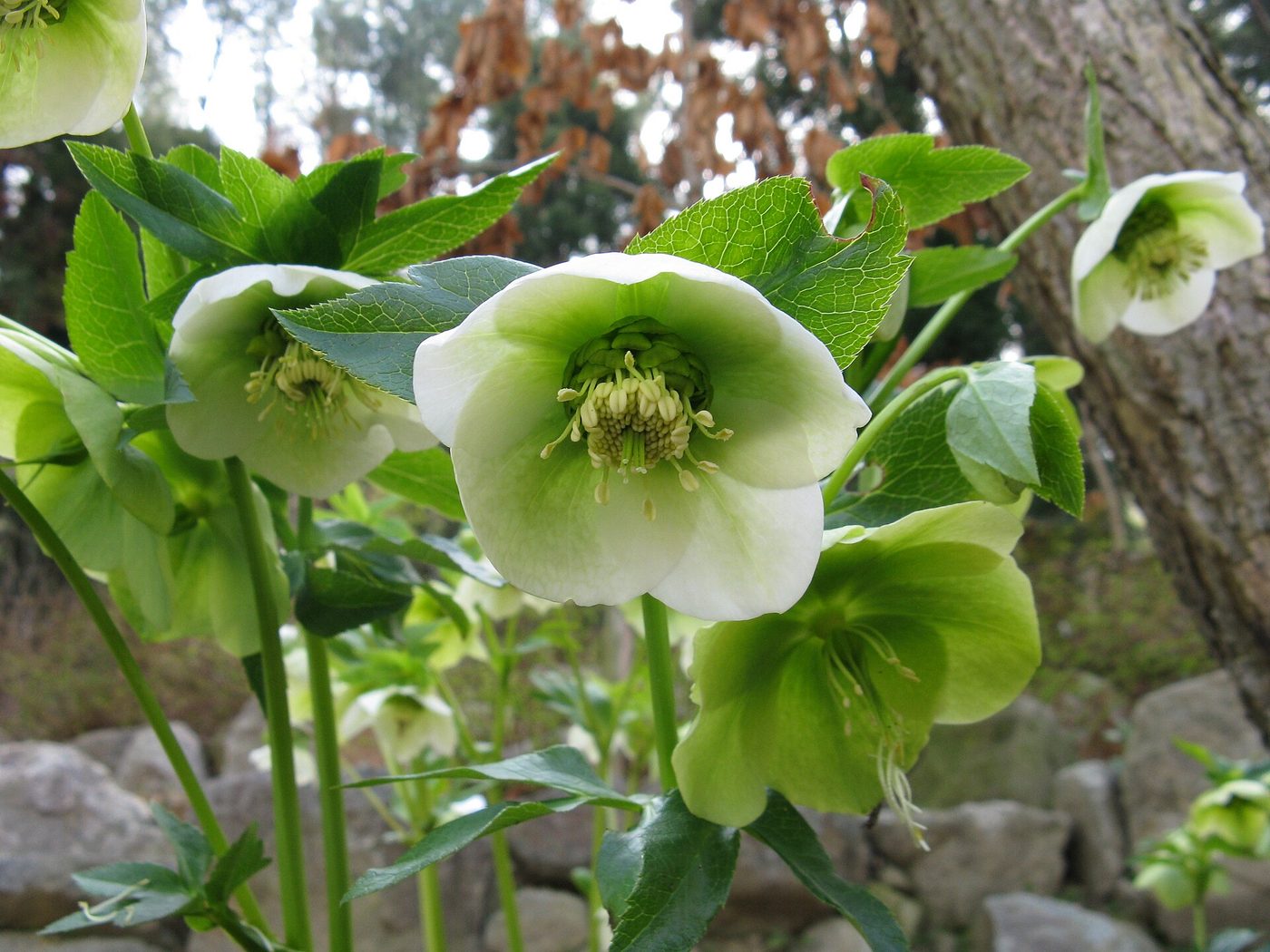
Photo: KENPEI · CC BY-SA 3.0
Lenten rose
Helleborus orientalis
A flower of still-cold days, the Lenten rose brings colour to the garden between late winter and early spring with elegant cups in soft hues, but it is poisonous.
Characteristics
A flower that defies the cold
The Lenten rose is a perennial herbaceous plant much prized for its early flowering, which occurs between late winter and early spring, when few other flowers enliven the garden. Its cup-shaped, slightly nodding flowers come in a range of delicate colours from cream white to pink, from purple to greenish, often with elegant spotting inside. Its leaves, leathery and a fine dark green, form elegant clumps and persist for a long time. It is a close relative of the Christmas rose, but flowers a little later, around the Lenten period, from which it takes its name.
Habitat and cultivation
Native to the regions of south-eastern Europe and western Asia, it grows naturally in undergrowth and shady areas. In the garden it is ideal for brightening corners in shade or partial shade, under trees or along north-facing walls, where few other plants thrive. It loves cool, rich and well-drained soils, and is a hardy, cold-resistant plant. Once established it needs little care and over time forms fine clumps that can even self-seed.
A poisonous plant
Like all hellebores, the Lenten rose is poisonous: all its parts contain substances that are irritant and toxic if ingested. For this reason it should be grown with awareness of its nature, keeping it out of the reach of children and pets, and handling it carefully, since the sap can irritate sensitive skin.
Care and curiosities
The Lenten rose is a long-lived and generous plant: every year it gives an abundant and lasting flowering, which can extend for weeks. It is much loved by gardeners precisely because it offers colour at a time of year when the garden is often bare. Its flowers, which defy the frost, are an early announcement of the spring to come.
In the garden
Thanks to its discreet elegance and its ease of cultivation in shade, the Lenten rose is perfect for shady borders, woodland gardens and natural arrangements. It is also little grazed by animals precisely because of its toxicity, which makes it resistant to browsing.
Flowering season
Practical tips
Water needs: Regular, cool soil — always check soil moisture before watering.
Prefers Shade or partial shade: provide the right light and rotate the plant for even growth.
Recommended soil: Rich, cool and well-drained. Refresh the substrate every 1-2 years.
Dust the leaves with a damp cloth to support photosynthesis.
Feed during the growing season (spring-summer) and stop in winter.
Pros
- Flowers in winter, when few other flowers exist
- Delicate and elegant colours
- Hardy and easy in shade
- Long-lived and little grazed by animals
Cons
- Poisonous in all its parts
- The sap can irritate sensitive skin
- Slow growth