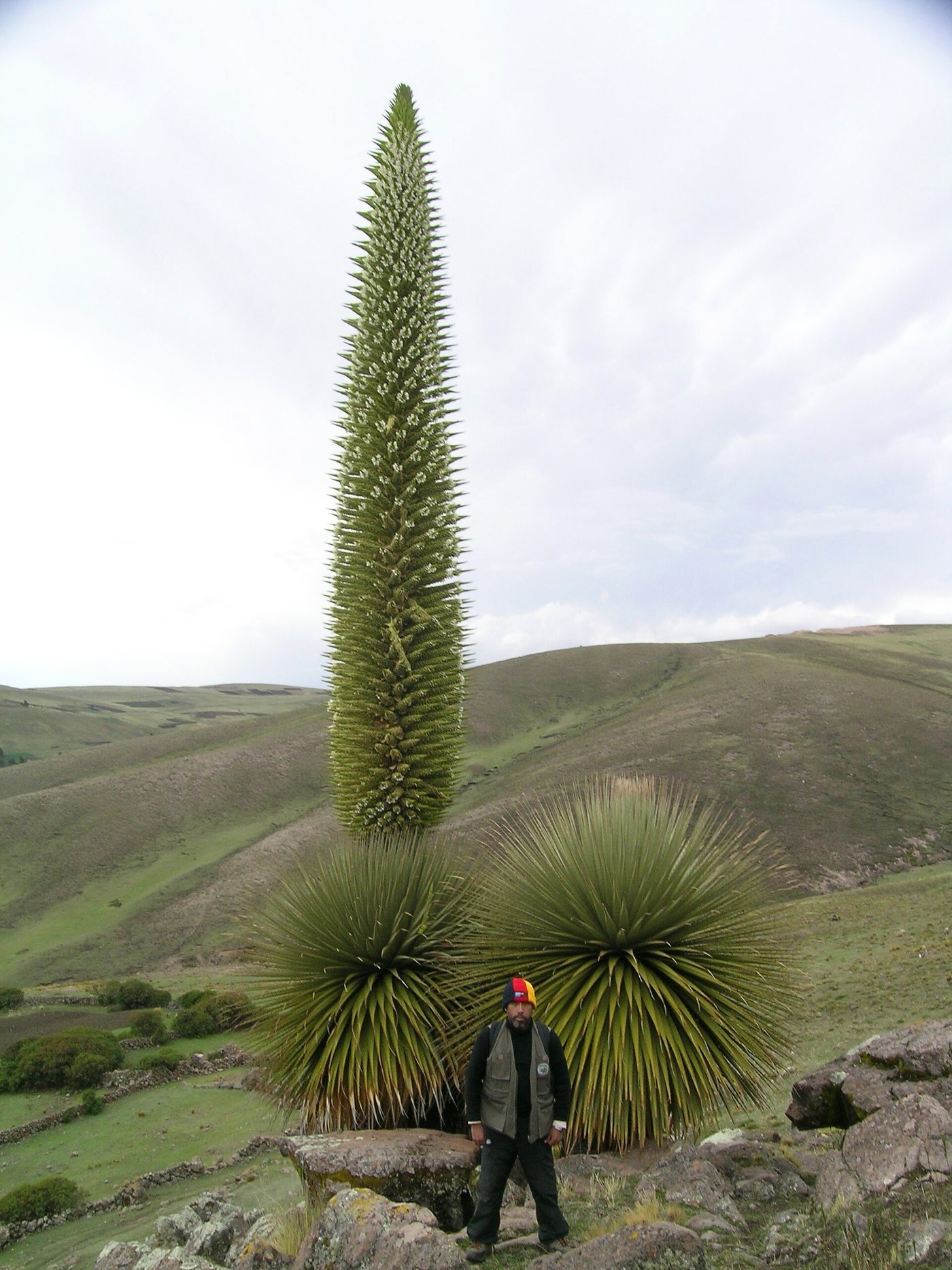
Photo: Pepe Roque · CC BY-SA 3.0
Queen of the Andes
Puya raimondii
The Queen of the Andes is the world's largest bromeliad: it flowers only once after decades, raising a gigantic inflorescence up to 15 metres tall.
Characteristics
The world's largest bromeliad
The Queen of the Andes (Puya raimondii), also called titanka, is the largest bromeliad species alive. For most of its very long life it appears as a dense, ball-shaped rosette of stiff, leathery leaves, long and pointed, edged with hooked spines. Then, just once, it produces a gigantic inflorescence that rises like a colossal candelabra up to about 15 metres tall, covered in thousands of flowers and able to produce millions of seeds.
Habitat and range
It is endemic to the high Andes of Peru and Bolivia, where it grows in the puna, the cold high-altitude grassland, generally above 3,500–3,800 metres, on sunny, well-drained slopes. It is adapted to extreme cold, wind and intense sunlight.
Life cycle
It is a monocarpic plant: it grows extremely slowly for many decades — even a century — storing energy, flowers just once in a spectacular burst, and then dies, leaving survival to the huge quantity of seeds it produces. Its mass flowering is a rare and memorable event for the people of the Andes.
Did you know?
Its large flowers attract many pollinators, including birds and insects. Unfortunately its spiny structure can trap small birds, which sometimes become caught among the leaves.
Conservation
The IUCN lists it as Endangered. Populations are declining because of its restricted range, fires, grazing, collection and climate change, which threaten an already very slow and vulnerable reproductive cycle.
Practical tips
Water needs: Moderate; well-watered slopes — always check soil moisture before watering.
Prefers Full high-altitude sun: provide the right light and rotate the plant for even growth.
Recommended soil: Rocky, free-draining high-mountain soil. Refresh the substrate every 1-2 years.
Dust the leaves with a damp cloth to support photosynthesis.
Feed during the growing season (spring-summer) and stop in winter.
Pros
- The world's largest bromeliad
- Gigantic, spectacular inflorescence
- An icon of Andean flora
Cons
- Endangered
- Flowers and dies only once (monocarpic)
- Very slow growth and reproduction