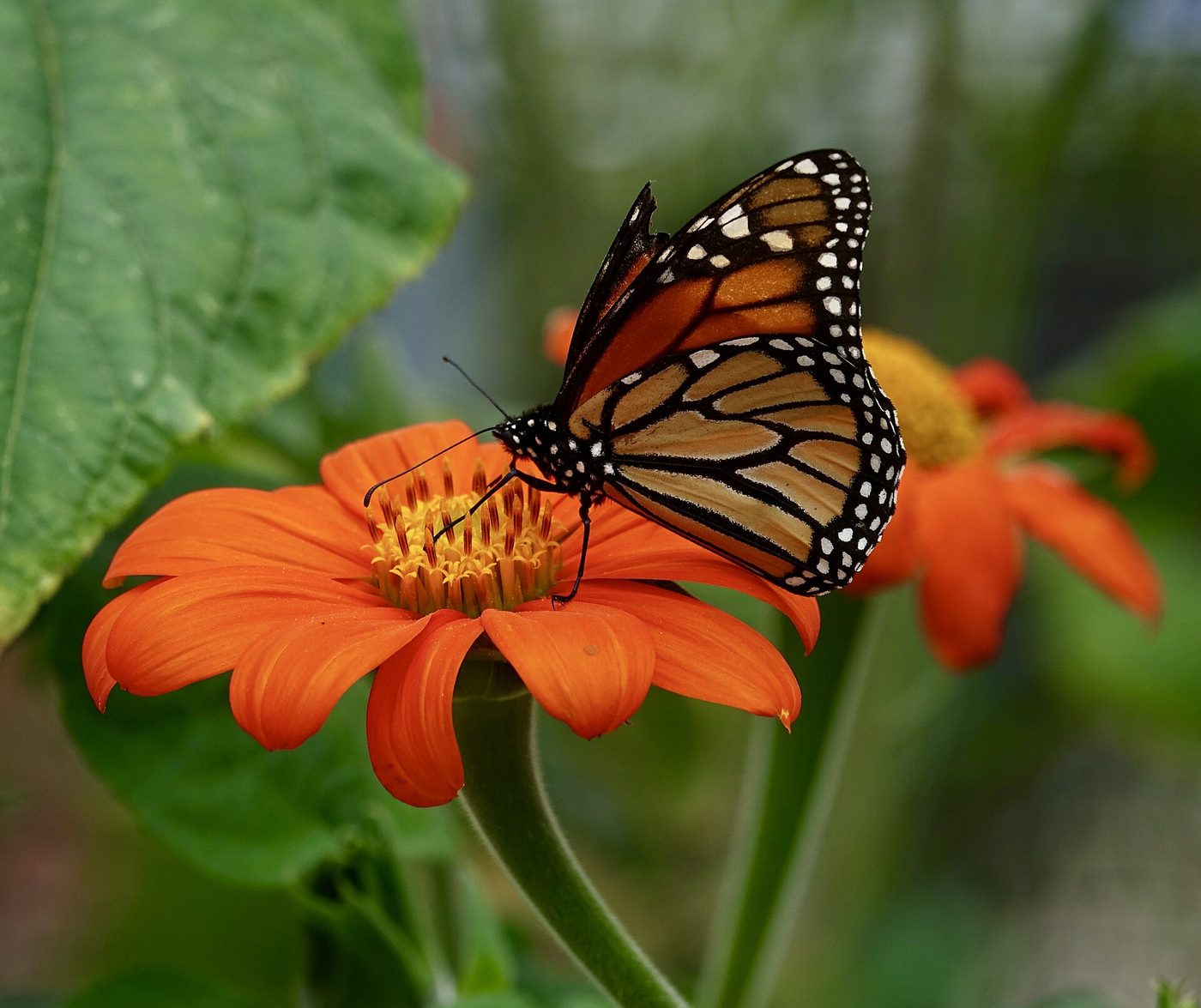
Mexican sunflower
Tithonia rotundifolia
The Mexican sunflower is a vigorous, tall annual with large orange-red flowers, a magnet for butterflies and pollinators in summer gardens.
Characteristics
Orange flowers for butterflies
The Mexican sunflower, or tithonia, is an annual herb of the daisy family, Asteraceae, the same as sunflowers and daisies. It grows fast into tall, robust bushes that can exceed two metres, with broad, rough leaves. The flowers are large daisy-like heads of an intense orange-red with a yellow centre, carried on long stalks. They are a real magnet for butterflies — especially monarchs — bees and other pollinators.
Origin and habitat
It is native to Mexico and Central America, where it grows in seasonally dry tropical areas. It loves warmth and full sun and is adapted to periods of drought.
Cultivation
It is very easy to grow from seed, sown in spring in full sun, on well-drained, even poor soil. It grows very quickly and flowers for a long season, from summer into autumn. It tolerates drought well and needs no rich soil; indeed, too fertile a soil favours leaves at the expense of flowers. It dislikes frost and completes its cycle in a single season.
Garden use and facts
It is perfect for tall borders, butterfly gardens and colourful backdrops. The cut flowers last well in a vase. Thanks to their fast growth and abundant biomass, related species of the genus Tithonia are used in tropical agriculture as green manure.
Care
It needs little attention: moderate watering and no waterlogging. Removing faded flowers prolongs the bloom. In very windy spots the tall stems may need support.
Flowering season
Practical tips
Water needs: Moderate, drought-tolerant — always check soil moisture before watering.
Prefers Full sun: provide the right light and rotate the plant for even growth.
Recommended soil: Well-drained, even poor. Refresh the substrate every 1-2 years.
Dust the leaves with a damp cloth to support photosynthesis.
Feed during the growing season (spring-summer) and stop in winter.
Pros
- Orange-red flowers, a butterfly magnet
- Very fast growth and long flowering
- Drought-resistant and undemanding
Cons
- Annual: must be resown each year
- Tall stems may need support