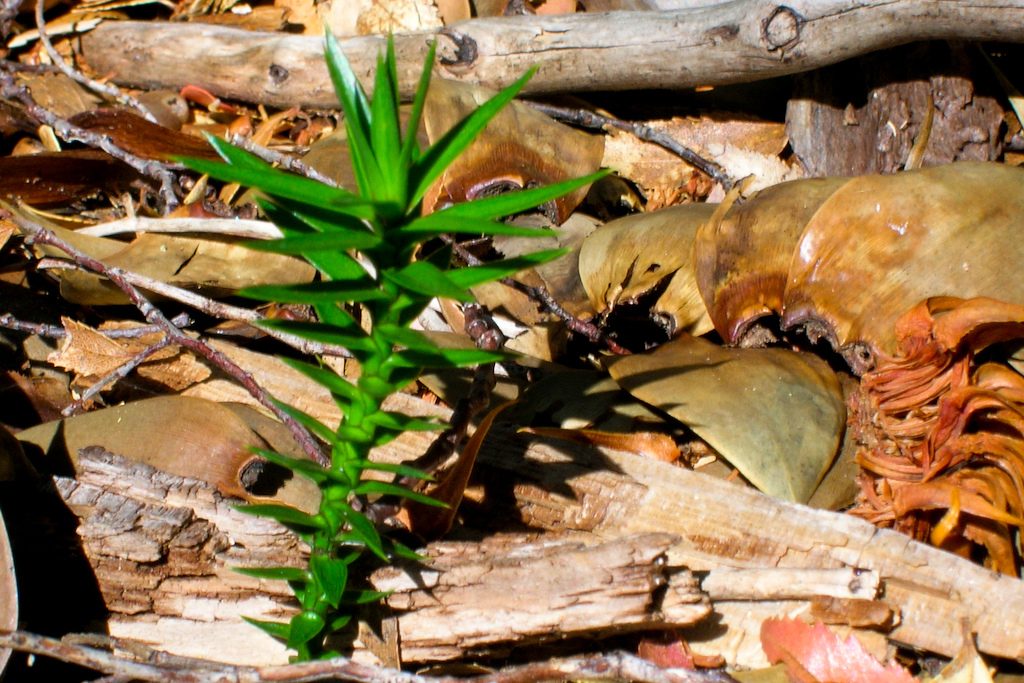
Monkey puzzle tree
Araucaria araucana
With its rigid branches covered in triangular, spiny leaves, the monkey puzzle tree is a majestic and very ancient conifer, a true living fossil of the Andes.
Characteristics
A prehistoric tree
The monkey puzzle tree, also often called the Chilean pine, is one of the most fascinating and ancient trees on the planet, a true living fossil belonging to a lineage of conifers dating back millions of years. It has an unmistakable appearance: a straight, columnar trunk, topped in adult specimens by an umbrella-like crown, and rigid branches covered with leathery, triangular, pointed and sharp leaves arranged in a spiral. It is precisely these spiny leaves, which make climbing difficult, that inspired the curious nickname linked to monkeys.
Habitat and distribution
The monkey puzzle tree is native to the mountainous regions of South America, between Chile and Argentina, where it grows on the slopes of the Andes and in high-altitude temperate forests. It is adapted to cool, humid climates and to soils that may even be poor and volcanic. It is a long-lived tree that can live for many centuries, and some monumental specimens reach considerable ages.
Precious seeds and cultural value
The monkey puzzle produces large cones containing edible seeds, the so-called Andean 'pine nuts', rich in nutrients. These seeds have for centuries been an important food for the indigenous peoples of the region, in particular the Mapuche, for whom the tree also has a deep sacred and cultural value. The gathering of its fruits is traditionally tied to the life of these communities.
Cultivation
Thanks to its spectacular form, the monkey puzzle is grown as an ornamental tree in parks and large gardens in many temperate regions of the world. It loves sunny positions and well-drained soils, and is quite hardy, although it grows slowly. It requires adequate space, given the size it can reach in adulthood.
Conservation
The monkey puzzle tree is classified as an endangered species. The main threats are the destruction of forests, fires and environmental changes affecting its natural habitat. Protecting the ancient Andean forests where it grows is essential for the survival of this extraordinary witness of the planet's distant past.
Practical tips
Water needs: Regular, cool soil — always check soil moisture before watering.
Prefers Full sun: provide the right light and rotate the plant for even growth.
Recommended soil: Well-drained, even poor or volcanic. Refresh the substrate every 1-2 years.
Dust the leaves with a damp cloth to support photosynthesis.
Feed during the growing season (spring-summer) and stop in winter.
Pros
- Living fossil with a spectacular appearance
- Long-lived, living for many centuries
- Produces edible, nutritious seeds
- Imposing ornamental for parks and large gardens
Cons
- Endangered species in the wild
- Slow growth
- Requires much space in adulthood