Welwitschia
Welwitschia mirabilis
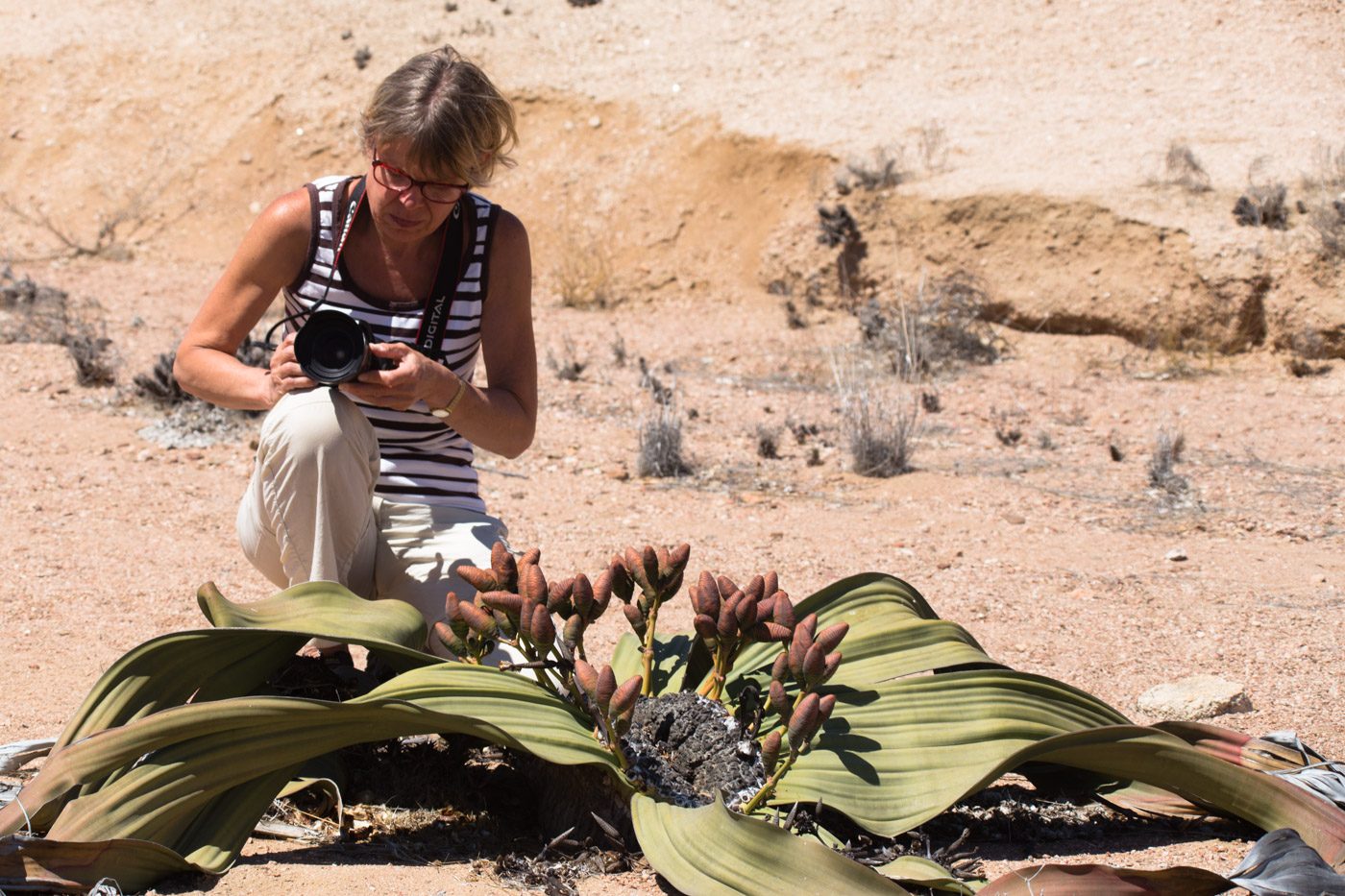
A living fossil of the desert: the welwitschia produces only two leaves in its entire life and can survive for over a thousand years in the sands of the Namib.
Characteristics
A living fossil
The welwitschia is one of the strangest and most extraordinary plants in the world, so much so that it is considered a true 'living fossil'. It resembles no other plant: from a short, broad, concave woody stem sprout only two strap-shaped leaves that grow continuously throughout the plant's life. Over time the wind and sand tear them into many strips, giving the plant a dishevelled appearance, almost that of a heap of dried leaves. In reality those two leaves are the same ones it has had since birth.
Habitat and distribution
The welwitschia lives in one of the most arid environments on the planet: the Namib Desert, between Namibia and Angola, in south-western Africa. Here rainfall is very rare, and the plant has learned to exploit above all the moisture of the fog that rises from the ocean. With long roots and its broad leaves it manages to capture and retain every available drop of water, surviving where almost no other plant could.
Longevity and biology
One of the most incredible aspects of the welwitschia is its longevity: many specimens are centuries old and some are estimated to exceed a thousand years, true living monuments of the desert. It is a gymnosperm plant, distantly related to conifers, with separate male and female specimens that produce cone-like structures for reproduction. Its growth is extremely slow, adapted to an environment where every resource is precious.
Curiosities
Its scientific name recalls the wonder this plant inspires: the term 'mirabilis' means 'marvellous'. It has become a natural symbol of Namibia, where it is protected and admired as one of the botanical wonders of the African continent.
Conservation
The welwitschia grows only in a limited area and in extreme conditions, which makes it a precious species to safeguard. It is protected by local laws that forbid its collection in the wild. Conserving its fragile desert habitat is essential to ensure the survival of this unique plant, a living witness of very distant geological eras.
Practical tips
Water needs: Very little: it exploits fog moisture — always check soil moisture before watering.
Prefers Full sun, desert environment: provide the right light and rotate the plant for even growth.
Recommended soil: Sandy, very well-draining. Refresh the substrate every 1-2 years.
Dust the leaves with a damp cloth to support photosynthesis.
Feed during the growing season (spring-summer) and stop in winter.
Pros
- A true living fossil, unique in the world
- Extraordinary longevity, even over a thousand years
- Adapted to survive in an extreme desert
- Botanical symbol of Namibia
Cons
- Grows only in specific desert environments
- Extremely slow growth
- Protected species, delicate to cultivate