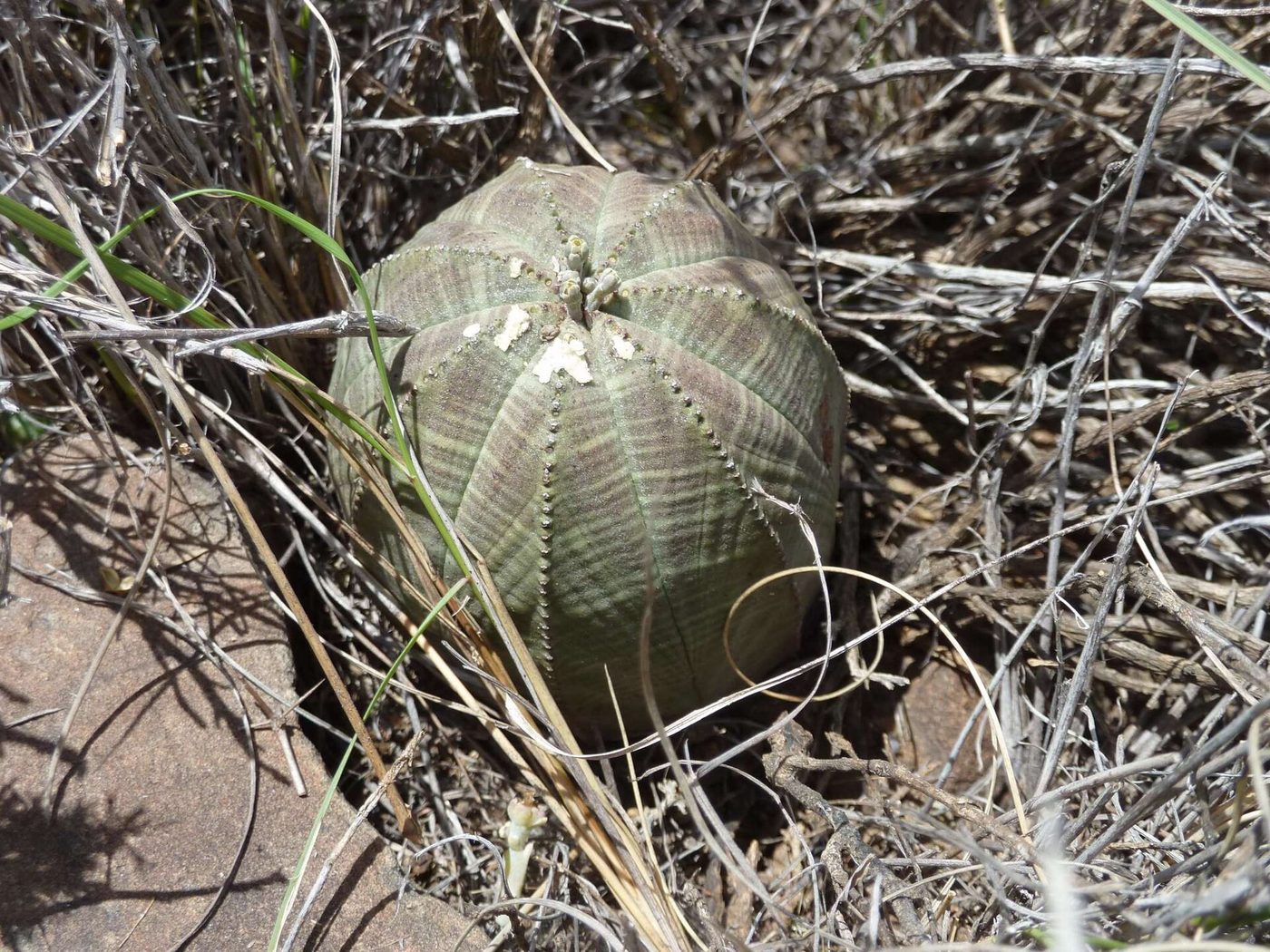
Photo: Andrew Hankey · CC BY-SA 4.0
Baseball plant
Euphorbia obesa
The baseball plant is a small South African succulent with an almost perfectly spherical shape — a curious ribbed green globe, much loved by collectors.
Characteristics
A succulent shaped like a ball
The baseball plant (Euphorbia obesa) is a small succulent with an almost perfectly spherical shape, resembling a baseball. Its spineless, greyish-green body bears eight regular ribs and fine cross-bands that form an elegant chequered pattern. With age it may elongate slightly, becoming cylindrical. Like all euphorbias, if cut it exudes a toxic, irritating white latex. It is dioecious: male and female plants are separate, each producing small, inconspicuous flowers at the top.
Origin and habitat
It comes from a very restricted area of the arid Karoo, in the Eastern Cape province of South Africa. It grows on sandy soils, often sheltered beneath small shrubs, blending in with its surroundings so well that it can be hard to spot.
Cultivation and care
It is a prized but very slow-growing succulent. It wants plenty of light or full sun, a very well-drained mineral substrate and sparse watering: let the soil dry out completely between waterings, and almost stop watering in winter. It dislikes waterlogging, which causes rot, and it is not frost-hardy.
Did you know?
Its unusual, symmetrical shape has made it one of the most sought-after succulents among collectors worldwide. Its latex, common to all euphorbias, must be handled with care, and the plant is best kept away from children and pets.
Conservation
In the wild it is rare and protected: over-collection of wild specimens has threatened its populations, leading to its inclusion in conventions on trade in at-risk species. However, it is widely propagated in cultivation, which relieves pressure on wild plants.
Practical tips
Water needs: Sparse: typical of succulents — always check soil moisture before watering.
Prefers Full sun or very bright light: provide the right light and rotate the plant for even growth.
Recommended soil: Very free-draining, sandy-mineral cactus mix. Refresh the substrate every 1-2 years.
Dust the leaves with a damp cloth to support photosynthesis.
Feed during the growing season (spring-summer) and stop in winter.
Pros
- Unusual, symmetrical spherical shape
- Small and easy to keep in a pot
- Very drought-resistant
Cons
- Toxic, irritating latex
- Rots with too much water
- Very slow-growing and rare in the wild