African Lion
Panthera leo
Characteristics
Temperament
Only social felid in the world. Lives in prides of 5-30 related individuals. Female cooperative hunting. Males protect territory (114 dB roar, audible at 8 km). IUCN Vulnerable since 1996.
Diet
Strict carnivore. Hunts ungulates (wildebeest, zebra, buffalo, antelope). Female cooperative hunting dawn/dusk, sprint 50-60 km/h. Male eats up to 40 kg/sitting. Success rate 20-25%. Practises kleptoparasitism.
The African Lion (Panthera leo) is one of the largest and most iconic felids in the world, universally known as "the king of beasts" for its imposing size and its symbolic role of strength, courage and royalty. Second largest cat on the planet (only the tiger exceeds it in size), it is the only truly social felid: it lives in complex family groups called "prides", comprising 5-30 related individuals. Adult males weigh 150-250 kg and are distinguished by the spectacular mane, symbol of virility and dominance. Apex predator of African savannas, it is in dramatic decline: the global population has fallen by over 50% in the last 50 years (from 100,000 to 20,000-30,000 specimens) due to habitat loss, conflict with herders, poaching. It has been classified Vulnerable (VU) by IUCN since 1996; some subspecies such as the Asian lion (P. l. persica) are critically endangered.
Classification and category
The Lion belongs to the order Carnivora, family Felidae (felines), subfamily Pantherinae, genus Panthera. The genus comprises 5 large "roaring" felids: lion (P. leo), tiger (P. tigris), jaguar (P. onca), leopard (P. pardus) and snow leopard (P. uncia). The five members of the genus are distinguished from other felids by an anatomical modification of the hyoid bone and vocal cords that allows the emission of the roar, audible up to 8 km away. Modern systematics distinguishes two main subspecies: P. leo leo (West/Central African Lion, India) and P. leo melanochaita (East/Southern African Lion). The dimensions are impressive: males 150-250 kg, length 1.7-2.5 m, withers height 1.1-1.2 m, tail 70-100 cm; females 110-180 kg, length 1.4-1.8 m. The record for a male in the wild is 313 kg (South Africa, 1936). Longevity is 10-14 years in wild females (more territorially stable), 8-12 years in males (harsher life due to territorial fights), 20-25 years in captivity.
Habitat and distribution
The African Lion's habitat consists of open savannas, grasslands, acacia woodlands, semi-deserts, mountains up to 4,000 m elevation. It prefers areas with sufficient visibility to hunt and low vegetation to hide during ambushes. It is absent from rainforests (preferred by the leopard) and extreme deserts. Historically the species was widespread throughout Africa, from Southern Europe to the Middle East, to northern India; today the distribution is reduced by over 80% compared to the past.
Currently the Lion lives in fragments of savanna in: Sub-Saharan Africa (largest populations in Tanzania — about 14,000 specimens in Serengeti/Selous, Kenya — Masai Mara, South Africa — Kruger NP, Botswana — Okavango, Zambia, Zimbabwe, Mozambique). West Africa: less than 400 remaining specimens (Burkina Faso, Niger, Senegal, Benin) — population classified Critically Endangered. India: the subspecies P. l. persica survives only in the Gir Forest (Gujarat) with about 670 specimens (2020 census) — recovery from only 20 specimens in the early 1900s. The global IUCN conservation status is Vulnerable (VU) since 1996. The main threats are: habitat loss (urbanisation, agriculture), decline of wild prey (human hunting of herbivores), human-lion conflict (retaliatory killings after attacks on livestock), poaching for the illegal trade in parts (teeth, claws, bones for Chinese traditional medicine), sport hunting (legal in some countries). The Lion is protected by CITES Appendix II (Appendix I in India). Active conservation programmes: Lion Recovery Fund, Panthera Project Leonardo, Born Free Foundation.
Diet
The African Lion is a strict carnivore and apex predator, at the top of the food chain of African savannas. It hunts practically any animal it can take down: main prey are large ungulates — wildebeest, zebras, buffalo, gemsbok, kudu, eland, antelope, gazelle, impala. Secondary prey: warthogs, Thomson's gazelles, Grant's gazelles, ostriches, giraffes (rare and dangerous hunt). Occasional prey: young hippopotamuses, young elephants, young rhinoceroses — only large prides. They are able to take down prey 3-5 times their weight, such as 800 kg buffalo. The hunting technique is specialised: cooperative group hunting, performed mainly by females at dawn or dusk. Lionesses coordinate the attack with complex strategies: some act as "centre" (advance towards the prey), others as "wings" (flank them). The sprint speed is 50-60 km/h for short stretches (200 m); lethal bite to the throat of the prey (suffocation) or to the nape. Males rarely hunt; when they do, they attack large prey (buffalo, hippopotamuses) or defend captured prey.
Consumption is impressive: an adult male eats up to 40 kg of meat in a single sitting (15-20% of its weight), then may not eat for 3-5 days. The average requirement is 5-8 kg of meat per day. After a successful hunt, the feeding hierarchy is rigid: first the dominant adult males, then the females, finally the cubs — this causes high infant mortality in periods of scarcity. The lion drinks infrequently; in the Kalahari deserts it survives by obtaining water from the blood and fluids of prey. Hunting success rate: 20-25% (vs 30-40% for African wild dogs, 50%+ for cheetahs in short chases). They practise much kleptoparasitism: they steal prey from cheetahs, leopards and hyenas (they are able to drive away even a 70 kg spotted hyena from its food).
Physical features
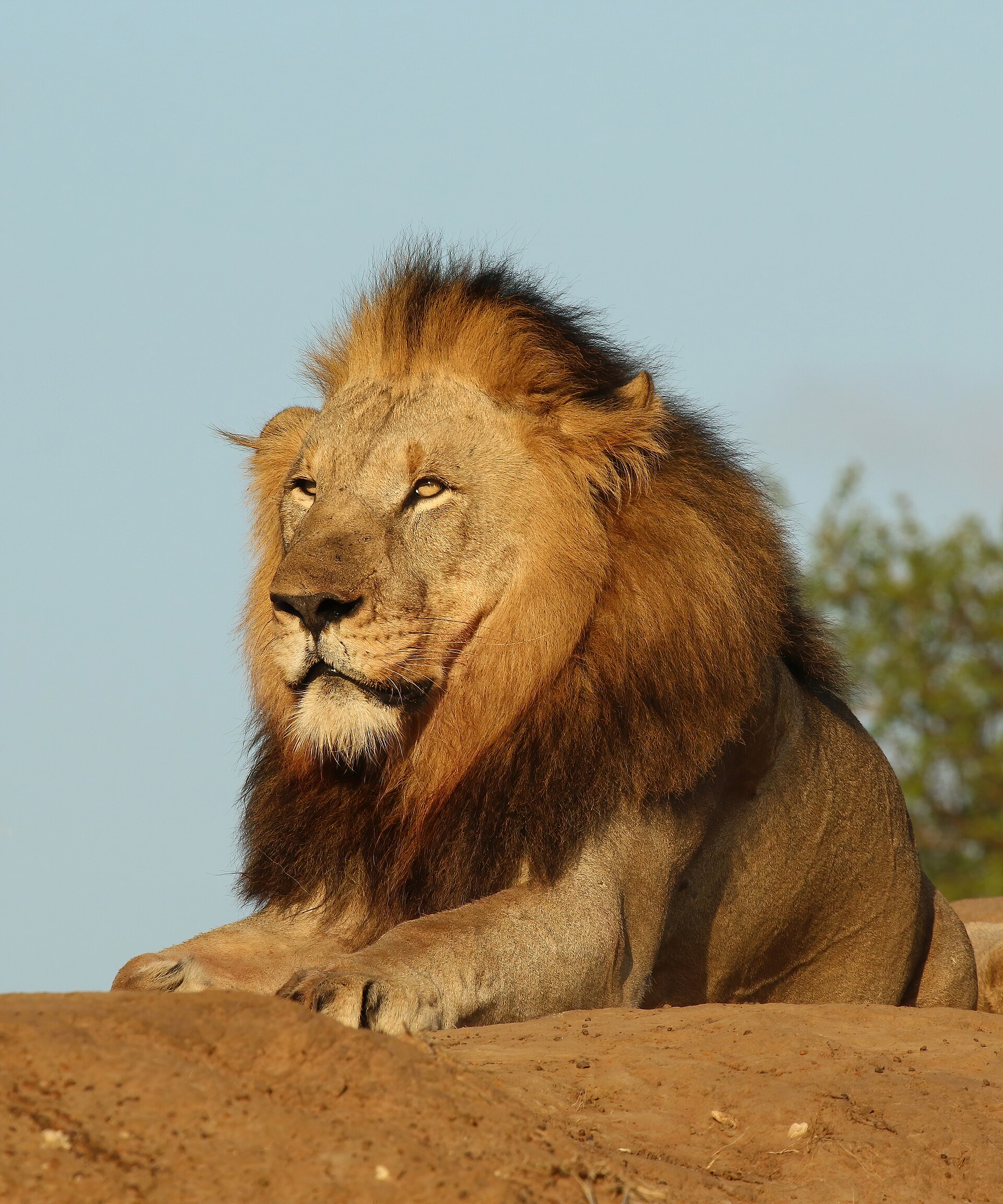
The Lion is a felid with a massive, muscular, powerful body, perfectly adapted to hunting large prey. The weight of adult males is 150-250 kg (record 313 kg), of females 110-180 kg — one of the most marked sexual dimorphisms among felids. The head-body length is 1.7-2.5 m in males, with a tail of 70-100 cm ending in a characteristic black tuft of hair (present only in adult lions, after 5 months of age). The withers height is 1.1-1.2 m. The colour of the coat is basically uniform tawny-sand, varying from light pale yellow to dark brown. The belly is lighter. Cubs have typical rosette spots on the legs and sides that disappear within the first year (at 6 months they are already faded).
The most distinctive feature of adult males is the mane: long, thick hairs that cover the head, neck, shoulders, chest. The mane begins to grow at 1-2 years and reaches maximum expression at 5-6 years. Colour and thickness of the mane depend on genetics, age, hormones, climate. Lions from hot areas (East Africa) tend to have shorter and lighter manes; those from cold areas (Moroccan Atlas, now extinct) had long and dark manes. The black mane is considered a sign of dominant male: studies have shown that females prefer to mate with dark-maned males, and that intruder males are more dissuaded by dark-maned males. The skull is massive, with powerful temporal and jaw muscles; the bite force is 650 psi (about 4,450 N). The teeth include 4 characteristic 7-8 cm long canines. The legs are powerful: the claws are retractable (8 cm), the thumb has a modified fifth digit (dewclaw). The vision is excellent; the lion sees 6× better than us in the dark thanks to the tapetum lucidum. The hearing is fine: it can hear prey at 1.5 km. The sense of smell is less developed compared to dogs.
Behaviour and curiosities
The Lion is the only social felid in the world. It lives in prides usually composed of 5-15 individuals, exceptionally up to 30: a coalition of 2-4 related adult males (brothers), 4-10 related adult females (mothers, daughters, sisters), and cubs of all ages. Females are the stable nucleus of the pride and remain in the same pride for life; young males are expelled at 2-3 years and become "nomads" for 2-3 years before trying to conquer a pride from another rival male coalition. Pride territories cover 30-400 km² depending on prey abundance. They are actively defended with olfactory marking (urine, scent glands), scratching on trunks, and especially the roar. An adult male roars with a power of 114 decibels, audible at 8 km — one of the most powerful sounds in the terrestrial animal kingdom.
Reproduction is not seasonal: it occurs throughout the year, but with synchronisation among the females of the pride (so all cubs are born in the same period, an advantage for communal care). The gestation lasts 105-115 days; the female gives birth to 2-4 cubs (occasionally 5-6) in an isolated den, where she keeps them hidden for 6-8 weeks before reintroducing them to the pride. Cubs weigh 1-2 kg at birth, are blind (eyes open at 7-14 days) and covered with spots. Pride females practise communal nursing: a mother feeds the cubs of another without problems (cooperation typical of social mammals). Cub survival rate: 20-50% in the first 2 years. An ethically shocking but biologically strategic practice is infanticide: when a new male coalition conquers a pride, it kills all the cubs of the previous pride (to reset the reproductive cycle of the females).
Historical and cultural curiosities: the lion has been the most represented animal in human art ever — from the Chauvet cave painting (35,000 years ago) to medieval heraldry, to the FCI emblem (Italian and worldwide). In ancient Mesopotamia the lion was a symbol of the king; in Egypt it was a divinity (the lion-goddess Sekhmet). Ethological curiosity: lions sleep 16-20 hours a day — they are among the most "lazy" mammals — an energy-saving strategy in the heat. Females are mainly active between 6:00 PM and 6:00 AM. Scientific curiosity: unlike other felids, African lions do not often climb trees (apart from the populations of Akagera in Rwanda and Lake Manyara in Tanzania which are famous for this local adaptive behaviour). Dark curiosity: the "Tsavo Maneaters" is a famous event of 1898: two maneless male lions killed 35-135 British Railways workers near the Tsavo River (Kenya) before being shot by Colonel John Patterson. The skulls are at the Field Museum in Chicago. The modern explanation: the two lions had sick teeth that prevented normal hunting, forcing them into opportunistic predation on vulnerable humans. Linguistic curiosity: the Lion of the Dutch Flag is actually... a lion! It appears in dozens of national flags and emblems in Europe (Spain, Belgium, England, Scotland, Norway, Estonia, Bulgaria, etc.).
Pros
- Felino più sociale al mondo: vive in branchi di 5-30 individui
- Icona culturale: simbolo di forza e regalità da 35.000 anni
- Forza fisica: morso 650 psi, scatti 50-60 km/h
- Longevità 10-25 anni a seconda dell'ambiente
Cons
- Specie Vulnerabile IUCN: -50% in 50 anni
- Detenzione privata vietata in quasi tutto il mondo (CITES II)
- Pericoloso per l'uomo: storia 'Tsavo Maneaters'
- Leoni Asiatici (P.l.persica): solo 670 esemplari rimasti