Caracal
Caracal caracal
Characteristics
Temperament
Solitary, territorial, nocturnal-crepuscular. Iconic 10-12 cm black ear tufts (longest of any felid). Record 3+ m vertical jump to catch birds in flight ("skyhopping"). Speed 80 km/h. Sacred in Ancient Egypt. Hunting success 80% — highest among felids.
Diet
Strict carnivore. Hares/rabbits (50% of diet), birds in flight (caught with vertical 3+ m "skyhopping"), hyraxes, small antelopes, rodents, reptiles. Hunting success 80% — highest among felids. Can live without free water (hydration from prey). 1-2 kg meat/day.
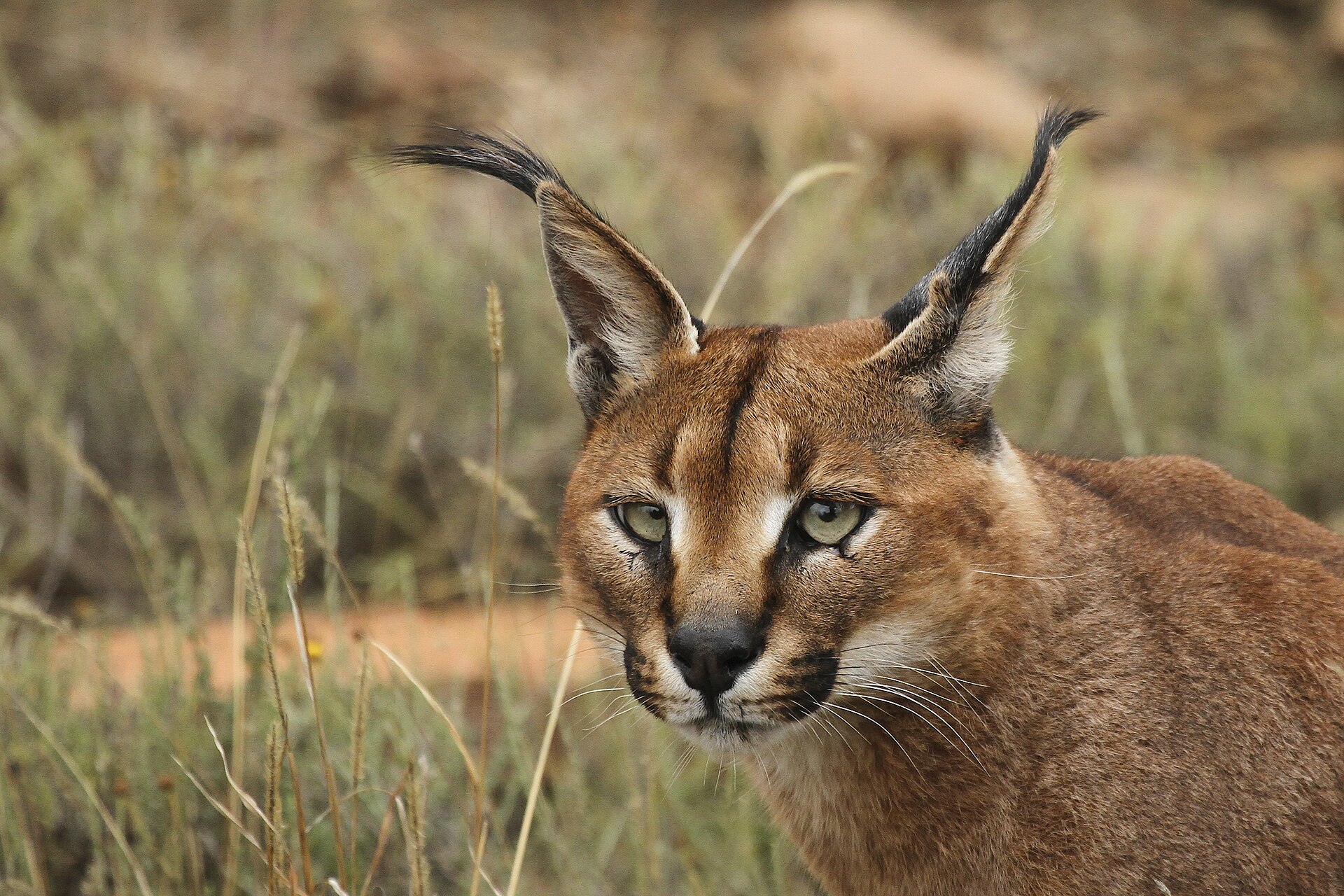
The Caracal (Caracal caracal), also known as the "desert lynx" or "Persian lynx" (but it is NOT a true lynx!), is a medium-sized cat (8-19 kg, 60-90 cm head-body length) distributed across an enormous region: all sub-Saharan Africa, the Middle East, central-western Asia, up to central India. It is the most iconically recognisable of the small/medium cats thanks to the long black tufts on its ears (10-12 cm, the longest of any cat), which give it an unmistakable "alien" appearance. The scientific and popular names derive from the Turkish "karakulak" meaning "black ears". The most spectacular feature is its extraordinary jumping ability: the Caracal can jump over 3 metres vertically (record 4 m), catching birds in flight with a unique technique called "skyhopping" — perfected to hunt sparrows, ducks, gallinaceans that take off in flight. Sprint speed: 80 km/h for short distances. Sacred in Ancient Egypt, depicted in Theban tombs and funerary statues, it was a symbol of pharaonic guardianship. IUCN status: Least Concern (LC) global, but with regional populations in decline and classified as Near Threatened in Asia, Critically Endangered in North Africa.
Classification and category
The Caracal belongs to the order Carnivora, family Felidae, subfamily Felinae (NOT Pantherinae like tigers, lions, leopards and jaguars), genus Caracal. Important: despite the "lyncoid" appearance (robust body, tufted ears), the Caracal is NOT a true lynx: the true lynx (genus Lynx: Lynx canadensis, Lynx lynx, Lynx pardinus, Lynx rufus) are in a different genus. The Caracal is more closely related to:
- African Golden Cat (Caracal aurata): same genus, rare cat of African rainforests
- Serval (Leptailurus serval): close relative, also African
- Asian Golden Cat (Catopuma temminckii): more distant relative
The genus Caracal is monotypic (1 single species currently). Phylogenetically, the Caracal diverged from the common lineage about 8.5 million years ago in the late African Miocene. There are 3 recognised subspecies (Kitchener et al., 2017, IUCN Cat Specialist Group):
- C. c. caracal — East and South Africa (main population)
- C. c. nubicus — North and West Africa
- C. c. schmitzi — Asia (Middle East, Caucasus, India, Central Asia)
The morphological parameters: weight 8-19 kg (M: 12-19 kg, F: 8-13 kg); head-body length 60-90 cm; tail 18-34 cm (relatively short, 1/3 of body); height at withers 40-50 cm. Longevity: 12-15 years in nature, up to 19-21 years in captivity. Sexual maturity: 12-18 months. Gestation: 69-81 days; litter of 1-6 kittens (average 3). Growth: kittens born blind (200-300 g), open eyes at 6-10 days, independent at 12 months.
Habitat and distribution
The Caracal is an extremely adaptable cat, present in numerous habitats:
- Open savannas (main habitat in Africa)
- Semi-arid steppes and thorn woodlands
- Dry forests
- Rocky deserts (Sahara, Namib, Kalahari, Arabian deserts) — can survive without free water, extracting hydration from prey
- Mediterranean scrubland (North Africa, Turkey)
- Mountain forests up to 3,000 m (Ethiopia, India)
Does NOT tolerate: dense rainforests, cold tundras/alpine zones. Historical distribution covered all of Africa (excluding central forests) and south-west Asia up to India. Today:
- Sub-Saharan Africa: all, healthiest population (hundreds of thousands of individuals)
- North Africa: Morocco, Algeria, Tunisia, Libya, Egypt, Sahara — population much declined, classified CR (Critically Endangered) in some areas
- Middle East: Arabian Peninsula, Iran, Iraq, Israel — small, fragmented populations
- Central Asia: Turkmenistan, Uzbekistan, Tajikistan — decline
- Caucasus/Turkey: critical population, ~50-100 specimens
- India: Rajasthan and Gujarat, severely declined population — about 50-100 individuals (Critically Endangered locally)
Global IUCN conservation status: Least Concern (LC) since 2016, based on the healthy African population. Global estimates: >50,000 mature individuals. Asian and North African populations are in significant decline. CITES: Appendix I for Asian populations, Appendix II for African.
Threats: habitat loss (agricultural expansion, urbanisation), retaliation killings (predation on small livestock, especially goats and sheep), illegal skin trade (local African market), poaching for "exotic pet" (popular in the Middle East and USA, illegal). In India and North Africa, it is one of the rarest species. Conservation in Iran: the National Asian Caracal Programme (2018) identified 60-150 surviving individuals, with habitat declining by 50%. In South Africa, where the population is abundant, the Caracal is considered a "problem" by farmers and killed legally — a controversial issue.
Diet
The Caracal is a strict carnivore, an opportunistic predator. Hunts preferably at dusk and night (nocturnal-crepuscular), but can also hunt by day in cool areas. Diverse diet:
- Small-medium mammals: hares, rabbits (50% of diet in Africa), hyraxes, daman, ground squirrels, jerboas, mice — it is the most effective hare hunter among felids
- Birds: guinea fowl, francolins, columbids, sparrows, geese, ducks. Catching birds in flight is the legendary specialty of the Caracal
- Large mammals (occasional): dik-dik gazelles, young antelopes, Thompson's gazelle cubs, lambs, kids
- Reptiles: lizards, monitors, snakes
- Rodents and small mammals: 30-40% of consumed biomass
- Fish: occasional, near waterholes
The "skyhopping" hunting technique is one of the most spectacular behaviours in the cat world. The Caracal hides in ambush near a bush or rock; when a flock of birds takes flight (alerted by its presence), the Caracal jumps vertically with an explosive propulsion from its powerful hind legs. It can reach 3-4 metres in height and in a single leap catch 2-3 birds simultaneously with its front paws (one strike for each!). This technique has earned it the nickname "feline acrobat". It is filmed in numerous nature documentaries as one of the most impressive cat behaviours.
The Caracal is one of the few cats that can live without free water for long periods: hydration from prey (meat contains 60-70% water), particularly in deserts where water is scarce. Quantity: 1-2 kg of meat per day. Hunting success: 80% (one of the highest among felids — higher than tiger, lion, leopard, cheetah!). Mother-cub pairs hunt together, teaching techniques.
Physical features
The Caracal has a slender, athletic, muscular body. The proportion is "lyncoid" — elongated body, long legs (especially the hind), relatively short tail. The base colour is uniformly tawny-sandy, from yellow-brown to brick-red, depending on the regional population. The belly is cream-white, with occasional small dark spots. Exceptionally, melanistic variants (completely black) have been documented (5 known cases, mainly Uganda and East Kenya).
The face has distinctive features:
- Facial mask: black line from upper lip to eye, dark under-eye
- Eyes: amber-yellow, large, frontal, with vertical slit pupils
- Nose: pink-brown, well developed
- Whiskers: long, white (tactile radar)
The ears are the most iconic and distinctive feature of the Caracal:
- Ear length: 8-10 cm
- Black tufts at the tip: 10-12 cm (record 15 cm!) — the longest of any living cat
- Tuft function: debated — according to some studies they serve for visual communication between conspecifics (signal of emotional state), to improve hearing (channelling sounds), or for camouflage (breaking the head profile)
- Mobility: the Caracal has 20 muscles to control each ear independently — can rotate them 180° and locate sounds in 3D with extraordinary precision
- Inner fur: white, contrasting with the outer black
The legs are notable:
- Hind: longer and more powerful than front — responsible for record jumps. Highly developed gluteal and quadriceps muscles
- Front: robust, with retractable claws 4-5 cm
- Foot pads: small, with insulating hairs — protection from hot desert terrain
The tail is short (1/3 of body, 18-34 cm) — not particularly useful for balance in vertical jumping (unlike cheetah and leopard). The teeth: canines 2.5-3 cm long, perfect for the "killing bite" to the nape of the prey. The senses: EXCEPTIONAL hearing (best among felids thanks to giant ears), excellent sight (nocturnal 6× more sensitive than humans), good smell.
Behaviour and curiosities
The Caracal is a solitary, territorial, nocturnal-crepuscular animal. Adult males have territories of 30-200 km², females of 5-25 km²; male territories overlap with those of 2-4 females. Territorial marking: urine sprays, scratches on trunks, visible faeces. Communication: limited vocalisations — meows, growls, hisses, purrs (yes! the Caracal also purrs, like all Felinae). Cannot roar (lacks the laryngeal adaptation of Pantherinae).
The reproductive behaviour: the season is all year in tropical areas, spring-summer in temperate areas. Females give birth in dens (rocky cavities, holes between rocks, abandoned dens of other animals). The kittens are altricial (200-300 g, blind, dependent). Growth: open eyes at 6-10 days, teeth at 30 days, leave the den at 4 weeks, accompany the mother to hunt at 4 months, independent at 12 months. Females give birth every 1-2 years.
Famous curiosities: the Caracal in Ancient Egypt. It was considered sacred and was depicted in:
- Tombs of the Valley of the Kings (Thebes, 1500-1200 BC): wall paintings depict caracals next to pharaohs or as guardians
- Bronze statues (late period, 700-300 BC) preserved at the Cairo Museum and British Museum
- Caracal mummies have been found in Egyptian tombs: the animals were embalmed and buried with pharaohs as pets/spiritual protectors
- Hieroglyphs associated the Caracal with the goddess Mafdet (justice and protection against snakes)
"Caracals in flight" curiosity: famous viral videos show the Caracal jumping 3-4 m vertically to catch birds. The first high-speed (slow-motion) video of a Caracal "skyhopping" was filmed by BBC Earth in 2013 for "Africa": a Caracal catches 2 pigeons simultaneously in a single leap. Biomechanical study: the jump is propelled by the hind legs with 5 G acceleration, reaching 7 m/s at take-off. Caracal "skoincoaching" sport curiosity: in some regions of Central Asia (Iran, Kazakhstan), the Caracal was tamed to hunt birds in place of falcons (tradition "Caracal polo"). Caracals were taken on a leash to flocks of pigeons/wild ducks, and released for "hunt-and-catch". Ancient tradition documented until the 19th century, now extinct.
Domestication curiosity: the Caracal is one of the wild cats occasionally tamed as a domestic (exotic) pet. IN the USA, some states allow them to be kept legally. However, they remain wild animals: even raised from kittens, they retain predatory instincts, mark territory (urine), can injure or kill other pets, and need large spaces. Not recommended as pets by most experts. In Europe, possession is subject to CITES permits. In the Emirates, owning a Caracal is a status symbol for the rich.
"Karakulak" curiosity: the scientific name and almost all local names (including Italian "Caracal") derive from the Turkish "karakulak" = "black ears" — referring to the famous black tufts. The name entered scientific use through the German explorer Johann von Schreber who formally described the species in 1776.
Speed curiosity: the Caracal can reach 80 km/h in short sprints (50-100 m), the fastest medium-sized cat after the cheetah. By comparison: leopard 60 km/h, wolf 65 km/h, greyhound 70 km/h, gazelle 75 km/h, cheetah 110 km/h. Giant ears curiosity: the Caracal can hear rodents 30 cm under the ground thanks to superlative hearing (range 20 Hz - 65 kHz, beyond the ultrasound of bats and rodents). "Jaw closing force" curiosity: 100 PSI (below lion's 650 but above many medium cats). The "killing bite" to the nape of the prey is precise and lightning fast. Zulu folklore curiosity: the Zulus of South Africa call the Caracal "indabu" and considered it a symbol of speed and precision. Traditional warriors wore necklaces made of Caracal tufts to attribute to themselves the qualities of the cat. Longevity curiosity: the oldest documented caracal was "Marvin" at the Berlin Zoo, lived 21 years 3 months (1972-1993). Melanistic coat curiosity: only 5 melanistic caracals (completely black) have ever been photographed in the wild, all in Uganda and eastern Kenya. The mutation is due to the ASIP gene (Agouti Signaling Protein), recessive. Subspecies and hybrids curiosity: some breeders (illegally, in the USA) have crossed Caracals with domestic cats (Felis catus) to create the "breed" "Caracat" — sterile result and with serious behavioural problems. Practice condemned by international canine organisations. Arab folklore curiosity: in pre-Islamic poetry and in the tales of "One Thousand and One Nights", the Caracal appears as a symbol of agility and desert royalty. Skin curiosity: the Caracal's fur is traditionally used in North Africa for ceremonial hats — practice today prohibited by CITES Appendix II.
Pros
- Capacità di salto verticale spettacolare (3+ m, record 4 m)
- Successo di caccia 80% — il più alto tra i felidi
- Iconici ciuffi neri sulle orecchie (i più lunghi di qualsiasi felide)
- Resistente a clima desertico (può vivere senza acqua libera)
Cons
- Vulnerabile alla persecuzione per ritorsione (predazione di bestiame piccolo)
- Popolazioni asiatiche/nord-africane in declino critico
- NON adatto come animale domestico (selvatico, territoriale)
- Commercio illegale CITES Appendice II/I