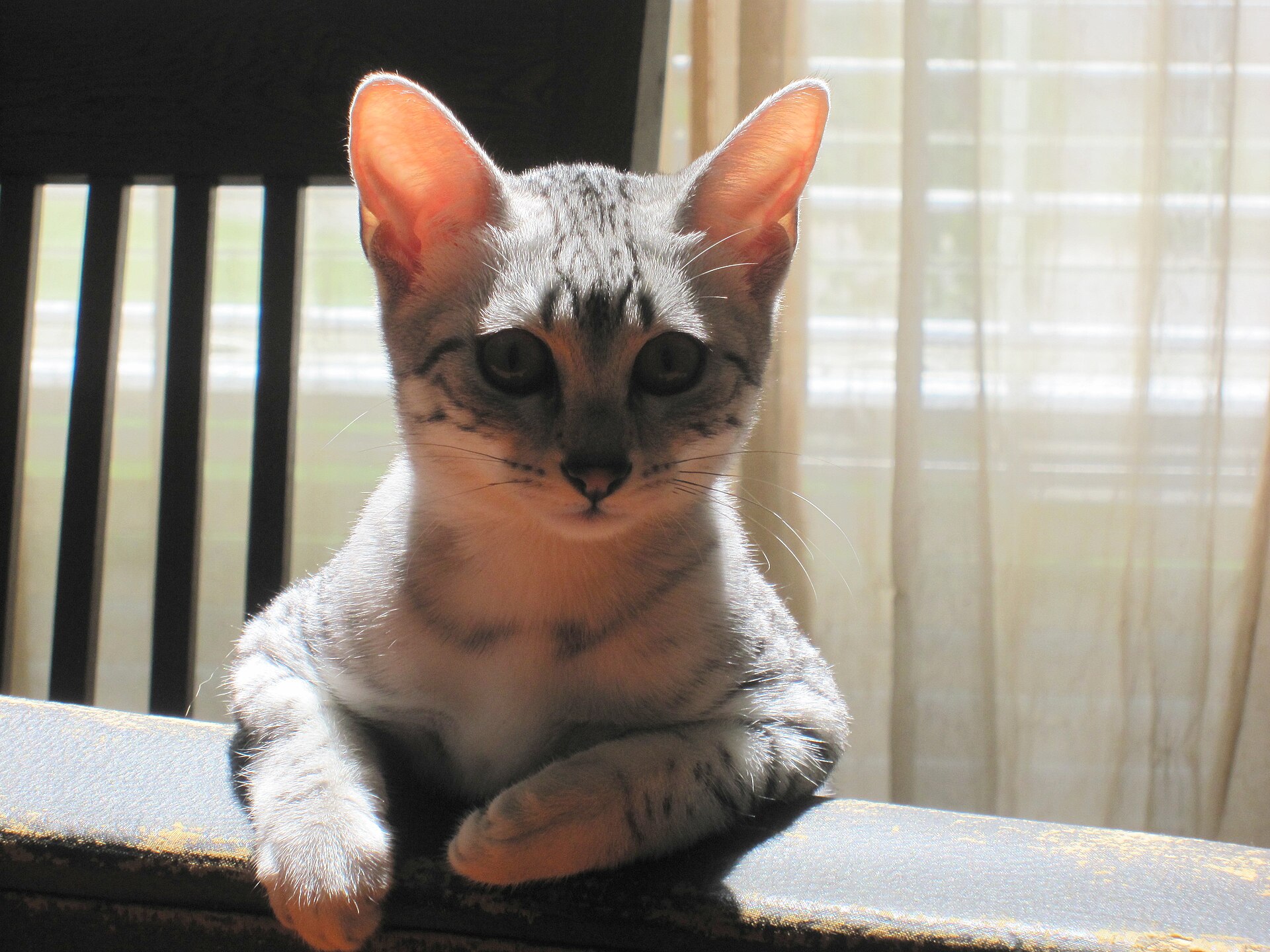
Egyptian Mau
Felis catus
Characteristics
Temperament
An affectionate, loyal, lively cat, deeply bonded to its human and family, whose company it seeks, but rather reserved and wary of strangers. Intelligent, athletic and playful, it is the fastest domestic cat and needs exercise, play and stimulation. It shows its happiness in ways all its own — moving its tail, "kneading" and with chirp-like vocalizations. It tolerates prolonged solitude poorly. An elegant, devoted companion, suited to those who can give it time and attention.
Diet
A strict carnivore, like every cat: it needs good-quality complete foods (wet and/or dry), rich in animal protein and suited to age and lifestyle, with fresh water always available. Being a particularly athletic, darting, fast cat, it needs a good energy and protein intake to support its musculature; at the same time, like every cat and especially if neutered, portions should be measured to avoid excess weight. Regular meals and plenty of "hunting" play keep it fit, satisfied and in its famous athletic shape.
The Egyptian Mau is a cat breed of ancient charm and unmistakable looks: one of the very few domestic cats with a naturally spotted coat, that is, with true spots and not mere tabby stripes. Famous for:
- Natural spots: its is one of the rare domestic coats with "genuine" spots, present even on the skin beneath
- Record speed: it is considered the fastest domestic cat, able to approach 50 km/h
- "Gooseberry-green" eyes: a characteristic light green, with an intense expression
- "Mascara lines": dark markings around the eyes and on the face, as in the cats of ancient Egypt
- The skin flap: a fold on the flanks that, as in cheetahs, lengthens the stride
- Antiquity: it closely recalls the cats depicted in Egyptian art thousands of years ago
The Egyptian Mau is a domestic cat and enters the portal among the shorthaired cats, alongside breeds such as the Bengal, Savannah, Siamese and Sphynx. It is a relatively rare breed, loved by those seeking an elegant, athletic cat with a deep bond with its human.
Classification and category
The Egyptian Mau is a pedigree domestic cat (Felis catus), and in the portal it is classified among the shorthaired cats. It is a natural breed in its basic features (the spotted coat is a spontaneous trait), then selected and standardized by humans. A key point is telling it apart from the other spotted cats: the Bengal, also in the portal, derives from crossing with a wild cat (the leopard cat) and is a "hybrid" breed; the Egyptian Mau, instead, has entirely natural spots of ancient origin; the Ocicat is a spotted breed but entirely "built" by humans by crossing other domestic breeds; it should not be confused with the Arabian Mau, a different, non-spotted breed from the Arabian Peninsula. Etymology: the word "Mau" simply means "cat" in ancient Egyptian (and is also onomatopoeic, from the cat's call); the name thus celebrates the breed's link with the Egypt of the pharaohs, where the cat was revered. Parameters: Weight generally 3-5 kg (males larger than females). Size medium, with a slim, muscular build. Coat short, dense and silky, with clear spots on a silver, bronze or smoke background. Longevity good, generally 12-15 years and more with proper care. Reproduction: the breed tends to have a slightly longer gestation period than the feline average, a small detail that distinguishes it.
Habitat and distribution
As a domestic breed, the Egyptian Mau has no wild range: it lives alongside humans. It does, however, have a very precise symbolic homeland, Egypt, and a fascinating modern history. Ideal living environment: the home, with room to move (being very athletic and fast, it loves having space to run, jump and climb); families and present people (it bonds deeply with "its own" and tolerates prolonged solitude poorly); and stimulating environments (it appreciates scratching posts, shelves, toys and high vantage points). Historical notes: the Egyptian Mau descends from the common cats of Egypt, similar to those depicted in the paintings and statues of the pharaohs. The modern breed was developed in the mid-20th century by the exiled Russian princess Nathalie Troubetskoy, who exported some Egyptian cats to Europe and then the United States, founding the official line. It is still a relatively rare breed, though much appreciated by connoisseurs. Not being a wild animal, it has no IUCN conservation status; its spread depends on responsible breeding and the interest of enthusiasts.
Diet
Like all cats, the Egyptian Mau is a strict carnivore and needs a diet rich in quality animal protein. As a very active domestic cat: good-quality complete cat foods (wet and/or dry), suited to age and lifestyle; a good protein intake to support its athletic musculature; and fresh water always available. Particular care: energy to sustain (being a sporty, darting cat, it needs the right fuel, especially if it plays and moves a lot); weight control (as for every cat, especially if neutered, portions should be measured to avoid excess weight); and regular meals and play (physical activity, including "hunting" play, helps keep it fit and satisfied). Crucially, the Egyptian Mau combines elegance and athleticism, and its diet should support this active nature without excess. A cat in good shape best expresses its famous speed and agility.
Physical features
An elegant, athletic cat with a spectacular coat. Coat and colours: short, dense, silky fur, with clear, well-distributed spots (also on the flanks, belly and even the skin); main colours: silver (silver with black spots), bronze (bronze with dark spots) and smoke; on the head, an "M"-shaped marking on the forehead (the "scarab") and lines called "mascara lines" around the eyes. The body and eyes: a medium-sized, slim but muscular body, with longer hind legs; a characteristic skin flap between the flank and the hind knee, which increases the stride; large "gooseberry-green" eyes, slightly slanted, with a somewhat "worried" or alert expression. Performance: exceptional speed (the fastest domestic cat, up to about 48 km/h); great agility in jumping and climbing; and very fast reflexes and a hunter's nature.
Behaviour and curiosities
The Egyptian Mau is an affectionate, loyal, lively cat, but also a little reserved. It bonds very closely with its human and its family, whose company it seeks, while it tends to be wary of strangers. It is intelligent, playful and active, and shows its happiness in ways all its own: by moving its tail, "kneading" with its paws and giving particular vocalizations like a chirp or "chatter".
The fastest cat: the Egyptian Mau holds the record of the fastest domestic cat — thanks to its longer hind legs and a particular skin flap on the flanks, similar to that of the cheetah, it can greatly lengthen its stride and reach speeds close to 48 km/h; it is, in practice, the "sprinter" among house cats. The "real" spots: unlike most tabby cats, whose markings are only patterns in the fur, the Egyptian Mau has genuine spots, present even on the skin beneath the coat: shaving it (which one obviously does not do) would still reveal them; it is one of the very few domestic breeds with entirely natural spotting, not obtained by crossing with wild cats. The pharaohs' cat: the Egyptian Mau strikingly resembles the cats depicted in the paintings, papyri and statues of ancient Egypt, where the cat was a sacred animal linked to the goddess Bastet; although a direct descent from those cats of thousands of years ago cannot be proven, the breed is regarded as a symbolic "heir", and its appearance evokes precisely that ancient world. The "M" and the mascara: on the Egyptian Mau's forehead stands out a dark "M"-shaped marking, often called the "scarab mark", while dark lines called "mascara lines" run around the eyes, like natural make-up; these details, combined with the light green eyes, give its little face an intense, unmistakable expression. The exiled princess: the story of the modern breed is tied to a fascinating figure, the exiled Russian princess Nathalie Troubetskoy; in the 1950s she obtained some Egyptian cats and devoted herself to fixing their characteristics, first in Italy and then in the United States, founding the official Egyptian Mau line; it is largely thanks to her that the breed survived and spread in the West. The cat that "talks": the Egyptian Mau is known for its particular communication — when happy or excited, it gives melodious vocalizations, a kind of chirp or "chatter" (in English, chortling), often accompanied by quick tail movements and "kneading" with the paws; it is an expressive cat that readily communicates with its human.
Pros
- Manto naturalmente maculato, raro ed elegante; aspetto da "gatto dei faraoni"
- Gatto domestico più veloce e atletico: vivace e giocoso
- Molto affettuoso e fedele, si lega profondamente alla famiglia
- Intelligente ed espressivo, comunica con vocalizzi e gesti caratteristici
Cons
- Razza piuttosto rara: reperibilità limitata e costo elevato
- Molto attivo: ha bisogno di spazio, gioco e stimoli, non adatto a chi è sempre assente
- Riservato e diffidente con gli estranei; mal sopporta la solitudine prolungata
- Non è un gatto selvatico né esotico: è un gatto domestico, da non confondere col Bengala (ibrido)