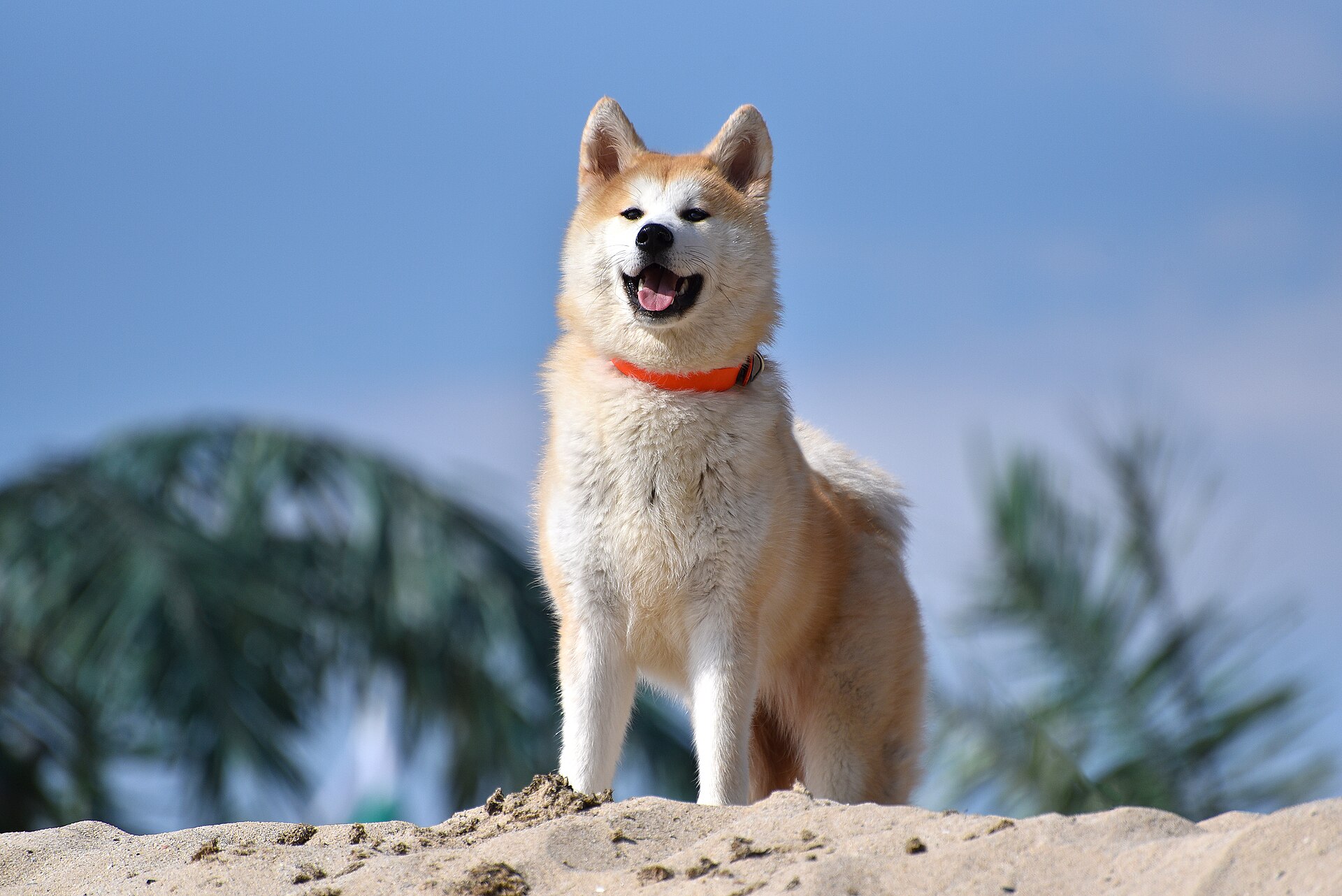
Akita Inu
Canis lupus familiaris
Characteristics
Temperament
Dignified, courageous, independent, deeply loyal, reserved with strangers. Quasi-feline: cleanliness, rarely barks ("Akita talk"). Independent thinker. Protagonist of the Hachiko story (9 years and 9 months of waiting at Shibuya station 1925-1935).
Diet
Carnivore: 1,500-2,500 kcal/day. Large breed premium kibble (28-35% protein). 2 meals/day to avoid GDV. Picky and frequently allergic (5-10%): chicken, beef, soy, corn, dairy. Predisposed to autoimmune diseases.
The Akita Inu (秋田犬, "akita ken") is the largest of the 6 native Japanese dog breeds, originating from the Akita prefecture in northern Japan (Honshu island). It is famous for being the national symbol of Japan since 1931 ("Living Natural Monument"), and for being protagonist of one of the most famous stories of canine loyalty in History: that of "Hachiko", who waited at the Shibuya station (Tokyo) for his deceased master for 9 years and 9 months (1925-1935). It weighs 30-50 kg and is 58-70 cm tall, of robust and powerful build. It descends from ancient large-game hunting dogs (wild boar, deer, bears) of Japanese mountains. It has a dignified, courageous, independent, deeply loyal character to the family, reserved with strangers. There are two distinct types: the Japanese Akita Inu (FCI Group 5) and the American Akita (FCI Group 2 since 1999), more massive and with wider colour variants. After being close to extinction (Second World War: 16 specimens remaining), today it is one of the most beloved breeds in the world.
Classification and category
The Japanese Akita Inu is classified by the FCI in Group 5 — Spitz and primitive type dogs, Section 5 (Asian Spitz and related breeds), FCI standard number 255. The official standard specifies: males 64-70 cm at the withers, 40-50 kg; females 58-64 cm, 30-40 kg. It is one of the 6 native Japanese breeds (together with Shiba Inu, Hokkaido, Kai Ken, Kishu, Shikoku Ken) — all protected as "Living Natural Monuments" by the Japanese government.
The breed has a complex history. The ancestors were "Matagi Inu" (large-game hunting dogs — wild boar, deer, black bears) used for centuries in Akita's mountains. In the Tokugawa period (1603-1867), Akitas were dogs exclusively of aristocratic ownership, reserved for the daimyō (feudal lord) of Akita. They were also used for dog fights (legal phenomenon until 1908) — many specimens were crossed with larger breeds (Tosa Inu, English Mastiff) to make them more fierce, deforming the original characteristics. In 1931, Emperor Hirohito declared the breed a "Living Natural Monument", including it in government protection programmes. The Second World War brought the breed close to extinction: in 1945 only 16 purebred specimens survived in all Japan. The breed was reconstructed in the 1950s-60s starting from these few genetic lines.
From the late 1940s, American soldiers brought Akitas to the USA, where a distinct line developed: the American Akita (larger, 50-60 kg, with colour variants including pinto and masked — forbidden in the Japanese standard). In 1999, the FCI officially recognised the two breeds as distinct: Akita Inu (FCI Gr.5) and American Akita (FCI Gr.2 — Molossians). Longevity is 10-15 years; the record is "Pusuke" (24 years in 2010 — an Akita-mix). Pure Akitas reach on average 10-13 years.
Habitat and distribution
The Akita Inu is a domestic dog (Canis lupus familiaris) and has no natural habitat. Originating from Akita's snowy mountains, the breed is extraordinarily adapted to cold climates: tolerates down to -30°C thanks to its very thick double coat. It suffers from humid heat above 28°C: in Italian summer months it requires air conditioning or cool environments. It adapts to houses with garden; less suitable for small apartments due to size. It needs 1-2 hours of exercise per day: walks, controlled play, obedience training. It is not a great running dog (unlike huskies), but adores long walks in mountains or snow.
The global distribution is wide but more concentrated than other breeds. In Japan it is one of the most beloved breeds: about 12,000 puppies/year registered with JKC (Japan Kennel Club). In the USA the American Akita is 47th in AKC 2024 registrations; the Japanese is less widespread. In Europe it has had a popularity boom from the film "Hachiko: A Dog's Story" (2009, with Richard Gere), which brought the Italian population from 200 to over 3,000 specimens registered with ENCI in 10 years. Important: after the media boom many buyers regretted because the Akita is not an "easy" dog — it is not suitable for beginners who have seen the film and think they are taking home "Hachiko". Diplomatic curiosity: in 2012, Japan donated an Akita puppy called "Yume" ("Dream") to Russian President Vladimir Putin as a diplomatic gesture — Putin accepted it with emotion (he was a known dog lover). Yume lived at the Kremlin until 2024.
Diet
The Akita Inu is a carnivore with needs suitable for a moderately active large dog. The daily caloric requirement for an adult is 1,500-2,500 kcal. The ideal diet includes premium "large breed" kibble with high protein content (28-35%) and moderate fats (12-18%). 2 daily portions are recommended to reduce the risk of gastric torsion (GDV), a frequent pathology in large breeds with deep chest. Avoid intense exercise 1-2 hours before and after meals.
Breed characteristic: Akitas are picky about food (feline character, like many spitz). They can refuse new foods even if hungry. Flavour rotation is important to maintain interest. In addition, Akitas are frequently allergic: chicken, beef, soy, corn, wheat are common triggers. In case of suspicion (itching, otitis, diarrhoea), an exclusion diet (new protein: duck, lamb, salmon, deer) for 8-12 weeks is the diagnostic strategy. Predisposition to autoimmune diseases: dermatitis, hypothyroidism, sebaceous adenitis (inflammation of sebaceous glands). Useful supplements: glucosamine+chondroitin after 5 years (joint problems like hip/elbow dysplasia), omega-3 EPA/DHA for skin/coat and inflammations, probiotics for sensitive intestine, vitamin E. Forbidden foods: chocolate, grapes, onions, garlic, cooked bones, xylitol, alcohol, avocado, milk (Akitas are often lactose intolerant).
Physical features
The Akita Inu has an imposing, robust, well-proportioned physique, of large primitive spitz type. The height at the withers is 64-70 cm for males, 58-64 cm for females. The weight is 40-50 kg (males) and 30-40 kg (females). Sexual dimorphism is marked (10-15% difference). The head is large, broad, triangular-shaped, with accentuated but soft stop (similar to that of a young bear cub). The muzzle is wide, strong, well-developed; the nose is black (in fulvous varieties), chocolate (in chocolate varieties).
The eyes are small, triangular almost almond-shaped, of dark brown colour, with dignified and proud expression. The ears are small, triangular, well proportioned, always erect and slightly tilted forward (spitz feature). The neck is strong, muscular, fairly short. The trunk is massive, with straight back, short and robust loin, well-developed chest. The tail is the most iconic feature of the breed: thick, curled over the back, usually in "sashio" position (curled in complete spiral). Pups that at maturity do not have a curled tail are not admitted in the standard.
The coat is double and thick: outer hair rough, straight, 2-3 cm long; undercoat woolly, soft, dense, very insulating. Shedding is abundant: moderate constant moult + 2 massive moults per year (spring and autumn, the "blowout seasons"). During moulting they lose enormous quantities of undercoat — enthusiasts say to "collect enough hair for another Akita". The colours admitted by FCI for the Japanese Akita Inu are only 3:
- Red fulvous (Akadama) with "urajiro" (white markings on muzzle, throat, chest, belly, inside of legs, under the tail) — the most common
- Brindle (Tora) — dark stripes on red/fulvous base with urajiro
- White (Shiroi) — completely white, no urajiro
The American Akita instead has a much wider variety of colours: pinto, masked, solid black, chocolate, etc. — all forbidden in the Japanese standard.
Behaviour and curiosities
The Akita Inu is a dog with a dignified, courageous, self-confident, independent, deeply loyal, reserved with strangers character. It is known for being one of the most "silent" dogs: it rarely barks, but can vocalise with various sounds ("Akita talk") — mumblings, moans, whistles, sighs — it is famous for the characteristic "Roo-roo". Typical behaviours:
- "Akita talk" — the dog "talks" to its owners through complex sounds not similar to normal barking
- "Dignified and reserved" — Akita does not greet everyone with enthusiasm; chooses who it loves and who it tolerates
- Instinctive distrust with other dogs (especially of the same sex) — the Akita has a "solitary" instinct, it is not as sociable as Golden Retriever or Labrador
- Instinctive hunting of small prey (cats, squirrels, rabbits) — heritage of past as hunter
- Clean as a cat — cleans itself frequently, is easy to train to do its needs outside
Famous curiosities: the "Hachiko" Story is one of the most famous stories of canine loyalty in History. Hachiko (1923-1935) was an Akita Inu owned by Professor Hidesaburō Ueno, agronomy professor at Tokyo University. Every day Hachiko accompanied Ueno to Shibuya station, and returned to greet him on his return from work. On May 21, 1925, Ueno died suddenly of brain haemorrhage during a lesson. Hachiko waited for his master at Shibuya station every day for 9 years and 9 months, from 1925 to 1935, until he died at the age of 11 (March 8, 1935). His story became national in the 1920s-30s, and after his death a bronze statue of Hachiko was erected at Shibuya station (1934) — today one of the most visited tourist attractions in Tokyo. The story has been adapted in various films: "Hachiko Monogatari" (1987, Japan), "Hachi: A Dog's Tale" (2009, with Richard Gere, USA). The real Hachiko is embalmed and preserved at the National Museum of Nature and Science of Tokyo.
Other curiosities: Akitas were used as "baby-sitters" of samurai children — the mother went to the river to wash clothes, and the Akita stayed with the children to play. This tradition continues: Akitas are known for being protective with the family children (but reserved with strange children). Breed curiosity: the "genro" (dignified gaze) — Akitas have a penetrating, calm, confident gaze, that recalls that of an old samurai. Historical curiosity: during the Second World War, the Japanese government ordered the killing of all dogs (non-military) for food rationing. It is estimated that only 16 pure Akitas survived in 1945 — the breed was on the verge of extinction. Reconstruction was done by a few brave breeders who hid the specimens in the countryside. Diplomatic curiosity: Japan has donated Akitas to various world leaders: Helen Keller (1937 — she brought the first Akita to USA), Vladimir Putin (2012, Yume), Zinaida Ruzic-Russian figure skater (2016). Medical curiosity: Akitas have a "reverse sneezing" — a harmless but dramatic respiratory spasm (it seems the dog is choking), caused by irritation of the soft palate. Common but not serious. Training curiosity: Akitas are "independent thinkers": unlike the Border Collie that awaits the command, the Akita evaluates the situation and decides on its own what to do. This makes it an excellent guard dog (judges autonomously if a person is a friend or enemy) but a challenge for those who want a classic "obedient" dog. Health curiosity: Akitas are predisposed to: hip/elbow dysplasia, progressive retinal atrophy (PRA), gastric torsion (GDV), autoimmune diseases (dermatitis, hypothyroidism), entropion/ectropion (eyelids).
Pros
- Simbolo nazionale del Giappone (Monumento Naturale Vivente dal 1931)
- Fedeltà eccezionale: la storia di Hachiko è icona mondiale
- Eccellente cane da guardia (giudica autonomamente)
- Vigoroso e adattabile a climi freddi (fino a -30°C)
Cons
- Non adatto a principianti: 'pensatore indipendente'
- Diffidente con altri cani (specialmente stesso sesso)
- Muta massiccia 2 volte l'anno + perdita pelo costante
- Predisposto a displasia, autoimmuni, GDV