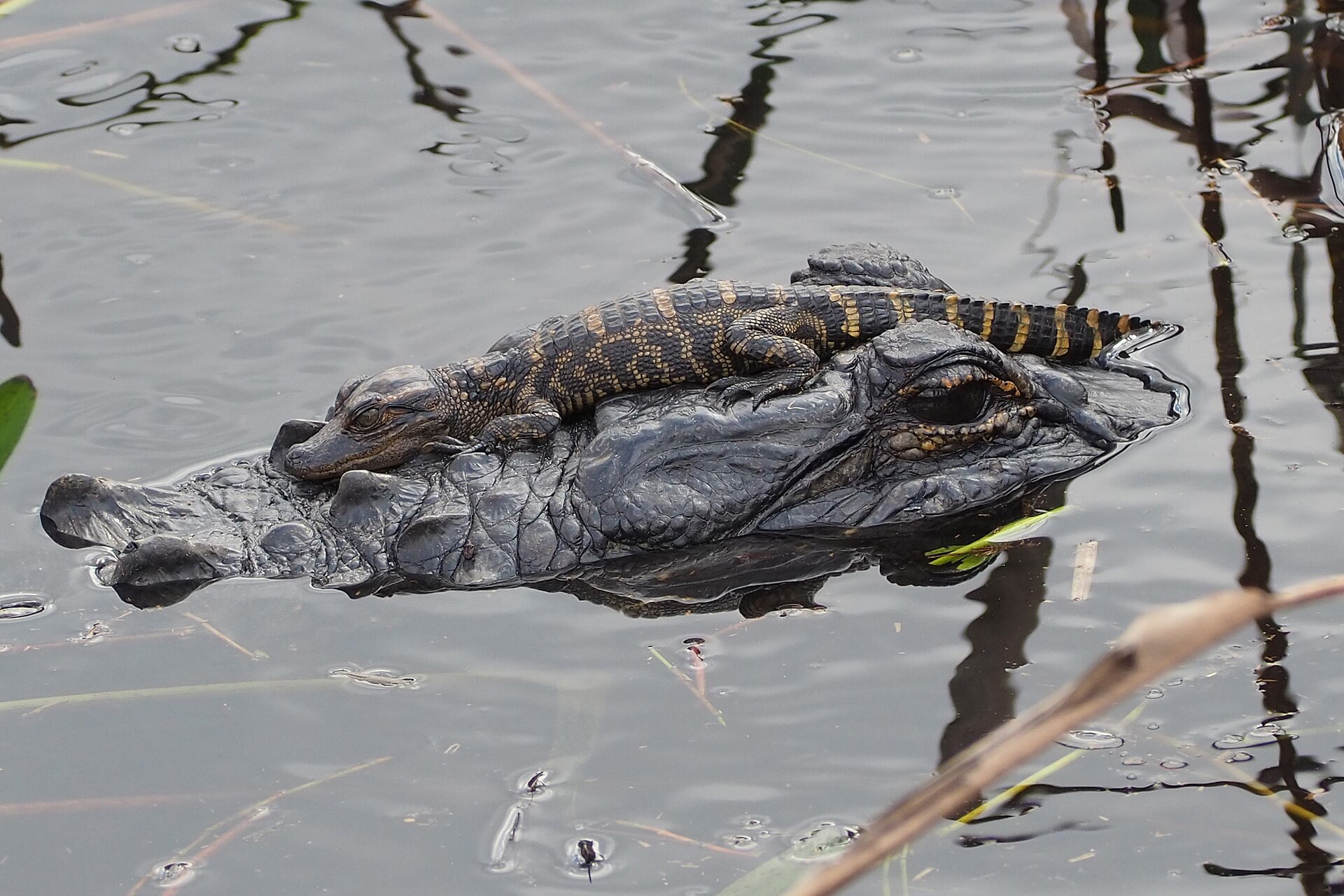
American Alligator
Alligator mississippiensis
Characteristics
Temperament
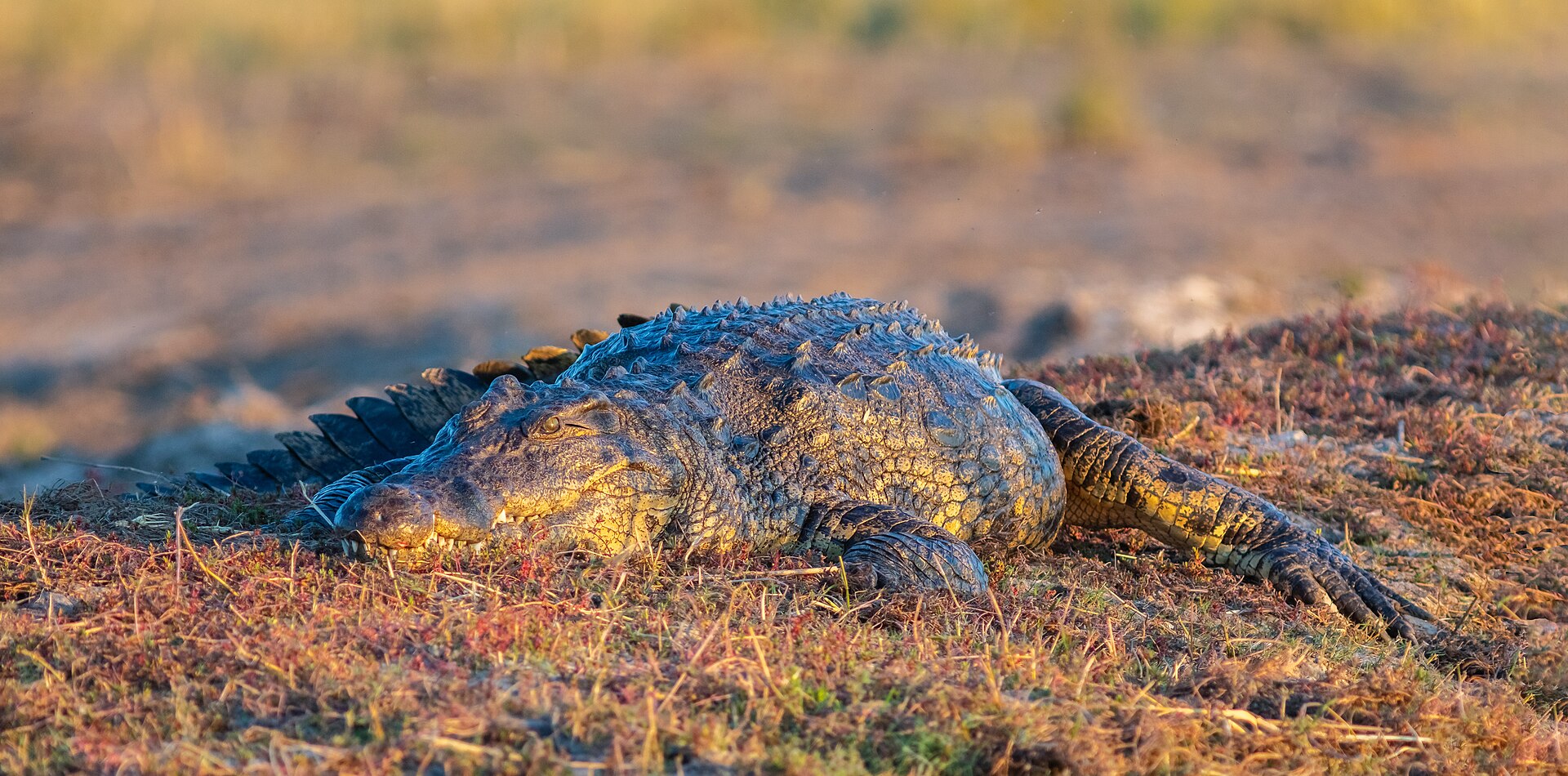
Solitary, territorial, nocturnal-crepuscular, apex predator. Distinctive features from crocodiles: "U" muzzle, lower teeth not visible, dark colour. Engineer species (alligator holes). Maternal care up to 2 years. Recovery from near-extinction (1967: 20,000 → 2019: 5+ million).
Diet
Apex opportunistic carnivore. As young: insects, snails, crayfish, small fish, frogs. Adult: deer, wild boars, capybaras, stray dogs, even young black bears. Hunts by ambush. Bite force 3,000 psi. "Death roll". 3-5 kg meat/week. "High walk" at 15-20 km/h.
The American Alligator (Alligator mississippiensis) is one of two living alligators in the world (the other is the Chinese alligator, A. sinensis), iconic symbol of the swamps of the south-eastern United States — especially the Florida Everglades and the bayous of Louisiana. It weighs 200-450 kg (record 600 kg) and is 3-4.5 m long (record 5.8 m), making it the largest reptile in the USA. It belongs to the Alligatoridae family, genetically distinct from Crocodylidae (true crocodiles): the two families separated 80 million years ago. Visible differences: the alligator has a wide rounded muzzle in "U" shape (the crocodile has a narrow "V" muzzle); the lower teeth are not visible with the mouth closed (in the crocodile they are visible); the colour is dark green-black (vs green-grey of crocodiles). After being brought to the brink of extinction between 1900-1960 by hunting for skin, it is now recovered thanks to the Endangered Species Act (1973): the population has grown from 20,000 to 5+ million specimens. Global IUCN status: Least Concern (LC) since 1985. One of the greatest American conservation success stories.
Classification and category
The American Alligator belongs to the order Crocodilia, family Alligatoridae, subfamily Alligatorinae, genus Alligator. The genus includes only 2 living species:
- A. mississippiensis — American Alligator (south-eastern USA)
- A. sinensis — Chinese Alligator (Yangtze River, China; critical, ~150 specimens)
The Alligatoridae family also includes South American caimans (6 species, genera Caiman and Melanosuchus). The first alligators appeared in the Upper Cretaceous (75-80 million years ago); the current species is essentially identical to 8 million year old fossils — a classic example of "living fossil". The American Alligator was scientifically described by François Marie Daudin in 1801.
Adult dimensions are: average length 3-4 m in males, 2.5-3 m in females; verified record 5.8 m in Louisiana (1890); weight 200-450 kg, record 626 kg (Florida, 2014). Sexual dimorphism is marked (males 30-40% larger). Longevity is 30-50 years in nature, up to 80+ years in captivity (record: "Muja", at Belgrade Zoo, captive specimen since 1937, exceeds 88 years in 2024 — the oldest documented reptile in captivity).
Habitat and distribution
The American Alligator lives in swamps, bayous (slow-flowing rivers), lakes, ponds, marshes, mangroves, slow-flowing rivers. It prefers fresh water, but tolerates brackish water; rarely in salt water (its salinising glands are inefficient compared to saltwater crocodiles). It lives in areas with dense vegetation (reeds, water lilies, mangroves). Unique characteristic: the alligator is an "engineer species" — it digs "alligator holes" in the areas (holes full of water 3-4 m in diameter, 1-2 m deep, which it maintains during the dry season by cleaning the mud sides). These "alligator holes" become essential refuges for other animals (fish, amphibians, reptiles, birds) during Everglades drought.
Current distribution includes the south-eastern United States: from North Carolina to the Rio Grande, through South Carolina, Georgia, Florida (largest population, over 1.3 million specimens), Alabama, Mississippi, Louisiana (largest population overall, over 2 million), Texas, Arkansas, south-eastern Oklahoma. Northern limit: 35°N, where winter temperature is the limit (alligators tolerate down to -10°C for short periods thanks to the "icing" behaviour — they freeze the muzzle and nostrils out of the pond water to breathe). Total population is estimated at 5+ million. Global IUCN conservation status is Least Concern (LC) since 1985. The species is a conservation success story: between 1900 and 1960 it was hunted massively for skin (population collapsed from millions to about 20,000 specimens, declared endangered in 1967); after the Endangered Species Act (1973) and the revised Lacey Act (1900), hunting was strongly regulated. The population recovered spectacularly: in 1987 it was removed from the endangered list. Today it is classified as "managed protected species" with regulated seasonal legal hunting: in Louisiana, for example, 30,000-40,000 specimens/year are harvested through licensing, over 350,000 eggs/year collected from farms (modern skin industry).
Diet
The American Alligator is an apex opportunistic carnivore: the diet varies drastically with age and size. Young (length 30 cm-1 m, weight 0.2-5 kg) hunt insects, snails, crayfish, small fish, frogs. Adolescents (1-2 m) feed on large fish, ducks, water turtles, snakes, otters nutrias. Large adults (2.5+ m) are apex predators: they hunt Florida deer (Odocoileus virginianus), wild boars, capybaras (rare), stray dogs, large terrestrial turtles, even young black bears. They also practise cannibalism: large alligators eat the small ones (up to 50% of cubs die this way in the first year).
The hunting technique is the ambush: the alligator hides just below the surface of the water, with only eyes, nostrils, and upper part of the head visible. When a prey approaches the shore or enters the water, the alligator attacks with a lightning lunge: lateral or anterior jump of 1-2 metres above the water. It grabs the prey with 80 powerful teeth, and drags it underwater to drown it. Bite force: 3,000 psi — higher than the lion (1,000 psi) and almost equal to the saltwater crocodile (3,700 psi). For large prey it practises the "death roll" — it rotates the body 360° rapidly to dismember the prey (the alligator cannot chew). Kleptoparasitism: large alligators steal prey from small ones, herons, eagles. Adult food requirement is 3-5 kg of meat per week; ectothermic metabolism = survives months without eating. The characteristic "high walk": the alligator can walk with the belly lifted off the ground and at speed of 15-20 km/h, for short stretches — faster than you can run from water on muddy terrain!
Physical features
The American Alligator has a massive, elongated, hydrodynamic body. Dimensions in adults: length 3-4 m (males), 2.5-3 m (females), verified record 5.8 m; weight 200-450 kg, record 626 kg. The head is the most distinctive feature, which differentiates it from crocodiles:
- Wide, "U"-shaped muzzle (alligator) vs narrow "V" muzzle (crocodile)
- Lower teeth NOT visible with mouth closed (upper teeth completely cover the lower ones) — in the crocodile, the 4th lower tooth is always visible
- Colour: dark green-black, almost black in adults; typical green-grey in crocodiles
The teeth are 80 total (40 upper, 40 lower), conical, replaceable throughout life (over 3,000 total teeth in life). The bite force is 3,000 psi (13,000 newtons). The eyes are golden in adults, red in young; vertical elliptical pupils. They have nictitating membrane for underwater vision; binocular vision 25°. Night vision is excellent thanks to the tapetum lucidum (red eyes in night light). The ears are lateral slits covered by skin that close when submerged. The nostrils are at the top of the muzzle and close hermetically.
The body is covered with osteoderms (ossified scales) on the back, forming an "armoured" carapace. The belly is softer and less protected. The legs are short but powerful: front with 5 toes, rear with 4 webbed toes. The tail is massive, laterally compressed, represents half of the total length and has the function of main motor in swimming. The ventral skin has flat, broad scales — much sought after as "alligator leather" for luxury leather goods (boots, belts, designer bags). Lingual glands expel the ingested salt (although less efficient compared to saltwater crocodiles).
Behaviour and curiosities
The American Alligator is a solitary in non-breeding season, territorial, predominantly nocturnal-crepuscular animal. Large adults are apex in many south-east USA ecosystems. Vocalisations are characteristic: adult males produce powerful low-frequency roars during the mating season (April-May), which make the water surface vibrate ("water dance" — the water above the alligator's back "dances" due to sonic vibration). The roar is heard at 1-2 km distance. Young make high-pitched calls like "umph! umph!" to attract the mother or call attention.
Reproduction: in April-June the female builds a mound nest of decomposing vegetation (fermentation produces heat: 32-34°C) and mud. She lays 20-50 white eggs. Temperature-dependent sex determination (TSD): 30°C = only females, 33°C = only males, intermediate temperatures = mix. Incubation lasts 65 days. The female protects the nest aggressively. At the time of hatching, the cubs emit high-pitched calls from inside the eggs: the mother opens the nest, gently picks up the cubs in her mouth, and transports them to the water. Maternal care lasts 1-2 years: exceptional feature among reptiles. Cub survival rate: 20% in the first year (predation by birds, fish, adult alligators). Sexual maturity at 8-13 years.
Famous curiosities: the "high walk" of alligators — they can walk with the belly completely lifted off the ground, at 15-20 km/h. Often visible on muddy roads of Louisiana or Florida. Survival curiosity: alligators of the north (North/South Carolina) withstand winters at -10°C with the "icing" phenomenon: they freeze the muzzle and nostrils out of the pond water to breathe, while the rest of the body remains under the frozen surface. It is a unique behaviour in the animal kingdom. Anatomical curiosity: alligator blood contains powerful antimicrobial peptides called "alligacin" — effective against antibiotic-resistant bacteria (including MRSA) and fungi. They have been under pharmaceutical study since 2008 for new antibiotics. Ecological curiosity: alligators are "keystone species" of Everglades ecosystems: "alligator holes" (holes dug and maintained by alligators) during the dry season become the only aquatic refuges for fish, frogs, turtles, snakes. Without alligators, the entire ecosystem would collapse. Historical curiosity: alligators were brought to the brink of extinction by hunting for skin (1900-1960). In 1967 they were declared endangered with a population of only 20,000 specimens. The Endangered Species Act (1973) prohibited hunting and trade. The population exploded: 1.3 million in Florida, 2 million in Louisiana. In 1987 they were removed from the endangered list. It is considered one of the greatest successes of the Endangered Species Act, second only to the recovery of the bald eagle. Pop curiosity: the alligator is symbol of Louisiana (state symbol since 1983), and icon of south-east USA sports teams (Florida Gators, etc.). Longevity curiosity: "Muja", an alligator at the Belgrade Zoo, Serbia, has been in captivity since 1937 — exceeding 88 years in 2024, it is the oldest documented reptile in captivity. Safety curiosity: despite the fame, alligator attacks on humans are rare: 1-2 deaths/year in all USA. However, in Florida incidents are increasing (28 documented deaths 1948-2023) with the urbanisation of swamps.
Pros
- Storia di conservazione di successo: da 20.000 a 5+ milioni in 60 anni
- Longevità eccezionale (30-50 natura, 88+ in cattività)
- Specie chiave delle Everglades (alligator holes)
- Sangue contiene 'alligacin': antibiotici naturali in studio
Cons
- Specie protetta USA, gestita con licenze annuali
- Forza morso 3.000 psi: potenzialmente mortale per umani
- Incidenti aumentano con urbanizzazione (28 morti Florida 1948-2023)
- Cattura/detenzione richiede permessi speciali