Western Whip Snake
Hierophis viridiflavus
Characteristics
Temperament
A diurnal, very fast, nervy wild snake of firm character, but entirely harmless. Solitary and heat-loving, faced with a human it flees in lightning bursts; only if grabbed or cornered does it defend itself vigorously, hissing and biting repeatedly (a venomless, harmless bite). An active, opportunistic hunter, it is a valuable predator of mice, lizards and even vipers. It is NOT an animal to handle for fun: it is protected, beneficial wildlife, to be observed and respected in nature, and never to be confused with a viper.
Diet
An active, voracious, opportunistic diurnal predator. It feeds mainly on lizards and other saurians, small mammals (mice, voles, rats) and other snakes, vipers included, as well as nestlings and birds' eggs (reached by climbing) and large insects and small amphibians. Not being venomous, it hunts actively by patrolling the territory at high speed and catches prey with its jaws, pinning it with its body and often swallowing it still alive. By feeding on rodents and vipers, it is a valuable natural ally of humans.
The Western Whip Snake (Hierophis viridiflavus), also called the green whip snake, is probably the most common and widespread snake in Italy: the fast, harmless colubrid that almost everyone, sooner or later, meets in the countryside or the garden. Famous for:
- Being the "Italian snake" par excellence: the most frequent snake-reptile across much of the peninsula
- Speed: very agile and darting, it shoots away in a flash when disturbed
- Harmlessness: it is not venomous and poses no danger to humans
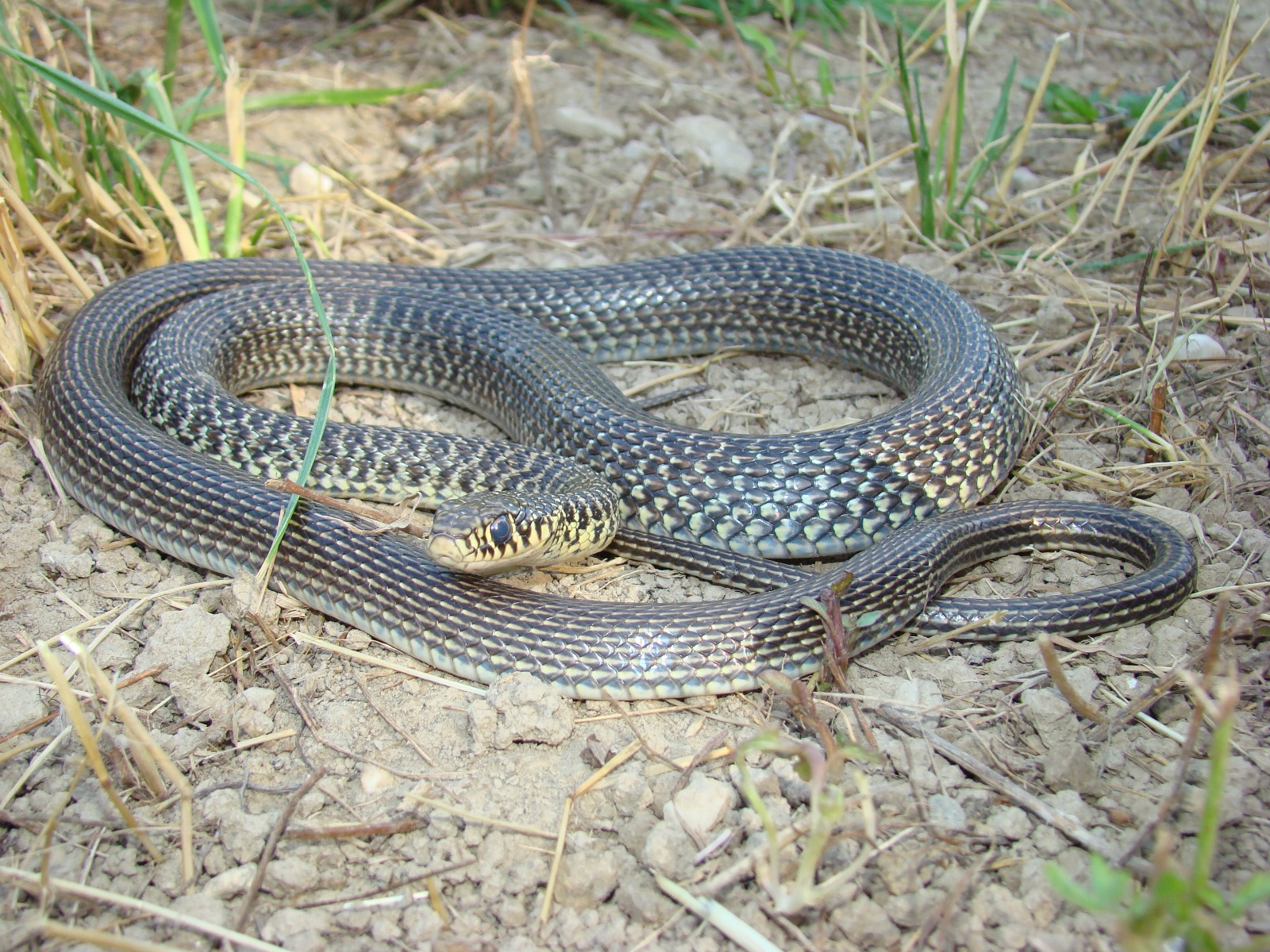
- The flecked livery: a blackish body densely spotted and barred with yellow-green, especially on the front half
- A lively temperament: if grabbed it defends itself firmly, biting repeatedly (but without consequences)
- Usefulness: it hunts mice, lizards and even vipers, providing a valuable service
IUCN status: Least Concern (LC), common and widespread. It enters the portal in the Snakes group, alongside the Aesculapian Snake (the other large harmless native colubrid) and the Asp Viper (the venomous one): together they represent "the snakes you actually meet in Italy". The Western Whip Snake, in particular, is the 200th entry in this portal — a milestone entrusted not to an exotic animal but to the most common and familiar of our snakes.
Classification and category
Order Squamata (the scaled reptiles), suborder of the snakes (Serpentes), family Colubridae (the colubrids, largely harmless), genus Hierophis. In the portal it is placed among the Snakes. It is important to tell it apart from other Italian snakes with which it can be confused: the Aesculapian Snake (Zamenis longissimus), also in the portal, is a harmless colubrid with a more uniform, bronze body and a calmer nature; the Western Whip Snake is instead darker and yellow-flecked, and much more nervy and fast; the viper (e.g. the Asp Viper) is venomous, stockier, with a triangular head and a vertical pupil; the whip snake is slender, with a little-distinct head and a round pupil; the grass snake is tied to water and often has a pale "collar". Etymology: the genus name "Hierophis" comes from Greek and means roughly "sacred snake"; "viridiflavus" means "green-yellow", referring to the flecked colouring; the Italian name "biacco" is an old, popular term for this snake. Parameters: Length generally 1-1.5 m, with specimens that can reach and exceed 2 m. Build slender, rangy and muscular. Appearance a typical agile colubrid, with a long tail. Longevity: remarkable, it can live over 10-15 years. Reproduction: it is oviparous; the female usually lays 5-15 eggs in warm, hidden places (under stones, in woodpiles, in the ground).
Habitat and distribution
The Western Whip Snake is a typically Italian and south-western European species: its range covers much of Italy (where it is the commonest snake), along with southern France, southern Switzerland, Slovenia, Croatia and neighbouring areas. Preferred habitats — it is extremely adaptable and heat-loving: countryside, fallow land, dry grasslands and woodland edges; dry-stone walls, hedges, vineyards, olive groves and piles of stones or wood; and ruins, embankments, gardens and outskirts, even in inhabited areas. It is a thermophilic, diurnal, sun-loving snake that often warms up in the morning before setting off to hunt. It is an excellent climber and a sprinter: its typical reaction, faced with a human, is a lightning flight among the grass and stones. In winter it goes into dormancy, sheltering in burrows and crevices. Precisely because of its adaptability and the frequency with which it lives near settlements, the Western Whip Snake is the snake Italians meet most often, often wrongly mistaking it for a dangerous animal. IUCN: Least Concern. It is common and not threatened overall, although locally it suffers from road traffic (very many whip snakes die run over) and direct killing by humans, out of fear or ignorance. It is nonetheless a protected species.
Diet
The Western Whip Snake is an active, voracious diurnal predator with a surprisingly varied diet. It eats: lizards and other saurians (among its favourite prey); small mammals (mice, voles and other rodents); other snakes (including young conspecifics and, especially, vipers); nestlings and birds' eggs, reached by climbing; and large insects and small amphibians. Hunting strategies: active hunting (it does not lie in ambush but actively patrols the territory at great speed, flushing out prey); capture by force (not being venomous, it seizes the prey with its jaws and pins it with its body, often swallowing it still alive); and opportunism (it exploits any prey of suitable size, from rodents to reptiles). Crucially, the Western Whip Snake is a valuable ally of humans. By feeding on mice and rats it helps control rodents, and — remarkably — it is one of the natural predators of vipers: its presence can help keep their numbers in check. Killing a whip snake, besides being pointless and illegal, can therefore even prove counterproductive.
Physical features
A snake with a long, slender, darting body. Colouring: a blackish or dark-brown background, densely spotted and barred with yellow-green, especially on the front half of the body, where it forms a kind of net; towards the tail the markings tend to arrange themselves in longitudinal lines; in some areas (especially the South and some islands) an almost entirely black form exists (carbonarius); the young have softer, grey-olive colours, with a different head pattern. The body and head: a slender, muscular body, with a long tail; a narrow head, little distinct from the neck, of an alert look; large eyes with a round pupil, typical of diurnal, harmless colubrids; smooth dorsal scales. Performance: exceptional speed (one of the fastest snakes in Europe); an excellent climber (it goes up walls, bushes and trees); and keen sight and great reactivity.
Behaviour and curiosities
The Western Whip Snake is a diurnal, nervy snake of firm character. It is solitary and territorial, and spends warm days hunting or basking in the sun. Faced with a human, its almost invariable reaction is a very fast flight; only if cornered or grabbed does it defend itself with great vigour, hissing and biting repeatedly. The bite, lacking venom, can at most cause a few scratches.
The most common snake in Italy: of all Italian snakes, the Western Whip Snake is the one most often met; it lives almost everywhere, from the countryside to suburban gardens, and is therefore the "snake" par excellence for very many people; unfortunately this frequency, combined with the instinctive fear of snakes, means it is also among the most persecuted, although it is entirely harmless and even useful. The viper hunter: one of the most surprising things about the Western Whip Snake is that it also feeds on other snakes, including vipers; although not immune to their venom, thanks to its speed and aggression it often gets the upper hand; for this reason, paradoxically, removing the (harmless) whip snakes from an area can favour the (venomous) vipers: one more good reason to protect them. The sprinter among snakes: the English name "whip snake" and the speed with which it moves describe it well; it is one of the fastest snakes in Europe: when it flees, it seems literally to shoot away among the grass and stones, vanishing in an instant; this speed is its main defence, much more than the bite, which it uses only as a last resort. "Not a viper": very many whip snakes are killed because mistaken for vipers; telling them apart is, however, fairly simple: the whip snake is long, slender and very fast, with a narrow head little distinct from the neck and a round pupil; the viper is shorter and stockier, slow, with a triangular head well set off from the neck and a vertical slit pupil; moreover the whip snake, if it can, always flees, while the viper tends to stay still, trusting in camouflage. The fighter: although harmless, the whip snake has a reputation as a "brave", combative snake; if it cannot flee and is grabbed, it does not hesitate to defend itself energetically, hissing, writhing and biting repeatedly; the bites can be annoying and leave small scratches, but are entirely venomless and harmless; it is defensive behaviour, not an attack: the whip snake "threatens" only to be left in peace. The guardian of the dry-stone wall: the Western Whip Snake particularly loves dry-stone walls, piles of stones and wood and old sunny ruins, environments rich in hiding places and prey (lizards and mice); these micro-habitats, typical of the traditional Italian rural landscape, are essential for it and for many other small animals: conserving them also means protecting this useful, fascinating snake.
Pros
- Del tutto innocuo per l'uomo: non velenoso, fugge sempre se può
- Prezioso alleato naturale: caccia topi, ratti e perfino vipere
- Il serpente più comune e adattabile d'Italia; IUCN Least Concern
- Affascinante velocista: uno dei serpenti più rapidi d'Europa
Cons
- NON è un animale da compagnia: è fauna selvatica protetta
- Spesso ucciso per paura o perché scambiato per una vipera
- Moltissimi esemplari muoiono investiti sulle strade
- Se afferrato morde con decisione (innocuo, ma fastidioso)