American Pika
Ochotona princeps
Characteristics
Temperament
Solitary, territorial, diurnal (rare among lagomorphs). Does NOT hibernate (record among alpine): survives -30°C with "haying" strategy (accumulates 30 dry grass piles for winter). Iconic "eeeep!" vocalisation. "Climate canary" — dies at 26°C external. Inspired Pokémon's Pikachu. Obligatory caecotrophy.
Diet
Strict herbivore. Grasses, alpine flowers, dwarf willow leaves, lichen. UNIQUE "HAYING" STRATEGY: in summer accumulates 1-30 dry grass piles ("hay piles", 2-5 kg total) under rocks — preserved with tannins as "natural preservative". 100 trips/day in summer. Caecotrophy (eats soft faeces for second digestion). 30 g vegetation/day.
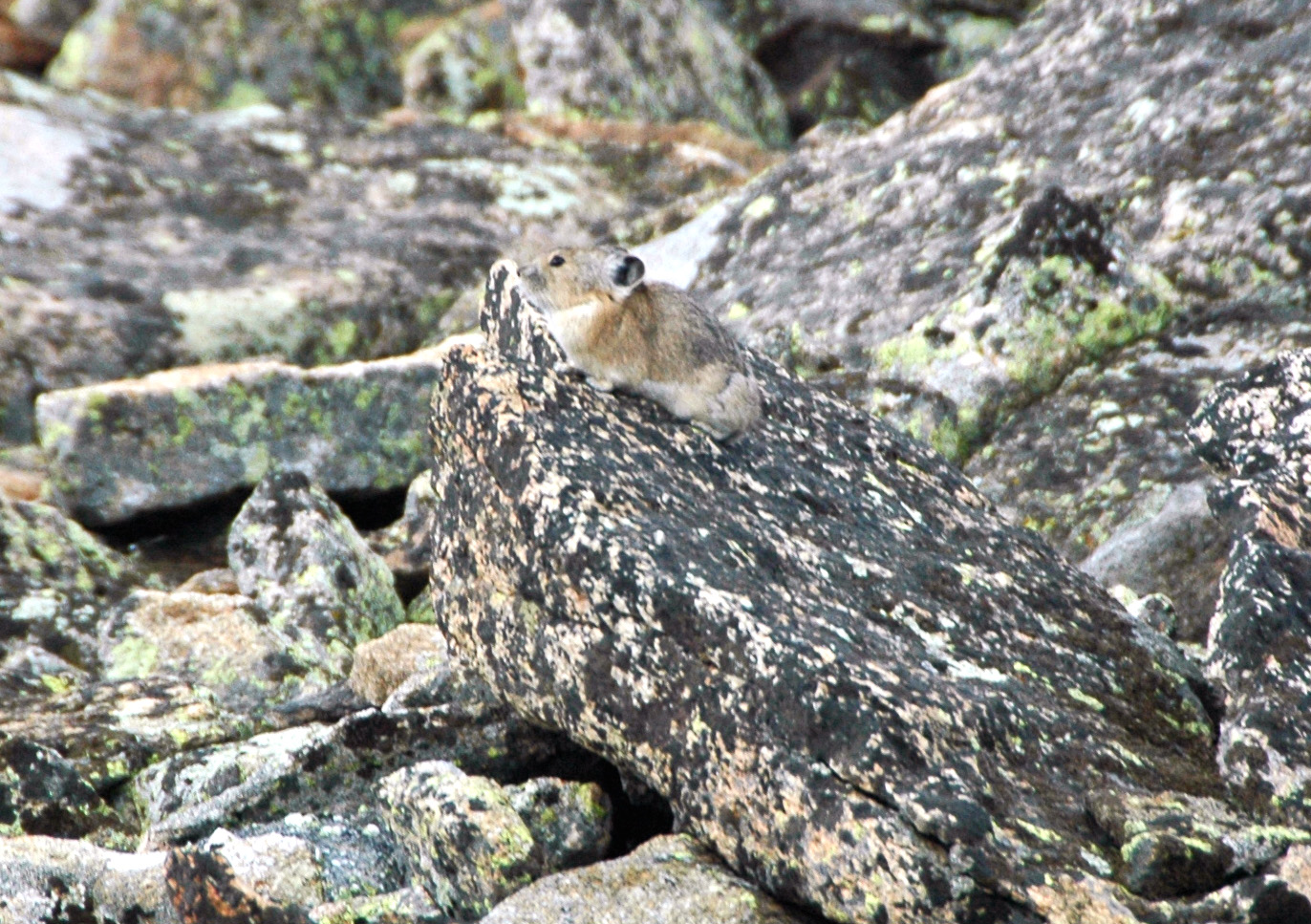
The American Pika (Ochotona princeps) is a small alpine lagomorph (NOT a rodent!) endemic to the western mountains of North America. Although it resembles a small rabbit without ears, it is a highly specialised species for life at high altitude (1,500-4,000 m, record 4,700 m) on the mountain ranges of the American West: Rocky Mountains, Sierra Nevada, Cascade Range, Coast Ranges. Compact measurements: weight 150-180 g, length 16-22 cm, with almost no tail (vestigial, 2 cm) and short rounded ears (diagnostic feature of pika compared to hares and rabbits). The coat is brownish-grey, camouflaged among the rocks of talus. Its survival strategy is extraordinary: it does NOT hibernate during winter (record among alpine lagomorphs!), but survives winters at -30°C thanks to a unique strategy called "haying" — accumulates during summer up to 30 stacks of dry grass (the "hay piles"), each of 1-3 kg, under rocks or in crevices. These "hay piles" provide food during winter when snow covers vegetation. The pika is an indicator species ("climate canary") of climate change: extremely sensitive to high temperatures (dies at 26°C!), its populations progressively disappear from lower altitudes with global warming. IUCN status: Least Concern (LC) global, but declining in many southern populations.
Classification and category
The American Pika belongs to the order Lagomorpha — NOT Rodentia! Lagomorphs include pikas, hares and rabbits, and are distinguished from rodents by having 2 pairs of upper incisors (rodents have 1). The phylogenetic separation between lagomorphs and rodents is about 50 million years. The family Ochotonidae (pikas) comprises only one genus, Ochotona, with ~30 species distributed mainly in Asia (25+ species) and only 2 in North America (O. princeps and O. collaris).
Etymology: Ochotona from Mongolian "ogotno" (the Himalayan pika); the name "pika" derives from Tungus "peeka" (characteristic vocalisation of the species). For a long time pikas were called "tailless rabbits" or "coney" in ancient North American English.
The American Pika (O. princeps) was scientifically described by Richardson in 1828. There are 5 recognised subspecies (Hafner & Smith 2010):
- O. p. princeps — Canadian Rocky Mountains Pika
- O. p. fenisex — Cascade Range Pika
- O. p. saxatilis — Central Rocky Mountains Pika
- O. p. schisticeps — Sierra Nevada Pika
- O. p. uinta — Uinta Mountains Pika (Utah)
The closest relatives of the American Pika are:
- Ochotona collaris — Collared Pika (Alaska, Yukon)
- Ochotona daurica — Daurian Pika (Mongolia, Russia)
- Ochotona macrotis — Large-eared Pika (Tibet, Himalaya)
- Ochotona alpina — Alpine Pika (Central Asia)
The morphological parameters:
- Weight: 150-180 g (M and F similar — minimal dimorphism)
- Head-body length: 16-22 cm (record 24 cm)
- Tail: 1-2 cm — almost vestigial, hidden under the fur (diagnostic feature: pika without visible tail)
- Ears: 1.5-2.5 cm — short, round, brown with light edges
- Legs: short, sturdy, with strong claws to climb rocks
Longevity: 3-6 years in nature (record 7 years), up to 10 years in captivity (rare). Sexual maturity: 1 year. Gestation: 30 days; litter of 2-5 young (record 6), 2 litters/year (spring-summer).
Habitat and distribution
The American Pika is a specialist of alpine-subalpine environments. Obligatory habitat:
- Rocky talus: rock debris fallen from cliffs, forming "labyrinths" of crevices — ESSENTIAL habitat for the pika (impossible to survive without). The crevices between rocks provide thermal protection and from predators
- Altitude: 1,500-4,000 m (record 4,700 m, San Juan Mountains). The limits are dictated by the availability of talus + tolerable temperature
- Exposure: prefers north or northeast slopes (cooler)
- Adjacent vegetation: alpine meadows, mountain prairies, lichen shrubs, dwarf willow, variety of grasses and flowers — food source
- Temperature: tolerates -30°C in winter (with insulating snow cover), but SUFFERS above 25°C in summer
Does NOT tolerate: temperatures above 26°C for more than a few hours (this is "the" physiological limit of the pika — such high body temperature is lethal!), areas without talus, dense coniferous forests, humid terrains. Pikas are "islanders" of each mountain massif — unable to disperse through hot valleys between mountains, populations of different chains are genetically isolated for tens of thousands of years.
Geographical distribution:
- Canada: British Columbia, Alberta (Rocky Mountains)
- USA: Washington, Oregon (Cascades), Idaho, Montana, Wyoming, Utah, Colorado, New Mexico, Nevada, California (Sierra Nevada)
Global IUCN conservation status: Least Concern (LC). Estimated population: millions of individuals. However, regional populations in significant decline:
- Great Basin (Nevada-Utah): 8 of 25 historic populations extinct in the last 100 years
- Sierra Nevada: 10-30% decline in 100 years
- Bodie State Park (California): extinct since 1999
The American Pika is one of the most studied "climate canaries": its low altitude populations are disappearing, and high altitude ones have shifted upward by an average of 1.8 m/year in the last 50 years. Smith et al. (2015) studies have shown that up to 50% of pika populations could go extinct by 2100 if warming continues. CITES: not listed. The pika is also a key species for many predators: main prey of Pallas's Cat in Asia (relatives), and in North America for: golden eagles, hawks, foxes, ermines, weasels, and martens. Its presence/absence has cascading effects on the alpine food web.
Diet
The American Pika is a strict herbivore, with an exclusively vegetable diet. Most unique feeding strategy:
- Summer (June-August): active foraging for 16+ hours a day! Collects all types of available vegetation: grasses (Carex, Festuca), alpine flowers, dwarf willow leaves, blueberry shrubs, lichen
- Autumn-winter-spring: lives on "hay piles" accumulated in summer, supplementing with foraging under snow when possible
The "haying" strategy is the most characteristic behaviour of the pika:
- Summer harvest: the pika cuts stems and leaves of vegetation with its teeth, transporting bundles to the "hay pile" (stack under rock)
- Accumulation: each pika builds 1-30 "hay piles" in its territory during summer, total 2-5 kg of dry grass
- Selection: prefers toxic or tannin-rich plants (soapwort, arctic willow) — tannins preserve the grass against bacteria/mould as "natural preservative"
- Drying: the pika rotates and covers the stacks to accelerate drying; in 2-3 weeks the hay is ready
- Storage: dry hay can last 1-2 years
Unique feature: the pika produces 2 types of faeces — caecotrophy like other lagomorphs. The soft faeces (caecotrophs) are rich in vitamins and proteins and are ingested directly from the anus for "second digestion". Hard faeces are excreted normally. Quantity: ~30 g of vegetation/day in summer (15-20% body weight!). Pikas are among the most "industrious" animals in the animal kingdom — a single pika in summer can make up to 100 trips a day to its "hay piles".
Physical features
The American Pika has a compact, rounded, plush-like body. The coat has a double layer:
- Undercoat: dense, light, insulating — protects from intense cold
- Guard hairs: long, rough, water-repellent
- Colour: brownish-grey with mottling, with lighter bands above the ear and on the chin (camouflaged among rocks and lichens)
- Seasonal change: the winter coat is significantly longer and denser than the summer (50% more density)
The face has specific features:
- Ears: short, round (1.5-2.5 cm), white-cream edge. Diagnostic difference with hares (long ears!) and rabbits (medium oval ears)
- Eyes: large, black, frontal — excellent vision to spot predators from afar
- Whiskers: long, white, important for orienting in crevices between rocks
- Nose: pink, sensitive
The "lagomorph" anatomy:
- 2 pairs of upper incisors: unique feature of lagomorphs (compared to 1 pair of rodents)
- Teeth: continuously growing, like all lagomorphs
- Digestive system: highly developed cecum for cellulose fermentation, obligatory caecotrophy
- Heart: relatively large for the body — adaptation to altitude
The legs:
- Front: short, sturdy, 5 fingers (the fifth vestigial), curved and sharp claws for climbing rocks
- Hind: slightly longer than front (NOT excessively as in hares), 4 fingers
- Foot pads: furry (like fennec and kangaroo rat), protection from scorching/icy rocks
- Jump: the pika does not jump like hares — it runs with small bursts and rapid changes of direction
The speed is 15-20 km/h in sprint — not fast compared to hares, but optimised for escape into talus where it can disappear into crevices of a few cm in milliseconds.
Behaviour and curiosities
The American Pika is a solitary, territorial, diurnal animal. It is almost exclusively active during the day (rare among lagomorphs, usually crepuscular) — daytime activity is optimised for foraging and haying during the short alpine summers. Pikas defend very small territories (500-700 m²) but very intensely. The pika population in a talus is organised as a "colony" with contiguous territories (usually 1 adult/territory + young).
Territorial behaviour: constant vocalisations to mark territory. The pika is famous for its call: a sharp "eeeep!" or "wheek!" emitted when it spots an intruder, conspecific or predator. The call is audible at 50-100 m. Types of calls:
- "Short call" (1 brief note): greeting/territory marking
- "Long call" (sequence of 3-5 notes): predator alarm
- "Song" (more variable notes): only males in breeding season, lasting 30-60 seconds
Territorial marking: in addition to vocalisations, pikas rub the cheek glands (in zygomatic position) on rocks — chemical secretion identifies the individual.
Reproduction: monogamous (most pairs), 2 litters/year (May-July). Gestation: 30 days. Litter: 2-5 young, blind, naked, weighing 10-12 g. Rapid growth: open eyes at 9 days, leave the nest at 4 weeks, independent at 6 weeks, sexually mature at the first year. Juvenile mortality: 50-70% — young that cannot find their own talus territory die. Pikas are philopatric: they tend to settle near the mother's territory.
Famous curiosities: the "climate canary". The American Pika is one of the most studied species as a climate change indicator. Features that make it hypersensitive:
- Delicate thermoregulation: body temperature 39°C, DIES at 26°C external (above 25-26°C it cannot adequately thermoregulate). The thick fur is excellent for cold but terrible for heat
- Insular habitat: each mountain range is "island"; pikas cannot migrate through hot valleys
- Long gestation + 2 litters/year: slow reproduction, slowly adaptable
- Food specialisation: depends on specific alpine vegetation
Documented effects: upward migration of 1.8 m/year in residence altitudes; local extinctions in Great Basin (Nevada, Utah) — 8 of 25 historic populations disappeared. Models predict loss of 50-75% of populations by 2100.
"Haying" curiosity: the behaviour of accumulating haystacks is one of the most sophisticated in the animal kingdom. Ethological studies (Mihora & Smith 2017) have shown that pikas:
- Select toxic/tannin-rich plants with accuracy — prefer plants that preserve better
- Rotate the stacks regularly for uniform drying — like human farmers
- Cover the stacks with other grasses for protection from rain
- Remember the position of 1-30 stacks in their territory
"Snow cover" curiosity: paradoxically, the pika needs good winter snow cover to survive! Snow acts as insulator keeping the temperature below talus at about 0°C, even when external air is -30°C. A winter with little snow is LETHAL for the pika (direct frost on talus). Climate change reduces alpine snow cover = increases winter mortality. "Non-hibernation" curiosity: the American Pika is one of the few small alpine mammals that does NOT hibernate. Marmots, dormice, ground squirrels hibernate to survive; the pika instead remains active throughout winter (under snow, among talus, eats its hay piles). Advantage: does not waste metabolic time hibernating. Disadvantage: must accumulate large amounts of food. "Silent witness" curiosity: pikas are intensively studied because they are "silent witnesses" of climate change — they don't complain, but disappear. Their absent traces are alarm bells. Vocalisations curiosity: the pika's "eeeep!" is one of the most recognisable sounds of western North American mountains. Hikers can easily spot the presence of pikas in talus from the call. The name "pika" derives from "peeka" in Tungus, reproduction of the sound. "Furby" curiosity: the pika inspired the design of plush animals, in particular Pokémon's Pikachu! Confirmed by Satoshi Tajiri (Pokémon creator) in 1997: "Pikachu" derives from "pika" + "chu" (squeak in Japanese), and the design is based on American and Japanese pikas. Longevity curiosity: the oldest documented pika was a specimen 7 years old (Beaverhead Mountains, Montana) — extraordinary for its size. "Social behavior" curiosity: although territorial, pikas have a complex social life: they recognise each other individually through vocalisations; some studies show "friendships" between pikas of adjacent territories (frequent visits, cooperation against predators). Genome curiosity: the American Pika genome was sequenced in 2014 (Lan et al.) to study adaptations to altitude. Specific genes for: hypoxia tolerance (rarefied atmosphere), thermoregulation, cellulose fermentation.
Pros
- Adattamento estremo: sopravvive -30°C senza letargo
- Strategia 'haying' tra i comportamenti più sofisticati del regno animale
- Ispirò il famoso Pikachu di Pokémon
- Specie chiave dell'ecosistema alpino nordamericano
Cons
- 'Climate canary': estremamente vulnerabile al riscaldamento globale
- Muore a 26°C esterna (limite fisiologico assoluto)
- Popolazioni a bassa quota scomparendo (Great Basin: 32% estinte)
- Incapace di migrare attraverso valli calde (popolazioni isolate)