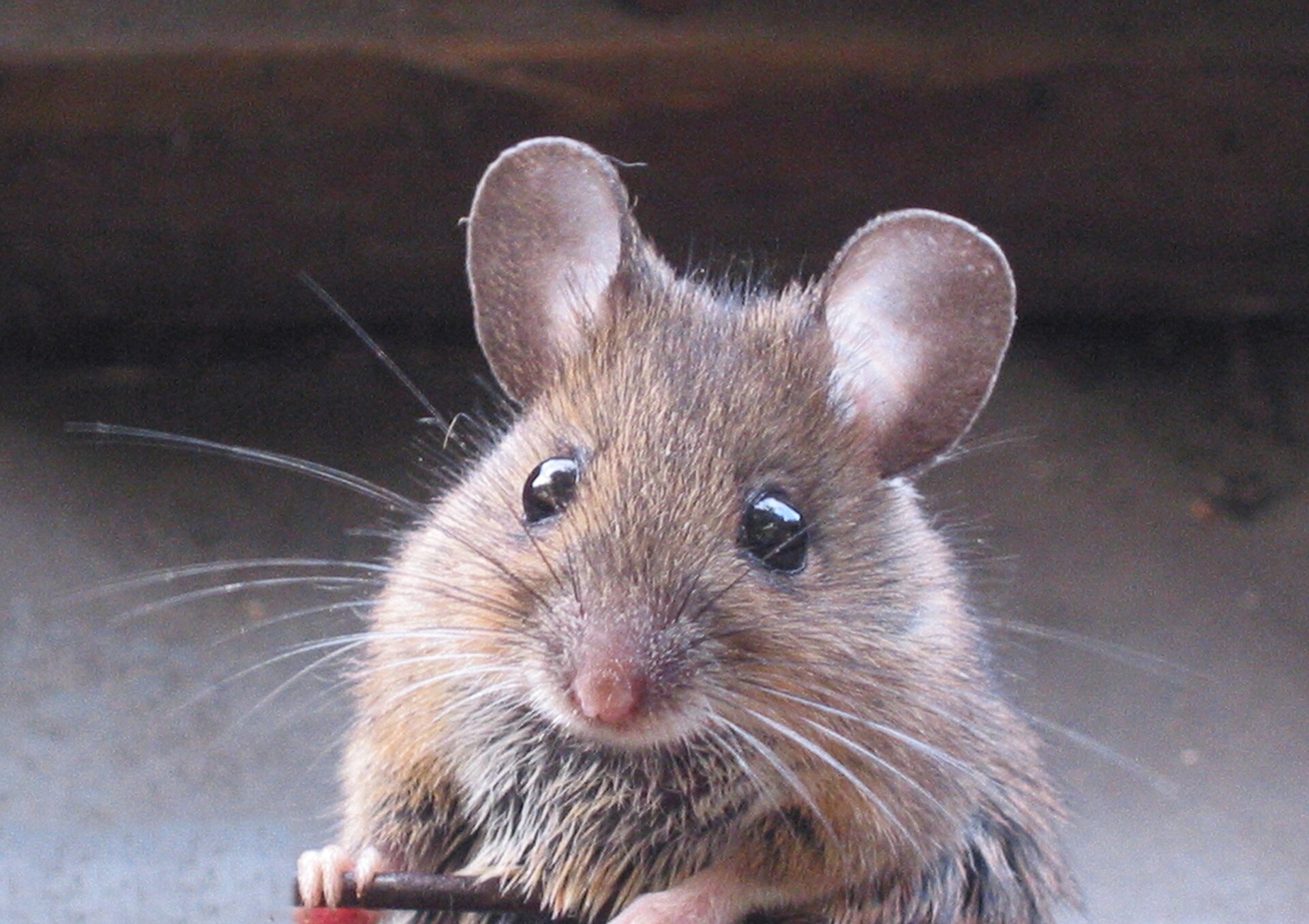
House Mouse
Mus musculus
Characteristics
Temperament
Social, crepuscular-nocturnal, hierarchical. Ultrasonic vocalisations (20-100 kHz) to "sing" and court. Can pass through 6 mm cracks. Fundamental scientific model.
Diet
Opportunistic omnivore: seeds, grains (preferred), fruit, human scraps, insects. 3-5 g/day. Survives without drinking free water (hydration from food).
The House Mouse (Mus musculus) is probably the most studied and widespread mammal in the world. Native to the steppes of Central Asia, it has followed humans to every corner of the planet, becoming the quintessential commensal: it lives wherever there are human settlements, from country houses to urban skyscrapers, from ships to Antarctic stations. Its scientific role is equally exceptional: it is the fundamental model organism of modern biology and medicine, with over 95% of its genome homologous to that of humans.
Classification and category
The House Mouse belongs to the order Rodentia, family Muridae, subfamily Murinae, genus Mus. The genus Mus comprises over 40 wild species distributed across Africa, Asia and Europe; M. musculus is the quintessential cosmopolitan species and the ancestor of the laboratory mouse. At least four main subspecies are recognised: M. m. musculus (Central-Eastern Europe), M. m. domesticus (Western Europe, Africa, Americas, Australia), M. m. castaneus (Southern and Southeast Asia) and M. m. molossinus (Japan). It is a small rodent: body length is 7-10 cm, with a tail of 5-10 cm; average adult weight is 12-30 g, with males slightly larger than females.
Habitat and distribution
The original natural habitat of the House Mouse was the semi-arid steppes of Central Asia, where the species lived in small colonies among plants and in burrows dug by other animals. With the invention of agriculture (about 11,000 years ago), the mouse began to associate with humans to exploit rich cereal stores, becoming the first commensal mammal and starting a story of coexistence that continues today.
The current distribution is cosmopolitan: all continents except Antarctica proper (but the mouse is present in Antarctic research stations), all inhabited islands, from the Maldives to the Galápagos. The preferred habitats are houses, barns, warehouses, restaurants, factories, sewer systems and any environment with accessible food stores. There is also a "wild" variant that lives in natural environments far from humans. Conservation status is listed as Least Concern (LC) by the IUCN — indeed, the House Mouse is considered one of the most invasive species on the planet, declared responsible for the extinction of numerous endemic birds on oceanic islands.
Diet
The House Mouse is an opportunistic omnivore with an extraordinarily flexible diet. It prefers seeds and grains (wheat, corn, barley, oats), which constitute the basis of its food in agricultural and domestic environments. It supplements with fruit, vegetables, cheese, meat, insects, larvae and in general anything humans consider edible.
Daily requirement is only 3-5 grams of food, but the annual economic damage caused by mice to world agriculture is estimated at over €7 billion: not for what they eat, but for what they contaminate with urine, droppings and hairs. The House Mouse has the unique ability to survive without free water: it gets all the hydration it needs from food, a feature that has favoured its colonisation of arid environments such as grain stores. It is also a great "cacher": it hides small stores of seeds in safe areas of the territory.
Physical features
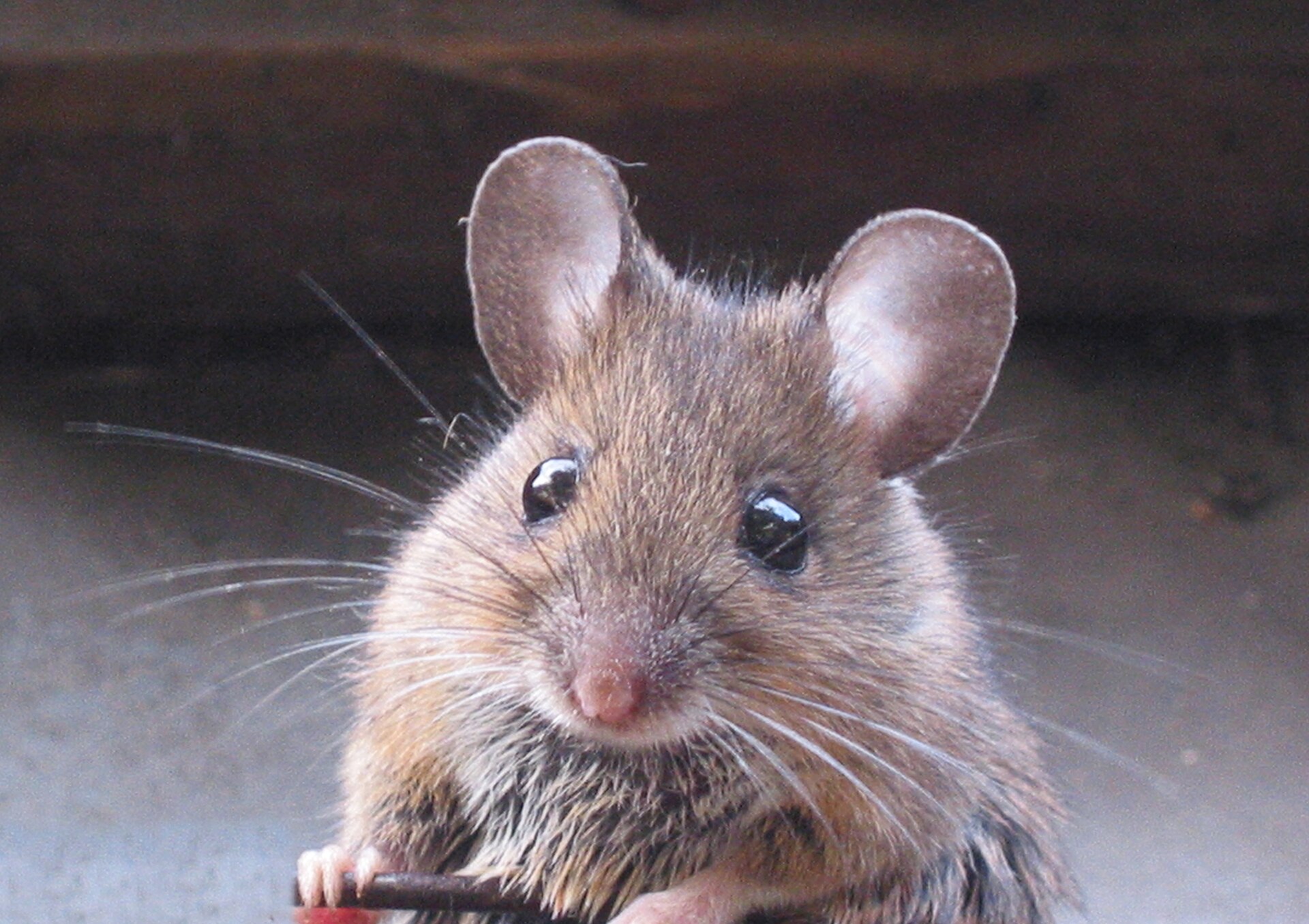
The House Mouse has an elongated, slender body, perfectly adapted to squeezing into minimal spaces: it can pass through an opening only 6 mm in diameter. The muzzle is pointed with large sensory whiskers, the eyes are black and protruding, the ears are wide and rounded. The coat varies by subspecies: the classic wild mouse is grey-brown on the back, white-grey on the belly; laboratory lines have standardised colours (C57BL/6 albino white, agouti, black), and fancy varieties (pet mice) present over 50 colours and patterns.
The tail is almost as long as the body, semi-naked (with few scattered hairs), scaly, and serves as a counterbalance during running, as a rudder in jumps and as a thermal regulator. The feet are equipped with sharp claws that allow climbing on vertical walls, electrical wires, even on smooth surfaces like wallpaper. The incisors are continuously growing orange (3 mm/week), capable of gnawing very hard materials such as concrete, plastic and electrical cables (a frequent cause of short circuits).
Behaviour and curiosities
The House Mouse is a social, crepuscular-nocturnal and hierarchical animal. In the wild it lives in small family colonies composed of a dominant male, several females and their young. Each colony defends a territory of a few square metres (in a house) or tens of square metres (in the countryside). Communication is complex: it includes urinary pheromones (for individual recognition and signalling of reproductive status), ultrasonic vocalisations (20-100 kHz, not audible to humans, used by males to "sing" during courtship), and body language.
Fertility is exceptional: the female can give birth to up to 10 litters per year, with 5-12 young per litter, in a life of only 1-2 years. Sexual maturity is reached at 6 weeks. A single mouse can therefore theoretically generate thousands of descendants in a few years — a factor underlying both demographic booms in affected areas, and its success as a laboratory animal. On the scientific side, the mouse was the first mammal whose genome was completely sequenced (2002); transgenic mouse maps allow the study of thousands of human pathologies (cancer, Alzheimer's, diabetes, dystrophies). Over 95% of the genome of Mus musculus is homologous to that of Homo sapiens — our common ancestors separated about 75 million years ago.
Pros
- Adattabile a qualunque ambiente
- Modello scientifico più importante per medicina e biologia
- Varietà fancy come pet (oltre 50 colori)
- Fertilità eccezionale (10 covate l'anno)
Cons
- Specie invasiva: estinzione di uccelli endemici insulari
- Danno economico globale di oltre 7 miliardi €/anno
- Veicolo di zoonosi (hantavirus, salmonellosi, leptospirosi)
- Prolifica in modo esplosivo se non controllato