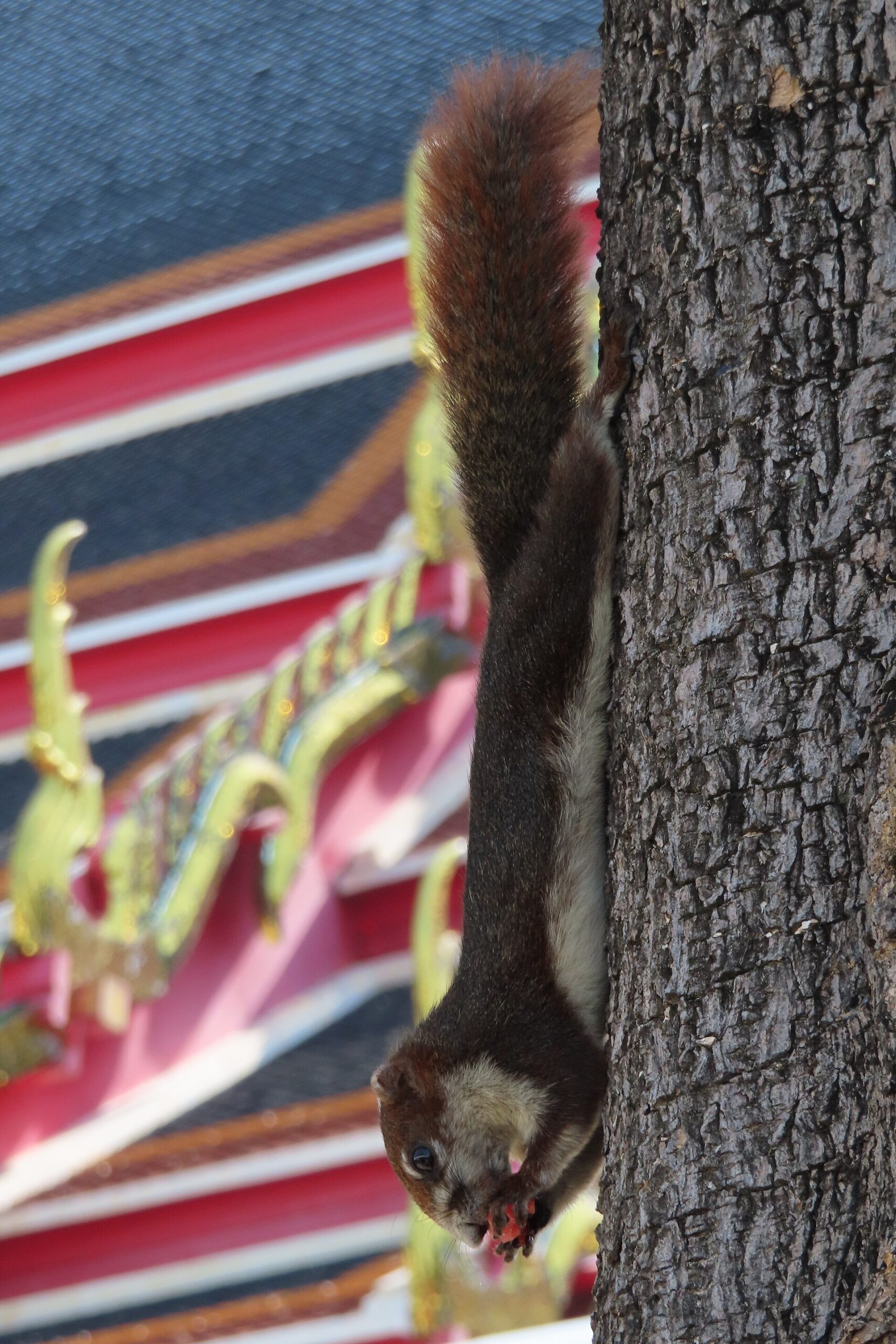
Finlayson's Squirrel
Callosciurus finlaysonii
Characteristics
Temperament
A wild, diurnal, extremely lively, agile and curious tree squirrel, highly skilled at climbing and leaping among the branches. Although sometimes kept as an exotic pet because of its spectacular colours, it is NOT a truly "easy" pet: it is a wild animal with strong needs for space, exercise and enrichment, and its spread as a pet has helped create invasive populations outside its range. It should be regarded above all as wildlife to know and respect, and — where introduced — to manage carefully to protect local ecosystems.
Diet
Omnivorous with a mainly plant-based diet: fruit, seeds and nuts as the basis, plus flowers, shoots, tender leaves and bark, occasionally supplemented with insects, eggs and other small animal foods. It feeds mainly in the trees, picking fruit and seeds among the branches with great dexterity, and is an opportunist able to exploit orchards, plantations and gardens too. By gnawing bark, buds and fruit, outside its range it can damage vegetation and crops, coming into conflict with human activities.
Finlayson's squirrel (Callosciurus finlaysonii), also known as the variable squirrel, is one of the most striking and curious tree squirrels of Southeast Asia. Famous for:
- The extraordinary colour variability: it can be cream-white, red, orange, brown or black, depending on subspecies and area
- The elegance and agility: a lithe tree squirrel with a long tail
- Membership of the Callosciurus: the "beautiful squirrels", a colourful Asian genus
- Its popularity as an exotic pet: its showy colours landed it in the pet trade
- The downside: released specimens have founded invasive populations outside its range
- Its presence in Italy: introduced populations have existed on Italian soil
IUCN status: Least Concern (LC) in its native range. It enters the portal among the squirrels, alongside the red squirrel and the gray squirrel, and ties in particular to the theme — already represented by the gray and the red-eared slider — of species that, as pets or introductions, become an ecological problem outside their natural environment.
Classification and category
Finlayson's squirrel is a rodent of the order Rodentia, family Sciuridae (the squirrels), genus Callosciurus — literally "beautiful squirrels", an Asian group known for gaudy colours. The species is Callosciurus finlaysonii. In the portal it is placed among the squirrels, i.e. the tree squirrels. It is useful to tell it apart from similar or related species: Pallas's squirrel (Callosciurus erythraeus), a close relative, is also an introduced and invasive Callosciurus in some parts of Europe, often darker and reddish-brown; Prevost's squirrel (Callosciurus prevostii) is unmistakable for its tricolour black-white-reddish coat; the red squirrel and the gray squirrel (genus Sciurus), already in the portal, belong to a different genus and have more uniform, "classic" colorations. Etymology: the genus name Callosciurus comes from Greek and means "beautiful squirrel"; the species is dedicated to Finlayson, the naturalist who made it known to science. The alternative name "variable squirrel" perfectly describes its best-known feature. Parameters: Head-body length roughly 20-22 cm. Tail nearly as long as the body (about 20-24 cm). Weight roughly 250-450 g. Longevity: a few years in the wild; in captivity it can live longer, even around 10 years with proper care. Reproduction: it nests in the trees, in nests of leaves and twigs.
Habitat and distribution
Finlayson's squirrel has a specific Asian origin but today a range expanded by humans: native range Southeast Asia — Thailand, Cambodia, Laos, Vietnam and Myanmar; introduced range following the exotic pet trade, introduced populations have appeared outside the range, including in Italy and other areas. Preferred habitats — settings rich in trees: tropical and subtropical forests, from lowlands to hills; plantations, orchards and cultivated woods; and parks, gardens and urban green areas, where it adapts well. It is an arboreal, diurnal squirrel: it spends most of its time in the trees, moving with great agility among the branches, and comes to the ground mainly to move about or look for food. Its adaptability and omnivorous diet let it thrive even in human-modified environments. This very adaptability, combined with having been spread as a pet, has favoured its establishment outside its native range. Status: Least Concern in the wild. Outside its range, however, it is considered a potentially invasive species: like other introduced squirrels and rodents, it can compete with local fauna and damage vegetation, and for this reason exotic populations are monitored and managed.
Diet
Finlayson's squirrel is omnivorous, with a mainly plant-based but flexible diet. It feeds on: fruit, seeds and nuts (the basis of the diet, energy-rich); flowers, shoots, tender leaves and bark; and insects, eggs and other small animal foods (occasional protein supplement). Feeding habits: it feeds mainly in the trees (it picks fruit and seeds among the branches with great dexterity); it is opportunistic (it exploits available resources, including those of orchards, plantations and gardens); and it can damage plants (by gnawing bark, buds and fruit, outside its range it can conflict with agriculture and ornamental greenery). Crucially, its varied diet and its ability to exploit cultivated and urban settings are among the reasons for its success as an adaptable species — and, where introduced, for its potential impact on local vegetation and fauna.
Physical features
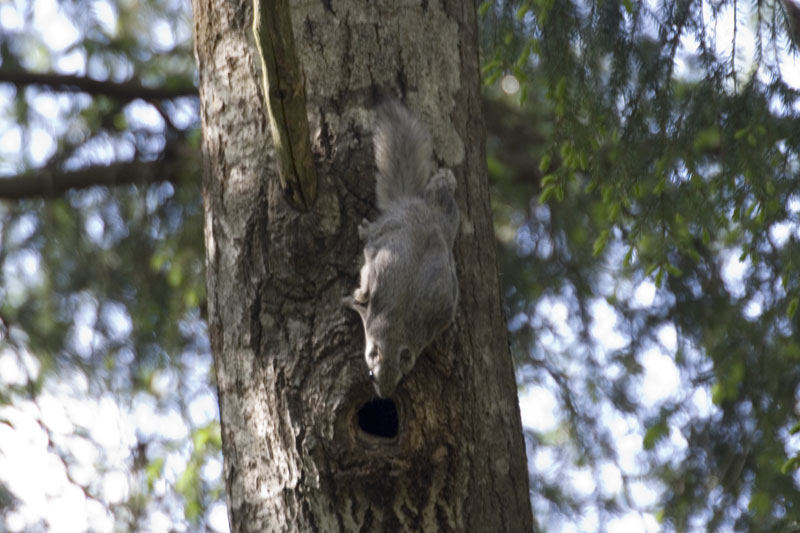
A lithe, elegant tree squirrel, made famous by the incredible variety of its coat. The "variable" coat — the distinguishing trait: an extremely variable colour (depending on subspecies and population, it can be near-pure cream-white, red, orange, brown or black); bicoloured forms (in some populations the body and tail have contrasting hues); and a dense, soft coat, with a particularly bushy tail. The structure: an agile, tapered body, typical of tree squirrels; a long, bushy tail, used for balance in leaps among the branches; and strong feet with hooked claws, perfect for climbing. The general look: large dark eyes, of an alert diurnal animal; quick, darting movements, with great jumping ability; and a medium size among tree squirrels.
Behaviour and curiosities
Finlayson's squirrel is an arboreal, diurnal and very active animal, quick of movement and lively in nature. It is famous above all for its incredible variety of colours, which has made it a fascinating subject both for nature lovers and, unfortunately, for the exotic pet trade.
The squirrel "of a thousand colours": few mammal species show a colour variability comparable to that of Finlayson's squirrel; among the various subspecies and populations there are individuals ranging from near-total cream-white to fiery red, from orange to brown to black; this variety makes the species a small living "sample card" of colours and a classic example of how appearance can vary within a single species. The "beautiful squirrels": the genus Callosciurus, to which it belongs, means precisely "beautiful squirrel"; it is a group of Asian squirrels known for gaudy, variable coats, of which Finlayson's squirrel is one of the most spectacular representatives, along with Prevost's squirrel (tricolour) and Pallas's squirrel. The exotic pet turned invasive: this squirrel's beauty has also been its "ecological undoing" outside Asia; prized in the exotic pet trade, it has founded — from released or escaped specimens — introduced populations in various countries, including Italy; as with other squirrels (the gray squirrel) and other exotic animals, these populations can compete with native fauna and damage vegetation, and are therefore considered a problem to monitor and manage. The cousin of Pallas: another species of the same genus, Pallas's squirrel (Callosciurus erythraeus), has also become invasive in some parts of Europe (Italy and France); the case of the introduced Callosciurus is studied carefully precisely for the lessons it offers on managing exotic species and on the need for a responsible animal trade. The tree acrobat: like all tree squirrels, it is an exceptional climber and jumper; the long bushy tail acts as a balancing pole and "rudder" during leaps among the branches, while the hooked claws let it move confidently even head-down along the trunks. Life in the trees: Finlayson's squirrel builds nests of leaves and twigs among the foliage and spends much of the day up high, in search of fruit and seeds; this close bond with the arboreal dimension makes it especially favoured in tree-rich environments, including urban green areas.
Pros
- Scoiattolo bellissimo e dai colori straordinariamente variabili
- Vivace, agile e affascinante da osservare nel suo ambiente arboreo
- Molto adattabile, presente anche in parchi e aree verdi
- IUCN Least Concern: non minacciato nell'areale d'origine
Cons
- Fuori areale è una specie potenzialmente invasiva (popolazioni introdotte anche in Italia)
- NON è un vero animale da compagnia 'facile': è un selvatico esigente
- Può danneggiare cortecce, gemme e colture, in conflitto con l'uomo
- La diffusione come pet ha contribuito ai problemi di invasività